
Mumbai, Sept. 29 -- In a conversation with Ashlin Ranjan, Amit Tolani, CEO, CEAT Specialty, discusses CEAT's expanding off-highway tyre portfolio through Camso, the shift towards radialisation and the growing demands on construction equipment. He also shares insights into the company's investments in automation, digitalisation, AI and sustainable manufacturing, as well as its plans to build more efficient and connected production capabilities.
With Camso giving CEAT access to premium construction, agriculture, material-handling tyre and track segments, where do you see the biggest growth opportunity over the next three to five years? What role will India play in the global OHT strategy?
Under the agreement with Michelin, for the first three years we will sell only Camso compact construction tyres and tracks. Therefore, the growth from Camso over this period will primarily come from the compact construction tyre and track segment.
At the end of the three-year period, in September 2028, we will be free to sell the Camso brand across other tyre and track categories. At that stage, our endeavour will be to expand into agricultural tracks and generate growth from those markets as well.
The off-highway market increasingly demands tyres with longer service life, lower total cost of ownership and improved machine productivity. Which technology areas is CEAT Specialty investing in to differentiate its OHT products, particularly for construction and mining applications?
We believe the customer has to receive the best total cost of ownership. That is the philosophy with which we operate.
The customer should be able to get the maximum operating hours from a tyre. Our very high flexion tyres, VF tyres, IF tyres and CFO tyres are all developed with that objective in mind-providing the lowest possible total cost of operation for the customer.
We are seeing considerable automation and digitalisation at this manufacturing facility. Which processes have benefited the most, and how have these investments improved quality, productivity and consistency?
The international market requires different types of tyres for different equipment, so one of the most important capabilities is being able to manufacture tyres in very small batches.
Without digitisation, automation and AI, it would be very difficult to manufacture small batches efficiently. This plant operates with an MOQ of one, meaning that if a customer needs a single tyre, we are capable of producing that tyre with minimal wastage and high efficiency.
I would therefore say that the entire plant has benefited from automation and digitalisation.
We are also a Deming Grand Prize organisation and strongly believe in lean manufacturing. This plant is extremely lean and efficient for the scale of operations it handles.
With CEAT now having access to Camso's manufacturing footprint in Sri Lanka, how do you see the role of different manufacturing locations within the global OHT supply chain? Do you see opportunities to manufacture more specialised products in India for export markets?
Each plant has its own unique strengths, and our immediate focus is on maximising the capacity utilisation of every facility.
This plant is currently operating at around 95 per cent capacity, and a significant expansion is expected over the next two-and-a-half months. Camso's plants, meanwhile, are operating at around 50 per cent utilisation.
Our first objective is to bring the plants closer to full utilisation. After that, we will also evaluate manufacturing consolidation depending on geopolitical conditions and business requirements.
India's construction equipment industry is moving towards higher machine utilisation, larger equipment and more demanding operating conditions. What changes are you seeing in tyre requirements from Indian OEMs and fleet operators, and how is CEAT adapting its OHT portfolio?
Construction equipment is becoming more advanced and is increasingly following global trends.
If you look at trucks, they historically used bias tyres before gradually moving towards radialisation. We are now seeing a similar trend in the OTR segment, where radialisation is beginning to grow. I believe this will become an important trend and eventually the norm for construction applications.
At the same time, the load-carrying capability of machines is increasing, equipment is being operated for longer hours and overall demands on machines are rising.
As a result, tyres need to withstand higher loads and more demanding duty cycles. The all-steel radial range that we have started manufacturing is designed to address these requirements.
With construction equipment becoming larger and more powerful, how are tyre requirements changing for applications such as rigid dump trucks, articulated dump trucks and wheel loaders?
Radialisation is becoming increasingly important.
Heavy-load carrying requirements are growing, and the operating speeds of equipment are also increasing. As infrastructure develops and better highways are built, heavy equipment is capable of operating at higher speeds.
Therefore, customers need tyres with higher speed ratings and greater load-carrying capability. This is one of the reasons why radialisation is gaining momentum.
Manufacturers today have access to enormous amounts of machine and production data, but the challenge is converting that data into action. Can you share an example where AI or data analytics changed a manufacturing or maintenance decision at this facility?
Maintenance was traditionally a lengthy activity that could take an entire day and was carried out periodically, whether quarterly or monthly.
With digital tools and predictive AI, we are now able to identify exactly where intervention is required.
For example, steam lines run below the factory and supply the presses where curing takes place. Earlier, if there was a leakage, it had to be detected manually.
Today, the systems can identify the exact location where intervention is required. This saves energy, time and rework.
Digitisation and AI are therefore being used across several areas, including mixing, maintenance and other manufacturing processes.
What makes this facility different from a conventional tyre manufacturing plant in terms of automation and digitalisation?
The biggest differentiator is the plant's ability to supply even a single tyre efficiently.
When you have more than 1,200 tyre sizes or SKUs, being able to manufacture an MOQ of one is a unique capability.
The plant is extremely lean and modern. Another distinctive aspect is the participation of women in manufacturing some of the world's largest agricultural tyres.
Despite dealing with heavy products, automation has created an environment where women can work effectively across the manufacturing process. These factors collectively make the facility unique.
What sustainability initiatives are being implemented at the plant, particularly around energy, water and resource use?
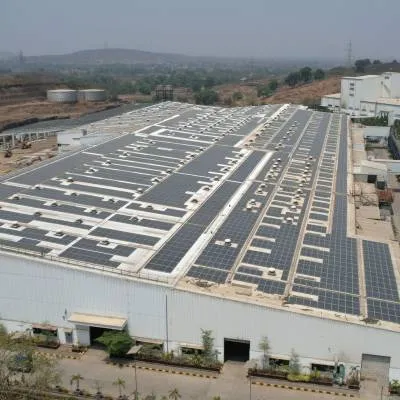
We are extensively leveraging solar energy. The rooftop has solar installations, and captive energy consumption is partly supported through solar power.
We are also focusing on recycling and reuse.
A significant part of the construction around this facility has been carried out with sustainability in mind. Stones and other resources available from nearby locations have been reused wherever possible.
Our overall endeavour is aligned with reducing the plant's carbon footprint and making manufacturing increasingly sustainable.
CEAT has invested considerably in automation and digitalisation. At what point does a smart factory move beyond automating individual processes and become a truly autonomous decision-making system? How close is this plant to that stage?
This plant is moving towards Lighthouse certification and Industry 4.0 standards, so we are already quite close to that stage.
Our objective is to continue challenging ourselves and bring more processes into that framework.
The facility has an indigenous Manufacturing Execution System and several digital initiatives. During the plant walkthrough, you would have also seen the SCADA systems deployed across the facility.
The overall manufacturing approach is increasingly moving towards connected and intelligent operations.
If you were designing this plant again today, based on everything CEAT has learned from its Industry 4.0 journey, what would you build differently from day one? Will the next generation of factories be fundamentally different in layout, automation architecture, data infrastructure or workforce model?
Technology is evolving so rapidly that whatever I say today may not remain relevant three years from now.
In hindsight, there are always things that could have been done differently, but the objective is to make the best possible use of the technology available at that point in time.
Fortunately, this plant has been built in modules. The latest expansion, which will increase capacity from 105 tonne per day to 160 tonne per day, is currently underway.
The new section being built is effectively a new-generation plant. We are using the most modern technologies and resources currently available to us.
The objective is to make the plant increasingly lean, efficient, less resource-intensive and more sustainable.
Published by HT Digital Content Services with permission from Construction World.