
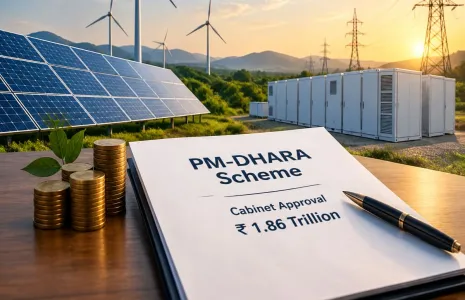
Mumbai, Oct. 8 -- The Union Cabinet has approved the Rs. 1.86 tn PM-DHARA scheme to strengthen India's intra-state transmission network and facilitate the evacuation of up to 135 GW of renewable energy across states and Union Territories. The programme is intended to support the country's renewable energy expansion and wider non-fossil power capacity goals.
PM-DHARA, or PM-Developing Harmonized and Accelerated Renewable-energy Access, includes 50 GWh of Battery Energy Storage Systems (BESS). These systems will be deployed at renewable energy developers' or generators' facilities, or at other locations considered important for grid flexibility. They will help manage renewable energy intermittency, transmission congestion, peak-hour curtailment and electricity demand during non-solar hours.
The scheme has a total project outlay of Rs. 1.86 tn and is targeted for implementation by FY 2032-33. Of this amount, Rs. 1.36 tn has been earmarked for intra-state transmission systems under Green Energy Corridor Phase-III, while Rs. 500 bn has been allocated for 50 GWh of BESS. Central Financial Support of Rs. 540.82 bn is also included to offset intra-state transmission charges and help contain consumer power costs.
Greenfield transmission projects will be implemented through Tariff Based Competitive Bidding, while brownfield upgrades and network-strengthening works will follow a Cost Plus Basis. State Transmission Utilities will serve as the overall implementing agencies, and Transmission Service Providers will participate in competitively bid projects through a Build-Own-Operate-Maintain model.
The scheme is designed to support India's target of 900 GW of installed non-fossil capacity by 2035. It is also intended to strengthen long-term energy security, reduce the carbon footprint associated with power supply and create employment in the power, manufacturing, construction and domestic energy storage sectors. The programme combines new transmission infrastructure with storage capacity to address renewable power evacuation and grid flexibility requirements as clean-energy generation expands.
Published by HT Digital Content Services with permission from Construction World.