
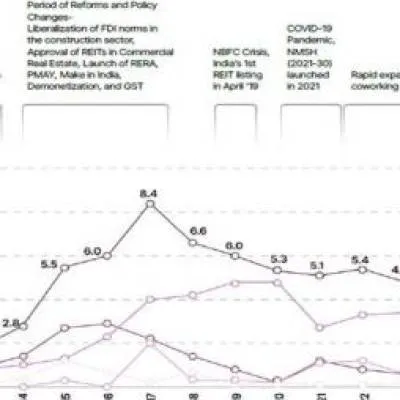
Mumbai, Oct. 23 -- India's real estate sector attracted over USD 85.5 billion in institutional investments between 2011 and the first three quarters of 2026, with investor interest shifting from residential properties towards commercial, industrial and warehousing assets, according to a report by Vestian.
Residential assets accounted for 13 per cent of institutional investments in the first three quarters of 2026, compared with 55 per cent in 2011. In contrast, investments in revenue-generating assets, including commercial real estate and industrial and warehousing properties, increased from 37 per cent to nearly 79 per cent over the same period.
Equity accounted for 85 per cent of the capital deployed in these income-generating assets over the 16-year period. Vestian attributed the shift to investor preference for recurring income supported by multi-year leases, tenant visibility and long-term occupier relationships.
Domestic investors gain ground
Foreign investors accounted for 49 per cent of total institutional investments between 2011 and the first three quarters of 2026. However, their share fell to 25 per cent in the first nine months of 2026 amid global economic uncertainties. The US and Canada together contributed nearly 90 per cent of foreign investment flows during the period.
The report also highlighted the growing participation of domestic investors and co-investors in the market.
Investment spreads beyond major cities
The top seven metropolitan markets continued to attract more than 95 per cent of institutional investments between 2011 and the first three quarters of 2026. However, the share of non-metro markets increased from 0.4 per cent in 2011 to over 4.7 per cent in the first three quarters of 2026.
Vestian also noted a rise in multi-city transactions, through which investors gain exposure to multiple markets under a single investment strategy.
Premium housing and new-age assets attract capital
Premium and luxury housing accounted for 56 per cent of residential investments between 2011 and the first three quarters of 2026, while affordable and mid-income housing received the remaining 44 per cent.
New-age real estate segments, including flexible workspaces, co-living, student housing, senior living, data centres and proptech, attracted USD 4.3 billion in institutional investments since 2016. More than 88 per cent of this capital was deployed between 2020 and the first three quarters of 2026.
The report also highlighted the role of Real Estate Investment Trusts (REITs), introduced in India in 2019, in broadening access to institutional-grade commercial assets. Commercial real estate accounted for 66 per cent of green and sustainability-linked investments between 2020 and the first three quarters of 2026, with residential real estate accounting for the balance.
Shrinivas Rao, FRICS, CEO, Vestian, said the market's next phase of growth would be shaped by greater diversity in asset classes, locations and investment structures. He added that the shift towards commercial and warehousing assets, geographical diversification, REITs and new-age segments had contributed to a broader institutional investment ecosystem.
Published by HT Digital Content Services with permission from Construction World.