
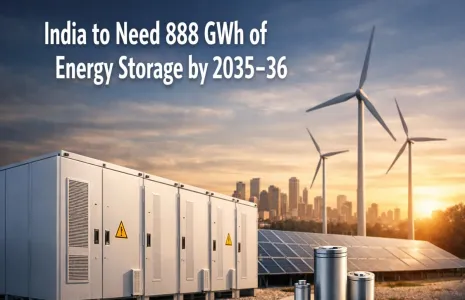
Mumbai, July 13 -- A new industry report by India Energy Storage Alliance (IESA) and Customized Energy Solutions (CES) says India will require 888 GWh of battery energy storage system (BESS) capacity by 2035-36, up from one GWh at present. The report was released at India Energy Storage Week (IESW) in New Delhi, where delegates from 15 countries attended the inaugural session. Organisers said the target positions storage as a core pillar for grid reliability and renewable integration. The event at Yashobhoomi brought over 200 exhibitors and more than 10,000 industry delegates for policy discussion and technical exchange.
The report noted that installed BESS capacity rose from 0.78 GWh in December 2025 to 8.7 GWh in the first half of 2026, an 11-fold increase, and that the country is on track to surpass 10 GWh by year end. It found that 47 GWh of tenders were floated in H1 2026, taking the total tender pipeline to 260 GWh. 18 BESS projects have been commissioned, with 70 per cent of recent capacity additions coming from merchant installations. Industry leaders described storage as indispensable infrastructure for making renewable generation dispatchable and stabilising the grid.
Manufacturing momentum was reported to be accelerating, with current lithium-ion battery cell capacity at around two GWh and announced targets of approximately 110 GWh by 2030. Cell and pack to container capacity is expected to reach 180 to 200 GWh by 2030. Despite global supply chain volatility and upward pressure on battery prices, the sector demonstrated resilience and is now regarded among the fastest growing markets worldwide. Several executives urged a domestic focus on owning the storage value chain and setting cost curves.
Speakers at the summit emphasised the need to integrate storage across generation, transmission, distribution and consumption to build a flexible resilient grid, and stressed that solar combined with BESS will play a central role in the clean energy transition. The report and summit outcomes are likely to inform policy and investment decisions as stakeholders move to scale capacity and manufacturing.
Published by HT Digital Content Services with permission from Construction World.