
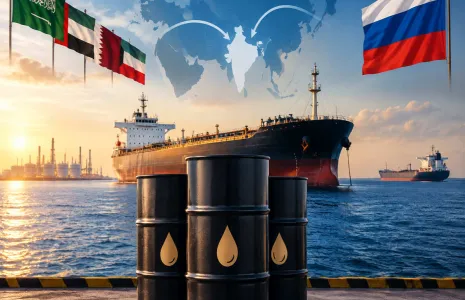
Mumbai, Nov. 5 -- India's crude oil imports reached a record 5.6 mn barrels per day in October, as refiners increased purchases from both the Middle East and Russia. Data from energy intelligence firm Kpler showed that Middle Eastern supplies accounted for about 2.3 mn barrels per day, while Russian crude flows remained strong at around 2 mn barrels per day.
Higher ship-to-ship transfers supported the movement of additional crude through the Strait of Hormuz during September and October. The recovery in Gulf supplies gave Indian refiners greater flexibility, allowing them to balance Russian and Middle Eastern barrels according to delivered prices, availability and supply security.
Russian shipments could moderate in November and December as attacks in the Black Sea push up freight rates. The resulting increase in landed costs may make Russian crude less competitive, while Gulf suppliers are offering more attractive delivered prices to regain market share in India.
However, any renewed disruption to flows through the Strait of Hormuz could encourage Indian refiners to return to Russian crude, even if transportation costs rise. An October 16 waiver under the Graham Act could also reduce concerns among some Indian buyers about the risks associated with purchasing Russian oil, giving refiners greater procurement flexibility.
India imports nearly 90 per cent of its crude requirements, making the availability and landed cost of alternative supplies critical to refinery economics. Russia became a major supplier after the invasion of Ukraine in February 2022, when Western sanctions, an European Union ban on seaborne Russian crude and the G7 price cap disrupted established trade flows.
Moscow's discounts drew Indian buyers, with Russian Urals at times trading about USD 30 a barrel below Brent in late 2022 and early 2023. Although those discounts have largely disappeared, Middle Eastern supply disruptions have kept Russian barrels important. India's sourcing decisions are likely to remain shaped primarily by commercial considerations and supply security rather than geopolitics alone.
Published by HT Digital Content Services with permission from Construction World.