
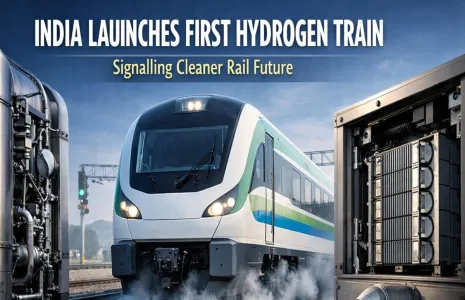
Mumbai, July 21 -- India has launched its first hydrogen-powered train, marking a step towards cleaner rail transport. Engineers described the hydrogen fuel cell system as an onboard electricity generator that combines hydrogen with oxygen to produce power for the traction motors, effectively making the unit an electric train that does not rely on overhead lines. Experts noted the only direct emission from the fuel cell is water vapour, positioning hydrogen as a low-pollution alternative to diesel on non-electrified routes.
The ministry said hydrogen for the train is produced offsite, compressed, transported and filled into high-pressure onboard tanks at dedicated refuelling points. An indigenous hydrogen storage and refuelling facility has been established at Jind to support the pilot trainset. Safety systems on the train and at the depot were described as able to detect leaks and high heat and to trigger automatic shut-off, while the pilot cabin includes a special mode to move the train to safety in an emergency.
The move places India among nations exploring or operating hydrogen trains alongside Germany, France, China, the United States and Japan, with Germany having the first commercial service in 2018. Analysts highlighted that the transport sector accounted for more than thirteen per cent of energy-sector emissions in India, with road transport dominating and the railways contributing one per cent. Observers argued that hydrogen can support the energy transition where direct electrification is difficult, provided that production emphasises green hydrogen from water electrolysis powered by renewable electricity.
Experts advised that sustainability depends on production methods, leakage control and fuel-cell efficiency, and that hydrogen deployment should focus on applications where electrification is infeasible. They noted that more than ninety-five per cent of India's broad-gauge network is already electrified, suggesting hydrogen trains will have a niche role rather than becoming the main solution. Efficiency figures for fuel cells were around fifty to sixty per cent for conversion of hydrogen to electricity and sixty to seventy per cent for electrolysis, highlighting supply-chain trade-offs. The railways offer a suitable environment for trials as fixed routes and timetables simplify refuelling logistics.
Published by HT Digital Content Services with permission from Construction World.