
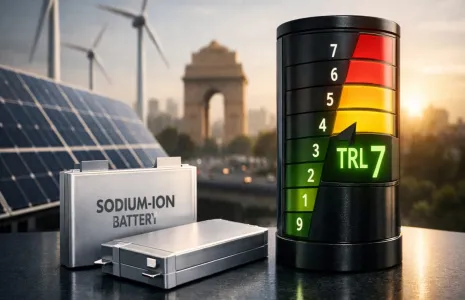
Mumbai, Aug. 27 -- Renewable Energy Secretary Santosh Kumar Sarangi said India is poised to see significant growth in sodium ion battery technology after researchers achieved Technology Readiness Level (TRL) seven and above, noting that reaching TRL seven typically allows progression from pilot projects to commercial production in two to three years. He made the remarks on the sidelines of the BloombergNEF summit in New Delhi. Technology Readiness Level (TRL) is a scale used to assess the maturity of a technology, with TRL seven indicating a system prototype demonstrated in an operational environment.
He said the government expects alternative battery technologies to play an increasing role as India expands energy storage to support a growing share of renewable energy. On vanadium flow batteries he noted domestic manufacturers are developing supply capacity and cited an order placed by NTPC Green Energy Limited for 100 megawatts (MW) of capacity as evidence of demand. He added that rising volumes should help bring down prices and transform the economics of longer duration storage.
Sarangi referred to estimates from the Central Electricity Authority (CEA) that India would have about 411 gigawatt-hours (GWh) of energy storage by 2031-32 and said the country was on track to meet that requirement earlier. He said the current deployed level of storage remained lower but that tenders and placements indicated that around 156 GWh of battery energy storage systems were under process and implementation. That pipeline, he suggested, reflected significant near-term capacity development.
He said the government is addressing battery recycling under existing e-waste rules and will add further detail if required. He also told delegates the administration is working on a new scheme to support domestic polysilicon manufacturing because capacity expected under the earlier Production Linked Incentive scheme was likely to be limited. To bolster energy security and manufacturing resilience he said India would look at adding at least 30 gigawatt (GW) of polysilicon capacity by 2030.
Published by HT Digital Content Services with permission from Construction World.