
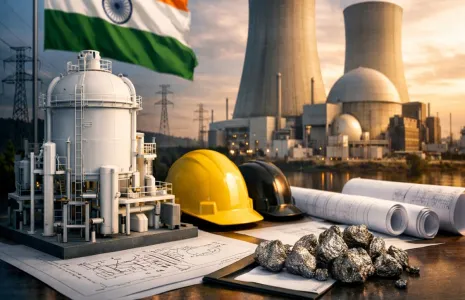
Mumbai, Aug. 17 -- India is strengthening its indigenous nuclear energy ecosystem with emphasis on advanced reactor technologies, small modular reactors (SMRs), domestic manufacturing, private-sector participation and long-term utilisation of thorium. The government set out the Nuclear Energy Mission in the Union Budget 2025-26 to expand nuclear capacity to 100 GWe by 2047. The minister of state in the prime minister's office outlined the roadmap in a written reply to Lok Sabha.
The policy combines deployment of large indigenous reactors such as 700 megawatt (MW) pressurised heavy water reactors and development of SMRs at brownfield sites and captive or off-grid applications. A key objective is to develop and operationalise at least five indigenous SMRs by 2033. The Bhabha Atomic Research Centre (BARC) is designing a 220 megawatt Bharat Small Modular Reactor, a 55 megawatt SMR and a high temperature gas cooled reactor of up to five megawatt capacity for potential hydrogen production.
The Indira Gandhi Centre for Atomic Research (IGCAR) continues research and engineering for sodium cooled fast breeder reactors and closed fuel-cycle facilities, remaining central to the long-term programme. The Sustainable Harnessing and Advancement of Nuclear Energy for Transforming India Act, 2025 has been enacted to enable wider public and private participation while maintaining regulatory oversight. The Department of Atomic Energy is supporting industry through knowledge sharing and development of domestic vendors and start-ups for critical equipment.
India pursues its three-stage nuclear programme to optimise uranium resources and to harness thorium by breeding uranium-233 for later large-scale use after sufficient fast breeder capacity is established. Thoria pellets have been used in initial reactor cores and irradiated pins reprocessed to obtain uranium-233, which was fabricated as fuel for the KAMINI reactor at IGCAR, Kalpakkam. Expansion of the Isotope Production Reactor will augment domestic production of medical isotopes and support technological self-reliance.
Published by HT Digital Content Services with permission from Construction World.