
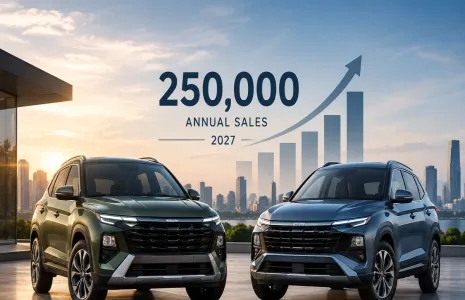
Mumbai, Oct. 29 -- Hyundai Motor India aims to sell at least 250,000 units annually of its Creta and new Bayon models from 2027, seeking to retain leadership in the expanding mid-size SUV segment. Managing Director and Chief Executive Officer Tarun Garg said the target represented a baseline for the company's future growth rather than an upper limit.
The mid-size utility vehicle segment, covering models between 4 and 4.4 metres in length, including SUVs and MPVs, sold around 900,000 units in the previous financial year, according to data from the Society of Indian Automobile Manufacturers. Hyundai sold close to 200,000 units a year in the segment during the past two financial years through the Creta alone.
The segment contributed nearly 35 per cent of Hyundai's total domestic sales in financial year 2026. The new Bayon, priced from Rs. 1 mn ex-showroom, is positioned between the sub-4-metre Venue and the mid-size Creta, giving Hyundai a second product in a category where the Creta has recently faced pressure.
Creta sales declined more than 9 per cent year on year to 89,727 units during the first six months of financial year 2027, while the industry's segment volume increased by more than 50 per cent. Garg attributed some of the decline to limited supplies of diesel variants, with the diesel Creta having a waiting period of more than one month.
The Bayon will be offered with petrol and CNG powertrains, without diesel or electric variants. Hyundai said market research indicated that petrol would account for the largest share of demand in the segment, while providing every powertrain in one model could make the range harder to manage. The model will be manufactured at Hyundai's Chennai plant and is expected to improve capacity utilisation after Venue production shifted to Pune.
Hyundai now has 10 models, comprising six SUVs, two sedans and two hatchbacks, across petrol, diesel, CNG and electric powertrains. The company previously announced plans to launch 26 models in India by the end of the decade, including 20 internal combustion engine vehicles and six electric vehicles. Its South Korean parent has committed USD 15.5 bn of investment in India by 2032.
Published by HT Digital Content Services with permission from Construction World.