
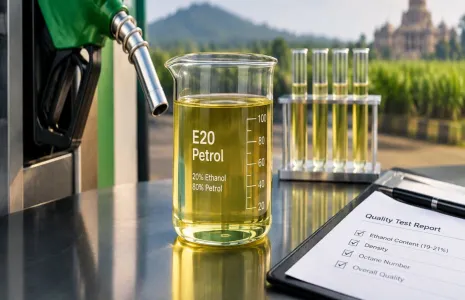
Mumbai, Nov. 16 -- The government has defended the 20 per cent ethanol-blended petrol programme after tests of 893 samples collected across 27 states and Union Territories found them compliant with prescribed quality standards. The samples were tested by Indian Oil Corporation (IOC), Bharat Petroleum Corporation (BPCL) and Hindustan Petroleum Corporation (HPCL), which said ethanol content remained within the prescribed 19-21 per cent range under the Bureau of Indian Standards' IS 17021 specification.
In Karnataka, 56 samples collected from different locations and covering all three oil marketing companies recorded ethanol content of 19-20 per cent, with an average of 19.30 per cent, according to the Ministry of Petroleum and Natural Gas. The findings conflict with a statement from Karnataka's Department of Food, Civil Supplies, Consumer Affairs and Legal Metrology, which reported ethanol levels of 26-31 per cent at selected retail outlets.
The oil companies have questioned the sampling and testing procedures used during Karnataka's October 2026 exercise. They said the exercise was conducted without their representatives and that they had not received retention samples, complete outlet-level details or laboratory reports. They also sought disclosure of the test methods, dilution procedures and reference materials used by a third-party laboratory.
Under applicable supply and marketing guidelines, six one-litre samples must be drawn during an inspection, with two each provided to the dealer, retained by the authorities or oil company, and sent to an authorised laboratory. The companies said Gas Chromatography testing must follow prescribed standards, including 1:1 dilution with oxygenate-free petrol and correction against an E10 certified reference material.
The ministry and oil companies also disputed estimates that E20 fuel could cause annual mileage losses of Rs. 620 bn and vehicle repair costs of Rs. 390 bn. More than 300 mn two-wheelers and 40 mn four-wheelers have reportedly used E20 fuel for over three years. Since 2014-15, the programme has generated foreign exchange savings of more than Rs. 1.97 tn, substituted 31.6 mn t of crude oil and reduced carbon dioxide emissions by about 95.2 mn t. The companies have sought a joint sampling and testing exercise with Karnataka using prescribed methods.
Published by HT Digital Content Services with permission from Construction World.