
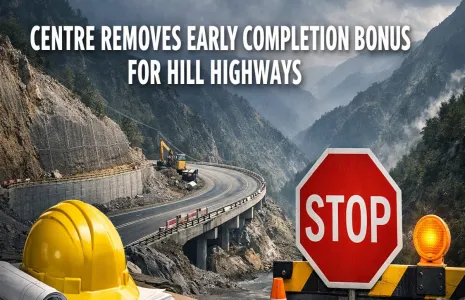
Mumbai, June 30 -- The Union Ministry of Road Transport and Highways (MoRTH) has revised norms for National Highway projects in hilly regions, removing incentives for early completion and introducing stricter measures to improve slope stability and safety. The amendments to model engineering, procurement and construction contract documents and consultancy frameworks for detailed project reports will apply to future National Highway and centrally sponsored projects in mountainous areas. The ministry said rapid expansion of highways through mechanical slope cutting had led to destabilisation and erosion in several locations.
One major change removes the early completion bonus, which under the existing EPC framework gave contractors a bonus of zero point zero three per cent of the contract value for every day a project was finished ahead of schedule. The provision has been scrapped for hilly projects and payment milestones are now tied to slope protection measures such as sealing tension cracks, soil nails, rock bolts, ground anchors and drainage systems to prevent water induced slope failures.
The revised framework mandates a phased construction approach under which contractors may initially undertake only formation cutting and slope profiling, with pavement construction and permanent structures permitted only after newly cut slopes have remained stable for at least one monsoon season. Geological investigation and monitoring requirements have been tightened and detailed surveys must now use Light Detection and Ranging (LiDAR) based mapping and drone surveys across a 300-metre-wide corridor, alongside deployment of Interferometric Synthetic Aperture Radar (InSAR) to detect minute ground movements.
Permanent observation pedestals will be installed on vulnerable slopes during construction and, for deep cut sections exceeding six metres, borehole investigations must extend at least five metres into competent bedrock before designs are finalised. Any proposal to modify approved slope protection measures will require scrutiny by independent bodies such as the Geological Survey of India or Tehri Hydro Development Corporation Limited. The ministry has directed the National Highways Authority of India (NHAI), National Highways and Infrastructure Development Corporation Limited (NHIDCL) and the Border Roads Organisation (BRO) to incorporate the provisions into future tender documents.
Published by HT Digital Content Services with permission from Construction World.