
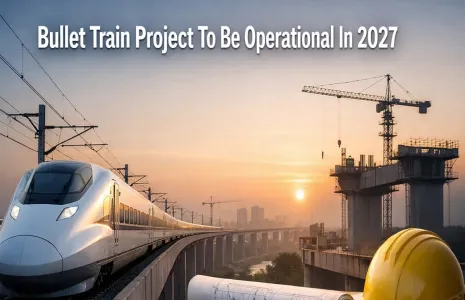
Mumbai, June 26 -- Union Railway Minister Ashwini Vaishnaw said on the sidelines of the 12th annual International Day of Yoga in Bikaner that India's dream bullet train project will be operational in 2027 and will open section by section. The minister described the timeline as the result of sustained construction progress and inter-agency coordination across affected states. He presented the phased commissioning as the fulfilment of a long-standing infrastructure vision that will begin delivering services from 2027.
The Mumbai-Ahmedabad High-Speed Rail Corridor (MAHSR), India's first bullet train project, remains under construction with works advancing in planned phases. Authorities have reiterated their commitment to complete and operationalise the corridor by 2027, while testing and commissioning activities are being scheduled for stretches as they are made serviceable. Civil works, including elevated viaducts, track laying and station construction, are reported to be at various stages along the alignment. Coordination with state governments and contractors is being maintained to manage land acquisition, utilities and safety clearances.
As part of a long-term plan to develop a nationwide high-speed rail system, the government has identified seven additional corridors for study and development. The proposed routes include Mumbai-Pune, Pune-Hyderabad, Hyderabad-Bengaluru, Hyderabad-Chennai, Chennai-Bengaluru, Delhi-Varanasi and Varanasi-Siliguri. Planning for these corridors is at various stages, with route surveys, feasibility assessments and alignment finalisation ongoing. Officials are working to sequence project delivery so that lessons from the MAHSR can be incorporated into subsequent schemes.
The expansion plans underline a broader strategy to modernise rail infrastructure and improve intercity connectivity across regions. The phased opening of the MAHSR is intended to provide practical experience in operations, safety protocols and maintenance regimes that will inform follow-up projects. The initiative is presented as a long-term investment in transport capacity and regional development, with policymakers citing faster journeys and enhanced economic linkages as central objectives.
Published by HT Digital Content Services with permission from Construction World.