
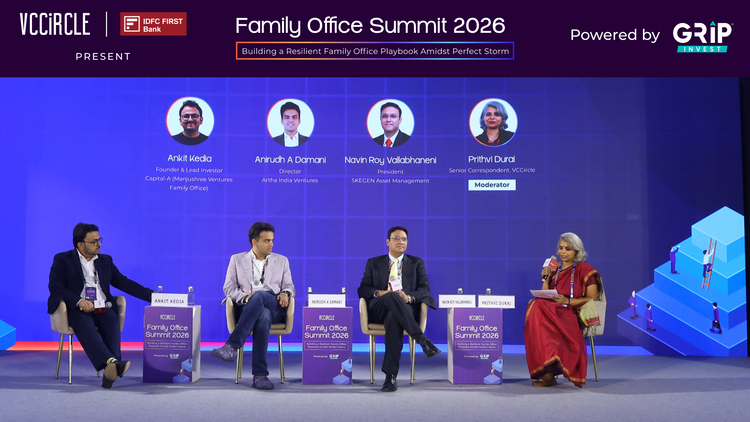
New Delhi, Aug. 13 -- For family offices considering the transition from managing proprietary capital to building an alternative investment fund, structure alone is not enough. The ability to deploy capital effectively, access the right private market opportunities and build sufficient scale can determine whether the model works.
Speaking at the VCCircle Family Office Summit 2026, Navin Roy Vallabhaneni, President of SKEGEN Asset Management LLP, discussed what family offices should consider before setting up an AIF, why size matters for accessing private equity opportunities, what potential external LPs may look for, and how autonomy between a family and its professional investment team can shape decision-making.
The Objective Comes Before the Structure
While Navin mentioned that every family office should consider an AIF structure, there are disadvantages if some essential conditions are not in place.
"I don't think anyone should not look at it, but I can definitely say there are certain disadvantages if you don't have certain things in place," he said.
The starting point, according to him, is clarity on the objective.
"The end objective is to deploy capital in the right way with minimum risk and get the highest return," he said, adding that while this is easy to state, it is much more difficult to implement.
Without Critical Size, Access Becomes Difficult
For Navin, one of the biggest challenges with individual families establishing their own AIFs is achieving sufficient scale. He identified access to the right transaction as central to private equity investing.
"The most important thing in private equity investment is getting the right deals at the right time at the right price, and unless you have a certain minimum critical size, you're nowhere," he said.
Without that scale, he argued, smaller funds may find themselves following larger investors or relying on personal relationships to participate in transactions.
He said he receives such requests regularly and helps where possible. But if families continue setting up relatively small AIFs individually, they may have to rely on personal relationships with larger investors for access to quality transactions and at the same time, not have the same rights in the portfolio companies as the larger investors do.
Pooling Capital Can Help Build Scale
For family offices serious about developing an AIF business, he suggested pooling capital with others rather than remaining sub-scale. Scale, in his view, directly affects whether a fund gets access to attractive opportunities.
"Today, if you want to do a good deal, you need to have size. Otherwise, nobody will even call you for a meeting," he said.
Ultimately, the test is whether the capital can actually be deployed effectively.
"If one is not able to deploy capital and achieve the targeted IRR, there's no point of having an AIF," he said.
Building a Track Record Before Raising External Capital
Navin said SKEGEN had not originally planned to raise external capital and that the Family Office Summit was the first event the firm had attended as it began exploring conversations with other families.
The firm, he added, had been operating for around two and a half years at the time of the discussion, had almost fully deployed its capital and has been generating strong IRRs, although he cautioned that the sustainability of those returns would have to be seen over time.
"We have a pretty good track record. It's only been two and a half years, but we've almost fully deployed our capital and are earning very good IRRs, but we'll see how these returns sustain," he said.
The conversations with prospective investors were still at an early stage and were largely taking place with families already known socially to the organization rather than through a formal fundraising exercise.
What Existing Relationships Change for LP Conversations
When a relationship with a prospective LP already exists, Navin said the nature of the conversation is quite different. Such discussions tend to focus on comfort with the investment team and with the sponsor, including whether the sponsor's brand can help the fund access attractive deals.
He said SKEGEN had experienced instances where the sponsor brand had helped it secure transactions at lower valuations than competing bidders.
"We've participated in competing bids in certain transactions where we have won deals at 10-15% lower valuation than others because of the value we bring to the table. We follow an active managed strategy and are fully committed to our portfolio companies and their promoters."
External LPs Will Ask the Standard Questions
Navin distinguished these relationship-driven conversations from the diligence that an unfamiliar external LP would undertake.
"If we meet external LPs who are not familiar with us, there will be many general questions that will be asked," he said.
Those questions, he said, would include the fund's track record, relevant performance statistics, entry and exit strategy, minimum holding period, investment policy statement, long term commitment of the investment team to the organisation to ensure continuity etc.
He acknowledged that having these kinds of conversations with external LPs is an area in which he does not yet have direct experience and expects to address this as SKEGEN begins engaging more actively with them.
"There is a lot more we need to do as an organisation internally in term of structure etc. to ensure that external LPs have the confidence to back us in the long term. Our intent is to ensure that external LPs see SKEGEN as an independent professionally run asset management business that meets their stringent standards and not just as another family office."
Autonomy Includes the Ability to Say No
Asked how an external professional team can balance its authority with that of the family whose capital it manages, Navin said the answer varies from one family to another. In his own case, he said the family had given him a lot of autonomy, including the ability to vote against their investment decisions.
"I've been lucky to work with a family which has given me so much autonomy and the ability to even go against their decisions," he said. The family may bring investment ideas to the team, he explained, but those ideas are analysed independently. If an opportunity does not meet the team's criteria, he has the freedom to recommend or decline the investment.
"To their credit, they've been super supportive of this. Whenever they come up with ideas or investment leads, our investment team analyses them. If we don't like something that doesn't meet our criteria, they've given us the freedom to decline the investment," he said.
He also stressed that this arrangement is not just a one-way street. There are mistakes his team also commits and the family has been extremely supportive in guiding and correcting them as well. He described the relationship as very healthy and said it had contributed to some of the best investment decisions made by SKEGEN.
Hiring People Who Can Challenge the Promoter
According to him, the amount of authority a professional team receives ultimately depends on how much responsibility the individual family or promoter is willing to delegate. That makes the choice of team particularly important. The ability to challenge the promoter is particularly important because, according to him, many businesses struggle with people simply agreeing with those at the top.
"You will find in many businesses, I'm not talking about family offices specifically but businesses in general, there will be a lot of yes men. There will be very few people who want to go against the promoter," he said.
In his case, he added, the family has allowed him that freedom when necessary.
About SKEGEN Asset Management
SKEGEN Asset Management LLP is the investment manager to Svadha Capital Trust, a SEBI-registered Category II alternative investment fund, and is backed by the Bharat Biotech Group. The firm follows a value-oriented investment approach, providing patient, long-term capital alongside strategic and operational support to late stage growth businesses. Its website reports assets under management of around Rs 2,087crs under the fund structure and close to USD 300mn overall.
SKEGEN focuses primarily on deep tech and consumption led manufacturing businesses, with investments targeted at sectors such as defence, aerospace, advanced materials, precision engineering, electronics and consumer products. Its strategy centers on companies with strong competitive advantages and long-term scaling potential, particularly in sectors that can strengthen India's industrial capabilities and resilience.
NOTE: This article has been developed by the VCCEdge Research Team for SKEGEN Asset Management LLP.
Published by HT Digital Content Services with permission from VC Circle.