
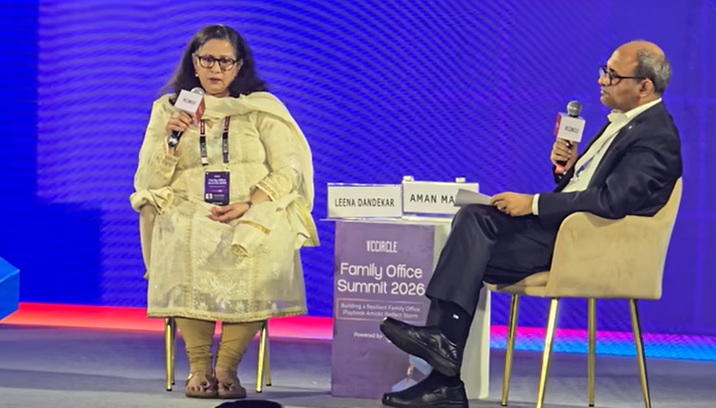
New Delhi, July 27 -- Raintree Family Office is structuring philanthropic and impact investing as an integrated capital allocation strategy rather than treating them as separate from investment returns, the single-family office's founder Leena Dandekar said at the VCCircle Family Office Summit 2026 in Mumbai.
Raintree, set up after Dandekar and her two children sold their stake in art and stationery business Camlin around 2017-18, was built from the outset without the fixed lifecycle of a conventional investment fund, she said during a fireside conversation at the summit.
Dandekar said the family's approach was never a progression from traditional philanthropy to impact investing, but grew simultaneously out of a broader decision about how to deploy the capital freed up by the exit.
"I did not start with philanthropy first," Dandekar said. "I started with wanting to create a portfolio of meaning- a portfolio that could drive positive change."
'Positive change'
The transition was harder than it appeared from outside, Dandekar said. Years of running an operating business had brought the family recognition and standing but not liquidity to deploy freely, and the shift to managing a pool of capital rather than a company required a new set of instincts. "This self-funded position was very difficult from the very beginning," Dandekar said.
The family's first principle was exclusionary rather than aspirational, she said. "Our money cannot do any harm," Dandekar said, describing an ESG-style screen the family built around that idea. ESG is short for environmental, social and governance parameters.
"We will not make money in certain sectors. That is a non-negotiable line for us," she said, adding that avoiding harm alone was insufficient. "Doing no harm is not good enough, because our world needs positive change-for the planet, and for people," she said.
Portfolio structure
Dandekar said roughly a third of the family's portfolio has gone into impact investing, structured in 10-year cycles, with the family now designing its thesis for the next decade. She said the impact investments are capital-generating, with returns and income from that pool funding the family's philanthropic and non-profit work, rather than the two pools operating independently of each other.
That capital is deployed in growth-stage companies rather than seed or early-stage bets, she said, with cheque sizes typically between $1 million and $7 million. Target companies must already be profitable or on a clear, cost-efficient path to revenue, she said.
"You made dividends, you made profits-that was really the core of a great business. I don't know any other way. So I said business and profits are number one," Dandekar said, describing the approach as a blend of business fundamentals and an impact thesis. "We don't do valuation-first investing," she said. "This is value investing-investing in the value of the business. The valuation largely follows."
Dandekar said the family did not begin with a fixed sector mandate, but arrived over time at community-focused themes including affordable and rural housing, microfinance, healthcare, education and climate, favoring longer-cycle commitments over shorter-term, heavily-reported corporate philanthropy models.
The family office has invested in companies such as Smart Joules, which provides energy efficient solutions; Proklean Technologies, which develops non-toxic products to replace hazardous chemicals; and Sedemac Mechatronics Ltd, a Pune-based maker of electronic component units that went public earlier this year.
Governance
Investment decisions run through a seven-member investment committee, comprising three family members and four external members, operating on a consensus basis, Dandekar said. "If the committee says no, we do not go ahead," she said. "We have never made an investment where the committee has said no."
Dandekar said the structure also functions as a family governance mechanism, giving the next generation a structured role in decision-making.
Impact versus returns
When asked how Raintree resolves trade-offs between commercial returns and impact outcomes, Dandekar said impact criteria are assessed first and gate any investment decision.
She said a company's product or service must address a genuine structural or environmental issue grounded in a clear, evidence-based rationale. "If we don't see that holding up for the lifetime of our investment, we just stop it right there. We won't go forward," she said, adding that commercial underwriting, including profitability and growth, is assessed only after that threshold is met.
Dandekar said the family accepts a return meaningfully below what a conventional, moderately aggressive Indian portfolio would target, citing the patience and hands-on work the model requires.
Philanthropic work
Dandekar said the family has run a landscape-level restoration programme for eight to nine years, built around repairing what she called "natural systems as well as human systems" together, with a focus on rural resilience, water security and community livelihoods.
"I think it's the most satisfying work I've ever done, something that does not benefit me, or my family, in any way," she said.
Published by HT Digital Content Services with permission from VC Circle.