
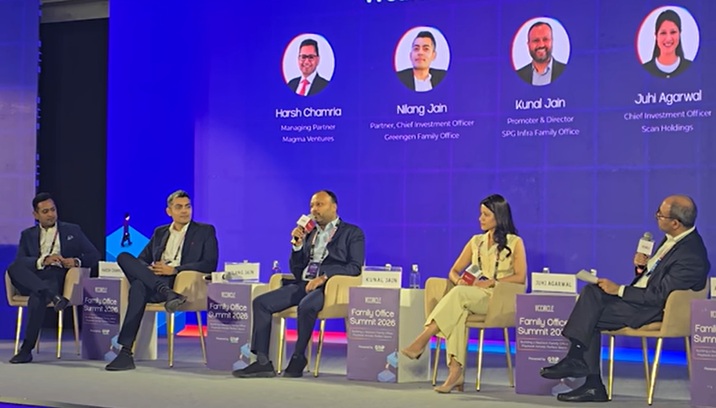
New Delhi, July 27 -- Promoters and chief investment officers from four Indian family offices (FOs) outlined sharply different approaches to splitting capital between growth and preservation, while agreeing on the importance of formal governance processes and experience-driven judgment during a panel discussion at the VCCircle Family Office Summit 2026 in Mumbai.
The panel featured Harsh Chamria, managing partner at Magma Ventures; Nilang Jain, partner and chief investment officer at GreenGen Family Office; Kunal Jain, promoter and director at SPG Infra Family Office; and Juhi Agarwal, chief investment officer at Scan Holdings Pvt Ltd.
Offence versus defence
Asked how family office capital is split between growth-oriented and capital-preservation strategies, Magma Ventures' Chamria said promoter families tend to run aggressive books.
"Promoters generally tend to be fairly aggressive with investments. So, I think for us, we tend to be fairly aggressive," he said, describing an asset-allocation approach built around a core of capital-generating regular income, sized against the family's annual expenses, and the remainder deployed for capital creation.
GreenGen's Jain said preservation carries particular weight given how quickly family wealth can erode across generations, citing research showing that a large share of family fortunes is lost within a few generations.
"Definitely preservation is important," he said.
SPG Infra's Jain said his family office follows a roughly 80:20 offence-to-defence split. A third-generation entrepreneur, he said the family has compounded its capital by more than tenfold under his watch, crediting the values instilled by his grandfather. "We are very happy to be aggressive and intensive, and hope to see the (next) generation," he said.
Scan Holdings' Agarwal said her family office does not frame decisions through an offence-versus-defence lens.
"We actually don't have this discussion between offensive and defensive," she said, describing a research-led process that allocates across three sleeves: a core equity book held over a multi-year horizon, a tactical sleeve held over shorter windows of roughly six to eight weeks, and a derivatives allocation. She said the broad structure runs to roughly 60% equity, with the balance split between cash and other instruments. The office does not use leverage, she added.
Mindset shift
Asked about the biggest adjustment in moving from operating a business to allocating capital across equities and venture capital, Chamria said the shift from "operator" to "capital allocator" was significant.
He said the family's former non-bank lender, Magma Fincorp, ran roughly 300 branches nationally with about 10,000 employees, while the investment business it built afterwards runs with a team of fewer than 100 people. According to him, the investing side requires drawing on outside expertise across sectors rather than relying on deep, singular domain knowledge built running an operating company. Chamria called the shift to a broader, more exploratory learning process as "very stimulating".
Small- and mid-cap view
On whether family offices should be significantly invested or overweight listed small- and mid-cap stocks given the current economic backdrop, Jain of GreenGen said the space rewards investors with genuine information or network edge - typically those with an operating business background or an ecosystem of industry relationships - and is not suitable for every allocator.
He added that his office favours a long investment horizon, citing multi-year holding periods running to 10, 15, 20 and even 30 years, and around 95% of its portfolio held with that long-term orientation.
Governance and in-house technology
Agarwal said the most important discipline for a family office with no prior investing background is building strong common-sense governance.
She said the family's operating business is professionally managed, limiting the influence of family dynamics on decision-making, and that the one asset-allocation decision the family took collectively at the outset was simply determining which asset classes the family was comfortable holding, with capital preservation - minimising the amount of money lost - as the guiding principle.
She added that the office has built proprietary, in-house software to underpin its investment process, incorporating financial statement analysis, technical charting, and a large historical database mapping roughly 586 securities the office has tracked since inception. She said the system has sped up how the investment team screens and prioritizes securities for deeper research.
Artificial intelligence
Agarwal said the family office has deliberately built its own AI and software tools rather than buying off-the-shelf products, saying no commercial product available in the market meets its specific portfolio-management needs.
She said AI is now integral to the office's operations, including automating accounting entry and NAV tracking, with accountants' roles shifting toward checking rather than manual entry. The office is also developing back-testing software that it expects to go live within six to seven months, she said.
However, she cautioned that in investing, "what answer AI gives and what actually happens is different", making human judgment indispensable.
Jain of GreenGen said his office uses AI extensively in primary research, including analysts working through roughly two decades of annual reports, transcripts and investor filings when evaluating small- and micro-cap companies. The office has also built customized AI agents for specific research tasks.
However, GreenGen has maintained its analyst hiring budget despite the efficiency gains from AI, Jain said. He cautioned that junior analysts risk losing the chance to build foundational research skills as AI takes on more of that work.
Responding to an audience question on where investors will continue to find an edge as AI reduces information asymmetry, Jain said judgment and emotional intelligence would remain lasting differentiators.
Gut feel versus data
Asked how much weight instinct plays in investment decisions, SPG Infra's Jain said what is often described as "gut feel" is actually the accumulated result of experience, upbringing, family background, and years spent in business.
He said that when the numbers and instinct are in conflict, it is often worth pausing to reassess rather than mechanically following either. Recounting a personal investment decision, made against the advice of his tax consultants and peers which ultimately proved highly profitable, Jain said that both data-driven research and instinct have important roles to play. According to him, governance structures create the discipline to act, while experience-based judgment allows a decision to be made when research alone is not conclusive.
Published by HT Digital Content Services with permission from VC Circle.