
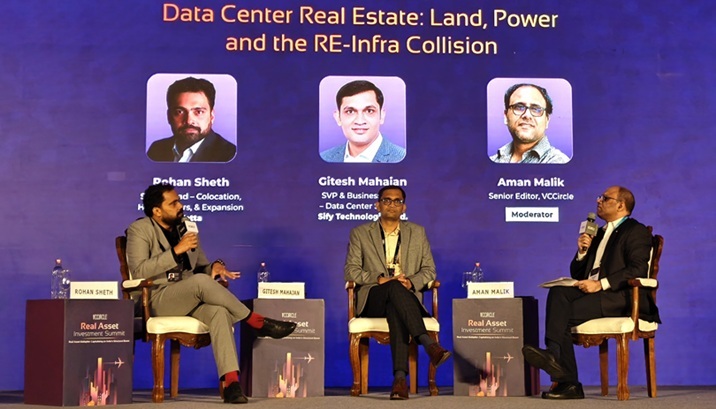
New Delhi, Nov. 26 -- Scaling operational data centre capacity in India hinges on power transmission feasibility, shifting AI workloads, and financing models that match long execution timelines, said panellists at the VCCircle Real Asset Investment Summit 2026 on Thursday.
"When we select land, our precondition is that power should be available. So, first we check the power feasibility, then only we get into a land transaction," Gitesh Mahajan, senior vice president and business head at Sify Technologies Ltd, said during a panel discussion at the summit held in Mumbai.
Mahajan was responding to a query about the bottlenecks that companies face when setting up a data centre. The discussion also included Rohan Sheth, senior vice president and head of colocation-hyperscalers and expansion at Hiranandani Group-backed Yotta Data Services.
Talking about the scale of data centres being planned, Mahajan said, "The scale we are considering today is no less than a 500-megawatt data centre campus. A 500-megawatt data centre campus roughly requires about 40-50 acres of land."
India's data centre capacity is projected to reach 8 GW by 2030, with long-term power demand forecasted to hit 17 GW by 2031-32. India's total data centre capacity has increased from about 375 MW in 2020 to around 1,500 MW.
On the investments needed to set up a data centre, Sheth pegged the cost at about Rs 40-45 crore per megawatt, including land, building construction, power, cooling, and everything else that goes into the facility.
Sheth explained that operators choose between two models: a powered space lease, where operators lease powered space for rent with no further investment, leaving hardware and software to the enterprise or hyperscaler customer. The second model was GPU-as-a-service (that Yotta follows), he said, referring to the graphics processing unit. In this model, operators build the facility and supply central processing units (CPUs), GPUs, storage, and networking themselves, leasing the hardware to AI companies and hyperscalers on a GPU basis.
For operators adopting GPU-as-a-service, costs would rise to approximately Rs 100-120 crore per megawatt when the provider funds everything from land to hardware.
Responding to allegations of environmental disruption by data centres, Sheth said India being a late entrant has adopted newer environmentally efficient systems.
"The cooling systems are air-cooled systems where you fill in water on day one, and for the next 5-10 years, the same water is recycled inside out. Now, when you compare your data center infrastructure with the Western world's infrastructure, we cannot say that we are facing the same environmental impact," he said.
Mahajan spoke about the need for GPU financing to be linked to business potential rather than customer contracts.
"Right now, whatever potential we are building, whatever business we are generating, the potential is 10-20-100 times more for business to come in. If the financing is changed to a potential of what business can come in, rather than against a firm customer contract, it will help us execute," he said.
Published by HT Digital Content Services with permission from VC Circle.