
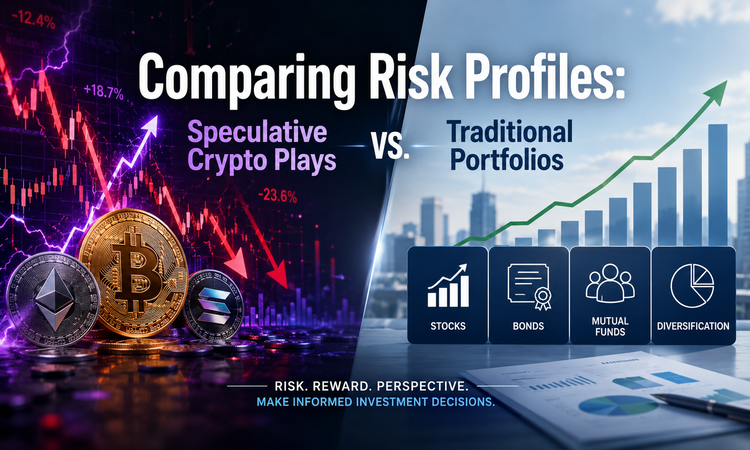
New Delhi, June 15 -- You could say the way we talk about investment risk has changed in a hurry over the last ten years. It is not just about bond laddering and your stock allocation numbers anymore. These days the discussion encompasses digital assets and DeFi protocols, and if you are part of the millions who use the crypto space every day, even free spins at a crypto casino is part of that ecosystem. Some will tell you cryptocurrency is the future of money, others a fancy lottery ticket, but one thing is for sure: it is taking up more room in the global investment dialogue. So making sense of how its risks compare to the sort of portfolio your financial advisor would put together is something you can no longer afford to be ignorant of.
The Tested Foundation of Traditional Portfolios
Traditional portfolios are built on a framework that has been tested, revised, and stress-tested over the better part of a century. The classic 60/40 split between equities and bonds, for instance, emerged from Harry Markowitz's Modern Portfolio Theory in the 1950s and has served as a baseline for retail and institutional investors ever since. The logic is straightforward: stocks provide growth, bonds provide stability, and the blend between them cushions the blow when one asset class underperforms. According to research published by the U.S. Securities and Exchange Commission, diversified portfolios that include a mix of domestic equities, international equities, and fixed income instruments have historically delivered annualized returns in the range of 7 to 10 percent over long time horizons, with drawdowns that, while painful during events like the 2008 financial crisis, tend to recover within a few years. The risk here is real, but it is mapped, modeled, and broadly understood.
There is a reason traditional investing is viewed as the safer option, and it has nothing to do with risk being non-existent. Rather, you have the benefit of an infrastructure put in place to handle that risk. Take the case of a blue-chip stock purchased via a regulated brokerage: you are shielded by layers of oversight that didn't just come about on a whim. You have regulatory agencies, deposit insurance, circuit breakers at the exchange and financials that have been audited, not to mention a wealth of historical data. All of these elements serve as guardrails. In fact, much of what is in the system today was a direct reaction to past calamities like Lehman Brothers or the dot-com implosion and even the 1929 crash. For a diversified investor, this kind of institutional memory is ingrained in the process and it goes a long way toward making a complete wipeout an unlikely event.
The Wild Terrain of Speculative Crypto
You will find the world of speculative crypto is a different animal altogether. The market has been anything but stable; in any given calendar year you can see 50 percent or more swings one way or the other, and at its height the total cap for all cryptocurrencies was over $3 trillion. Then there is Bitcoin. As the preeminent digital asset it has put in some new records after bouncing back from drawdowns of 70 percent plus on several occasions. With the likes of DeFi, meme tokens and smaller altcoins the volatility is even more extreme. Early adopters have made life-changing money on some of them, yet for many an investor the story ends with hard lessons and tokens that are worth nothing at all. VCs are not missing out either. Firms are putting billions into blockchain ventures despite the regulatory ambiguity, a pattern in private markets that VCCircle and others have been following closely as they report on deal flow in these tech sectors.
What sets crypto apart is the absence of the structural safeguards you would expect in traditional finance. Your exchange balance isn't protected by FDIC insurance, for instance. Then there are the risks inherent to DeFi: a flaw in a smart contract can see your liquidity pool bled dry in a night, and rug pulls from founders who bolt with the money after a funding round are an ever present danger.
Price discovery is another matter entirely. It is driven by a mix of things a conventional analyst wouldn't put up with: the whims of social media, what the whale wallets are up to, or a regulatory tweet from some government type. You have the viral energy of online communities to contend with as well. Put out one post on X and a well placed figure can have a token's price up by double digits before the day is out. Try that with an S&P 500 name and you will be hard pressed to find it happening.
Measuring Risk Beyond the Price Chart
What you tend to miss in this kind of comparison is the matter of measurable risk and how it is treated in each category. The old guard of finance has its way of putting a number on risk with tried-and-true metrics. There is a common language for fund managers and investors to talk about what kind of rough ride to expect, courtesy of standard deviation, beta coefficients, Sharpe ratios or Value at Risk models. Granted, they are far from infallible; one need only look at the 2008 mortgage crisis to see them come undone in a tail event. Still, they are what you have to make rational choices. For any asset that is publicly traded you can go back through decades of history and, by seeing how it has fared under various market conditions, get a fair idea of what to anticipate going forward.
You won't find a track record in crypto to compare with other investments. After all, Bitcoin is barely more than a decade old, having come into being in 2009, and the vast majority of altcoins are even newer. The market cycles are compressed, the data is sparse and the ties to other asset classes are in a constant state of flux.
Take the "digital gold" pitch for Bitcoin, for instance. For some time it was put forward as an inflation hedge, yet in the 2022 slump it tumbled right along with tech stocks, putting the lie to that sort of thing. Even the Federal Reserve Bank of St. Louis has put in the work to study how crypto volatility stacks up against traditional indicators; their research would have you believe it is not so much a unique asset class as a leveraged wager on risk. In times of euphoria it will outdo just about anything, but once fear sets in there is no conventional holding that gets clobbered as hard or as quickly.
The Role of Psychology and Access
You can't put a number on every aspect of a risk profile. When it comes to results, the behavioral element of investing is what really matters, and that is precisely where you run into trouble with something as speculative as crypto. There is a certain amount of friction in a conventional brokerage account, from the trading hours and settlement times to the minimums you have to meet and the overall no-nonsense feel of a platform meant for building wealth over time. These are deliberate obstacles. They are there to put the brakes on an impulsive move and let you cool off before you act on emotion.
There is no such thing as market hours in crypto. Come Sunday at 3 a.m., you are free to put in an order to buy or swap tokens while you are on social media and some thread is working up a frenzy over the next big coin. That kind of easy access is what draws in newbies, but it also does away with the safeguards that would otherwise keep you in check. Offshore venues will let you put on 50x or 100x leverage with hardly any verification of who you are. In a volatile market, liquidation cascades have a way of erasing those positions in a matter of minutes. If you have not been through a 40 percent drawdown before, seeing a speculative bet go under in front of your eyes takes its toll and can send you into a panic. You end up selling at the worst time and cementing losses that you could have made back with a little more patience.
Where Does This Leave the Modern Investor?
If you want an honest assessment, the days are long gone when traditional portfolios and speculative crypto were in separate worlds. You will find a good number of investors, especially the younger set under 40, with some of each in their mix. Their strategy is to have a solid base of index funds and bonds and then put a little capital at risk in digital assets. It is a workable plan provided you draw a hard line between the two and stick to it. Any money you put into crypto on a speculative basis ought to be disposable; you should be able to walk away from it without it making a dent in your long-term finances or the way you live.
You don't put together a portfolio to shun risk altogether; you do it so you can understand it, put the right price on it and accept it for what it is. There are similarities in the uncertainty you will find in a well diversified set of stocks and in your altcoins, but if you look at them closely the two are fundamentally different in how predictable they are and the scale of that uncertainty. An investor who thinks he can swap one for the other is asking for trouble. On the other hand, if you take the trouble to know why you own what you own, you will be able to rest easy come night time no matter what assets are in your hands.
Published by HT Digital Content Services with permission from VC Circle.