
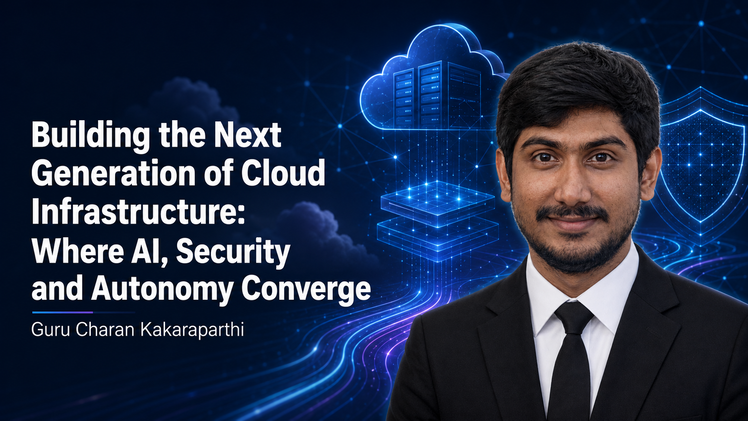
New Delhi, Aug. 25 -- Cloud computing is entering a new phase. Infrastructure is no longer expected to simply host applications, store data and provide computing capacity on demand. As artificial intelligence becomes embedded across enterprise operations, cloud environments are increasingly evolving into intelligent, automated and security-conscious platforms capable of supporting far more complex workloads.
The transition is creating a new set of infrastructure requirements. Enterprises need environments capable of deploying AI at scale, securing increasingly distributed architectures, automating operations and enabling more intelligent decision-making.
Cloud Engineer and Researcher Guru Charan Kakaraparthi, based in Arlington, Texas, has been exploring this intersection across cloud computing, AI, Kubernetes, hybrid-cloud architecture, cybersecurity, DevOps, automation and intelligent systems. His research focuses on how these technologies can converge to create cloud infrastructure that is AI-powered, secure and increasingly autonomous.
The Push Towards AI-Ready Cloud Infrastructure
The rapid adoption of AI across enterprises is becoming an important driver of cloud infrastructure investment.
According to the Stanford HAI 2026 AI Index report, organizational AI adoption reached nearly 88% in 2025, compared with 78% in the previous year, while 70% of surveyed organizations were using generative AI in at least one business function. As AI moves deeper into business operations, enterprises require cloud environments capable of reliably deploying, orchestrating and managing increasingly complex AI workloads.
Kakaraparthi's research addresses this transition through work on scalable AI deployment, Kubernetes orchestration and hybrid-cloud architectures.
His research, Efficient Deployment of Scalable AI Models via Kubernetes Orchestration in Hybrid Cloud Setups, examines flexible and distributed AI deployment. Another area of his research looks at combining serverless architectures with Kubernetes to support scalable and highly available AI workflows.
Together, these areas point towards the growing importance of cloud-native infrastructure as enterprises move AI applications from experimentation towards production environments. The commercial implications are significant as well. Gartner projects worldwide spending on AI-optimised Infrastructure-as-a-Service to grow 96% through 2026 to $42 billion, according to the article, highlighting the increasing demand for infrastructure designed specifically around AI workloads.
AI is Moving Deeper Into Software and Infrastructure Engineering
The influence of AI on cloud computing is also expanding beyond running models. Increasingly, AI is beginning to influence how software and infrastructure themselves are developed, deployed and optimised.
Kakaraparthi's research on Building a GenAI-Powered Advanced Code Generation Assistant Integrated with CI/CD Pipelines explores the integration of generative AI into software development workflows, including the incorporation of generated artifacts into development and CI/CD processes. His work on A Comparative Study of LLMs for Infrastructure-as-Code Generation and Optimization takes the idea further into the infrastructure layer by examining how large language models can assist in generating and optimising Infrastructure-as-Code.
The broader direction is significant. AI is moving from being something that runs on cloud infrastructure towards becoming a technology that can help build and operate the infrastructure itself. Stanford HAI's 2026 findings cited in the article provide another indication of this shift. Performance on the SWE-bench Verified coding benchmark increased from 60% to nearly 100% within a year, reflecting the rapid improvement taking place in AI-powered software engineering.
For cloud teams, this could gradually change the role of infrastructure engineers. Engineers may increasingly work alongside AI systems capable of generating configurations, analysing environments and supporting deployment decisions.
Security Has to Evolve Alongside Intelligent Infrastructure
The expansion of AI-enabled infrastructure also introduces another challenge: securing increasingly distributed and intelligent environments. Enterprises today frequently operate across hybrid and multi-cloud environments while simultaneously integrating AI into applications, development pipelines and infrastructure-management processes. Within this environment, security can no longer remain a layer added after infrastructure has been designed.
Kakaraparthi's research approaches security as an integral part of cloud architecture. His work on AI-Enhanced Zero-Trust Security for Hybrid Multi-Cloud Infrastructures examines the limitations of traditional perimeter-based security models. Another research area, AI-Based Detection of Supply Chain Attacks in CI/CD Pipelines Through Behavioral Pattern Mining, focuses on detecting potentially malicious behaviour inside software-development and delivery ecosystems.
He has also explored Secure Data Storage and Retrieval in Cloud Computing Using Homomorphic Encryption, addressing the protection of sensitive information using advanced cryptographic techniques. Taken together, the research points towards an important shift in cloud security. As infrastructure becomes more intelligent and distributed, security will also need to become more adaptive and embedded into the architecture itself.
Kakaraparthi's work approaches the challenge from several directions, including zero-trust architectures, encryption, behavioural security and AI-enabled protection.
Moving From Automated to Autonomous Cloud Infrastructure
Automation has been central to the development of cloud computing for years. The next stage could be considerably more ambitious: infrastructure capable of observing its own environment, predicting what might happen, making decisions and adapting with progressively less manual intervention.
Kakaraparthi's research on Autonomous Decision Engines for Enterprise Policy Optimization examines this transition from reactive operations towards more proactive infrastructure management. Such systems could potentially interpret changing operating conditions, identify abnormal behaviour, predict failures, optimise resource utilisation and dynamically adjust operational policies with reduced human intervention. The research has been approved for presentation at the ICDTA 2026 Conference, marking another step in Kakaraparthi's work around intelligent, adaptive and increasingly autonomous cloud infrastructure.
The concept represents a broader evolution in cloud architecture. Infrastructure automation traditionally executes predefined rules. Autonomous infrastructure attempts to interpret conditions and determine what action should be taken That distinction could become increasingly important as enterprise technology environments grow too complex for every infrastructure decision to be manually configured.
Applying the Convergence to Healthcare
Kakaraparthi's work also examines how the convergence of AI, cloud infrastructure and cybersecurity can extend into mission-critical environments.
His research on Cybersecure Embedded AI Systems for Remote Healthcare Monitoring in Smart Hospitals examines how embedded AI, intelligent monitoring and cybersecurity can be combined to support secure and connected healthcare environments. The research received the DASGRI 2026 Best Paper Award, recognizing its innovation, technical excellence, and potential real-world impact. The recognition was also covered by The Jerusalem Post on July 1, 2026, highlighting the research and its contribution to the field. According to the article, the conference received approximately 750 submissions from 16 countries, of which 110 papers were accepted following a double-blind review process.
The work illustrates how technologies being developed for intelligent enterprise infrastructure can also have applications in areas where cybersecurity, reliability and real-time monitoring are particularly important.
Contributing to the Broader Research Ecosystem
Beyond his own research, Kakaraparthi has participated in the broader academic and technology research ecosystem through peer review, technical committee roles, session chairing and speaking engagements.
His peer-review contributions include IEEE conferences RCSM2025, IATMSI2026 and CONIT2026, alongside Springer conferences FTNCT2025, DoSCI2026 and ICICC2026. He has also served on the Technical Team Committee for RCSM2025 and FTNCT2025, supporting technical activities and research evaluation.
His academic engagements have expanded further through his role as a Session Chair and Invited Speaker at ICCCNET2026. He has also received an invitation to serve as a Keynote Speaker at IEEE ICONAT2026 in Goa, reflecting recognition of his work across cloud computing, AI, cybersecurity and emerging digital technologies.
Researching Ahead of the Cloud Curve
One interesting way of viewing Kakaraparthi's research portfolio is against the technologies the wider cloud industry expects to become increasingly important.
In January 2026, iCertGlobal published its list of the Top 22 Cloud Computing Project Ideas in 2026, highlighting areas including AI, serverless architecture, zero-trust security, Kubernetes, green computing, blockchain, digital twins and remote healthcare.
A comparison with Guru Charan's research portfolio shows that 8 of these 22 emerging areas closely align with technologies he has already explored through his work and research, demonstrating strong relevance to the industry's evolving priorities. His broader portfolio spans AI, cloud infrastructure, cybersecurity, Kubernetes, automation, digital twins, healthcare and sustainable computing. The common thread is an attempt to look beyond technologies enterprises are deploying today towards the infrastructure requirements that could emerge as AI becomes more deeply embedded across the technology stack.
The Next Evolution of Cloud Infrastructure
The next phase of cloud computing is likely to be defined by more than scalability and automation, but Intelligence, security and autonomy are becoming increasingly important attributes: infrastructure capable of understanding workloads, detecting risks, optimising resources and adapting as operating conditions change. Kakaraparthi's research explores different parts of this transition through AI deployment, Kubernetes, hybrid-cloud architecture, generative AI, Infrastructure-as-Code, zero-trust security, encryption and autonomous decision-making.
At the centre of this work is one of the more important challenges facing enterprise technology teams: how to make cloud infrastructure increasingly intelligent without compromising security, reliability, governance or human oversight. As enterprises scale AI adoption, the long-term value of cloud infrastructure may therefore depend on more than the number of models an organisation can deploy. The larger challenge will be creating infrastructure capable of deploying intelligence securely, continuously adapting to changing conditions and supporting informed operational decisions.
Guru Charan Kakaraparthi's work sits at this intersection, contributing to the broader development of secure, AI-powered and increasingly autonomous cloud infrastructure.
NOTE: This research piece is authored by VCCEdge Research Team on Guru Charan K.'s works
Published by HT Digital Content Services with permission from VC Circle.