
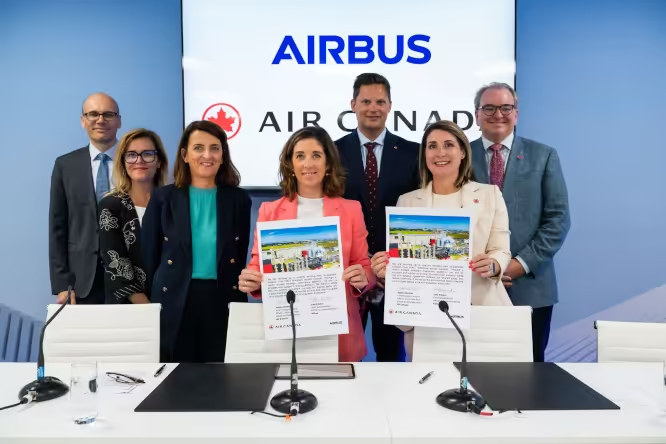
India, July 22 -- Air Canada, the country's largest airline and flag carrier, and Airbus, a global leader in aerospace manufacturing with the largest commercial aircraft industrial footprint in Canada, are uniting their shared commitment to aviation decarbonisation.
The Partnership
- Platform: A jointly funded Sustainability Co-Investment Platform.
- Investment: Up to C$13.7 million (US$10 million) to support a commercial-scale SAF industry in Canada.
- Goal: Accelerate a Canadian SAF project toward Final Investment Decision (FID), with government collaboration to build supportive policy frameworks.
- Advocacy: Both companies are working with the Canadian Council for Sustainable Aviation Fuels (C-SAF) to align industry and government efforts.
Corporate Travel & SAF
- Air Canada's Leave Less Travel Program: Provides corporate partners with verified SAF environmental attributes.
- Airbus Commitment: Signed a 5-year agreement, purchasing attributes linked to 60,000 litres of SAF for its first allocation.
- Impact: Helps reduce life-cycle emissions of Airbus' corporate travel while stimulating SAF demand.
Industry Transformation
- Fleet Modernization: Air Canada is introducing more fuel-efficient aircraft like the Airbus A321XLR and Canada-built A220.
- Net-Zero Goal: Both companies support aviation's global ambition to reach net-zero carbon emissions by 2050, with SAF as a critical pathway.
Economic Potential
- Macroeconomic Study (Airbus + ICF):
- Scaling SAF to meet 40% of Canada's aviation fuel demand by 2040 could add $32 billion to GDP.
- Create 140,000 jobs across agriculture, forestry, and urban sectors.
- Catalyst Effect: The platform is designed to kickstart a multi-billion-dollar SAF ecosystem in Canada.
What is SAF?
- Definition: Sustainable Aviation Fuel is a....
Published by HT Digital Content Services with permission from Travel Media.