
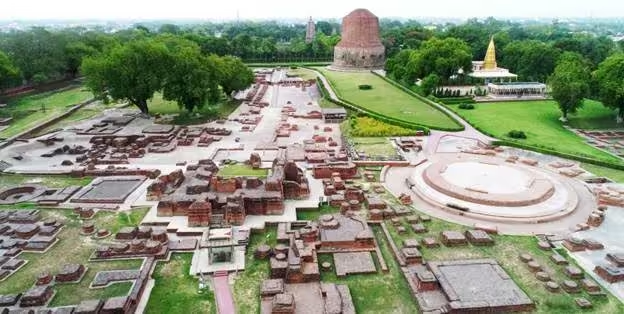
India, July 26 -- At the 48th Session of the World Heritage Committee in Busan, South Korea, the Ancient Buddhist Site of Sarnath has officially been inscribed on the UNESCO World Heritage List, becoming India's 45th World Heritage property.
Components:
- Chaukhandi Stupa
- Archaeological Remains of Sarnath (Dhamekh Stupa, Dharmrajika Stupa, Mulagandhakuti Vihara, Ashokan Pillar, etc.)
Historical significance:
- Site of the Buddha's first sermon (Dharmachakra Pravartana) in the 6th century BCE.
- One of the four principal Buddhist pilgrimage sites, alongside Lumbini, Bodhgaya, and Kushinagar.
Timeline:
Flourished from the pre-Mauryan period (5th-4th BCE) until its decline in the 12th century CE.
Rediscovery:
Excavated extensively by the Archaeological Survey of India (ASI) since the 19th century.
UNESCO Recognition
- Inscribed under criteria (iii) and (vi):
- (iii): Testament to centuries of Buddhist religious architecture and patronage.
- (vi): Direct association with Buddha's first sermon and the founding of the Sangha.
- This recognition highlights India's role as the birthplace of Buddhism and strengthens cultural diplomacy with Buddhist-majority nations across Asia.
National Significance
- Leaders including PM Narendra Modi, Union Culture Minister Gajendra Singh Shekhawat, and UP CM Yogi Adityanath hailed the inscription as a proud moment for India.
- The Ashokan Lion Capital, excavated at Sarnath, is......
Published by HT Digital Content Services with permission from Travel Media.