
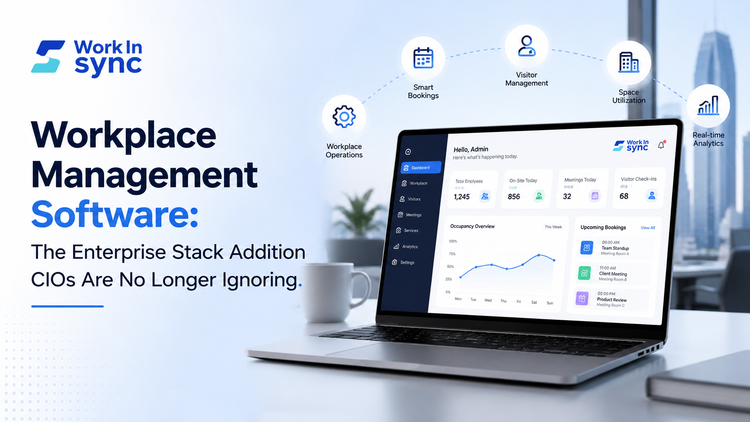
New Delhi, July 28 -- Hybrid Work Made Workplace Management Software an IT and Ops Problem, Not Just an HR One
When hybrid work gained the prominence it has today, it changed where employees worked and also what the enterprise technology stack was expected to do. Facilities teams that once managed a fully occupied, predictably dense office suddenly had no reliable way to answer the question every operations leader was being asked: how many people are actually in the building today, where are they, what are they using, is the current real estate enough?
The tools that were being used earlier in the times of full occupancy every day (spreadsheets, paper registers, siloed point solutions) weren't built for this new reality of hybrid work, where occupancy is unpredictable. What was needed is a unified workplace management software to fill this gap.
What Is Workplace Management Software?
Workplace Management Software is a unified platform that manages how employees interact with workplace resources. For instance booking desks, reserving meeting rooms, managing visitors, parking and cafeteria utilisation.
It helps replace the various spreadsheets, manual register entry or different point tools that an organisation may be using to separately manage desks, meeting rooms, visitors, parking, cafeteria, etc. In the prior mentioned method there are compliance issues and all different solutions operate in silos, the disconnected tools don't share data.
But a unified workplace management system works across all your use cases, integrates with your existing tools and provides a unified front for managing your workplace.
Core Modules
Desk Booking & Hot Desking
Desk Booking system is one of the first modules that organizations try to solve for using a point tool or a calendar workaround. But that can be highly detrimental to the employee experience.
A well-implemented desk booking solution simplifies the workday for both the admin and the employees. Employees can pre-book their preferred desks from an interactive floor plan that clearly states where their colleagues are sitting to improve collaboration. On the other hand the IT and ops team get real-time utilisation data at an office, floor, team, zone, or even day level. This is the data that answers the real- estate question, informs the hybrid scheduling policy, and gives facilities the numbers to have a credible conversation with the CFO about space efficiency.
Meeting Room Booking Software
Meeting room management solution brings in visibility, streamlines usage, and resolves conflicts automatically for meeting rooms. Calendar apps do enable booking meeting spaces but things go wrong when spaces are booked and employees don't end up using them. On-paper the meeting room is booked, but in reality those who booked the room aren't using it and others in need don't have a room. What's needed is an intelligent system that auto releases the room back into the booking pool if they aren't checked into by the configured time.
The software integrates with calendars apps (Outlook or Google Calendar) so employee experience doesn't get a complete overhaul. Kiosks outside the room tells the exact status (occupied, vacant, going to be occupied), with the ability to check in to the meeting from the kiosk itself or create a new meeting.
Visitor Management System
Most enterprises use a paper based system to track visitors. For a CIO or IT security lead, this presents a huge compliance and safety gap, along with the obvious bad visitor experience. A visitor management system replaces the paper log books with a digital system that enables pre-registration, where the visitors can fill in all their details before they even arrive. And are even informed of additional details like parking slot, wifi details, etc.
On the hosts end they get an automated alert when their guests arrive and when they overstay, keeping them always informed. The system also integrates with access control to manage visitor badge access to limited zones. The organisation also benefits with compliant and audit-ready logs.
Parking Management
Parking management is one of the key touch points when it comes to employee experience. First-come-first-served allocation creates uncertainty, conflict and wastage where employees have no idea if they'll get a parking slot when they go to work.
A parking management system brings in a pre-booking workflow, where employees can book their slots, or join the waitlist if slots are not available. Organisations can also assign parking to different user groups (PWD, parents, etc). On the day of the booking an automated number recognition system allows vehicles with a booking to enter the parking or restrict access for those without a booking.
Cafeteria Management System
Cafeteria management as a module tends to get neglected, however lack of accurate data highly impacts. When meals are prepared on guesswork, there's either a lot of wastage, or not enough food for all employees.
A digital cafeteria management system removes all ambiguity and brings in accurate demand. Employees can pre-book their meals (within the custom cutoff time) and the cafeteria gets demand-backed headcount before they begin prep. Payment for the meals can also be made through the platform itself.
Why Enterprises Are Adding This to the Stack Now
In the new work model, Workplace Management has also evolved to become a function of IT and Ops teams.
An efficient workplace management or a successful return to office needs data to work. Everything from attendance policy, anchor days, to real estate decisions need accurate utilisation data to work. With data being central to it all, point tools or data available in silos don't cut it anymore. A unified space management system instead of five disconnected tools, is the need of the hour. And has the potential to use data from the system to optimize costs, and extend elevated experience to the employees.
The IT logic here is the same as any other stack consolidation decision: one data model, one integration layer, one admin interface, one audit trail.
Conclusion
There's no denying that individual modules, whether that's desk booking, meeting room management, cafeteria management, or visitor & parking management, solve real workplace problems. But a unified platform with all the modules truly transforms how a workplace functions and the efficiency levels it can achieve.
When all the modules work together and feed into the same data layer, CIOs and IT teams know exactly who is in the building, how much of the space is booked and being used, who is occupying the meeting rooms, and where does parking and cafeteria utilisation stand.
That is the same logic a CIO applies to any other stack consolidation decision. And the result is operational efficiency for the IT and facilities team, cost optimisation and a great experience for the employees. When the office is easy to navigate, predictable, and responsive, employees make the decision to come in more often. That is the outcome the investment is ultimately for.
NOTE: No TechCircle Journalist was involved in the creation of this content.
Published by HT Digital Content Services with permission from TechCircle.