
New Delhi, Aug. 26 -- For CEOs, the AI question is no longer where to deploy it, but how it can reshape growth, resilience and competitiveness.
AI is moving beyond the technology function as CEOs and boards assess its potential to drive growth, resilience and competitive advantage. For industrial companies, the challenge is no longer where to deploy AI, but which business problems it should solve, and who owns the outcome.
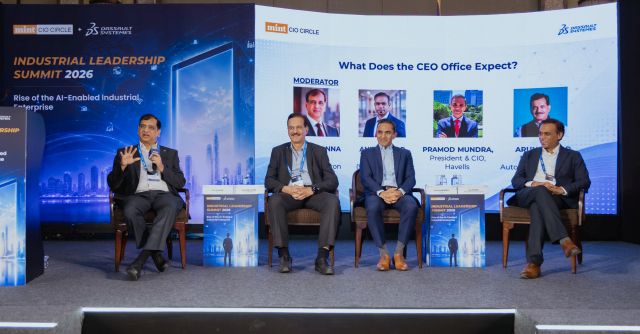
That was the central theme of the panel discussion "What Does the CEO Office Expect?", moderated by Amit Khanna, Partner, Grant Thornton Bharat, at the Industrial Leadership Summit, hosted by Mint CIO Circle and Dassault Systemes in Pune on August 21-22.
The discussion focused on how business leaders are evaluating AI for growth, resilience and competitive advantage, with Anil Pawar, Chief Operating Officer, Adani Group; Pramod Mundra, President & Chief Information Officer, Havells India Ltd.; and Arun Kumar Malhotra, auto industry expert and former Managing Director, Nissan India, sharing their perspectives.
AI proposals need to start with the business problem
AI investments are increasingly being judged not by the technology they deploy but by the business problem they solve. Malhotra said proposals going to the CEO or board should reflect the collective thinking of business functions rather than originate solely from the CIO's office.
"The proposal should not come from the chief information officer. It should come from all stakeholders combined." That means bringing production, R&D, marketing and operations into the conversation early, with the focus on how AI can change the business or its business model.
This shift also places a new expectation on technology leaders. "CIO, CDIO or CTO cannot remain technologists. They have to become business technology people," Mundra said.
For boards, the question is also moving beyond the expected return from an individual AI deployment to the competitive cost of not investing. "If I don't do this, where will I be? And if I do this, where will I be?" Malhotra said.
AI is thus entering the boardroom not simply as a technology investment seeking a return, but as a strategic decision that could determine where a company stands relative to competitors.
AI's bigger opportunity lies beyond efficiency
The focus on competitive advantage is also pushing companies to look beyond efficiency gains, which have been the easier starting point for many AI deployments.
Mundra argued that efficiency gains cannot continue indefinitely, while growth creates a more durable opportunity. "You can't really keep repeating the efficiency gains. But if you demonstrate growth, growth is something that you can keep repeating. There is no end to top line. There's always an end to bottom line."
At Adani Group, AI has moved into the CEO review process, with business CEOs expected to present their AI strategy and progress, Pawar said. "AI has to be imbibed into the business," he said.
Pawar cited an instance where AI detected an anomaly in electricity consumption that led to the discovery of revenue leakage involving a commercial consumer billed under a different category. For a large enterprise, such interventions can translate into significant value even when the improvement is relatively small.
AI helping businesses balance efficiency with resilience
AI is also emerging as a tool to manage uncertainty without simply adding buffers. Mundra said companies could use data and decision-making systems to remain lean while responding faster to changes in demand, supply and other disruptions. "Today, resilience is all about being very, very lean and very, very agile by using the right data, right decision-making systems and right optionality."
Pawar cited AI models being used to forecast the availability of components for large solar projects. The aim is to identify potential supply constraints early enough for the business to respond, rather than rely solely on additional inventory or capacity.
For companies operating complex supply chains, earlier visibility can create more choices around sourcing, inventory and production. Mundra also cautioned against applying conventional ROI metrics to every AI initiative where the technology has the potential to alter how a business operates.
"The promise of AI is not to just make incremental improvements, but to make disruptive improvements."
AI autonomy raises bar for human accountability
Greater autonomy brings a harder question for CEOs: who is responsible when an AI-driven decision goes wrong? Malhotra said companies need a "devil's advocate" to challenge AI proposals, test assumptions and examine potential failure scenarios.
"Opportunity is a double-edged sword. It could be plus one, it could be minus one." Mundra was more direct: "Your AI agent cannot face an audit committee. The algorithm cannot be understood by the board. It's a human being who has to answer."
As AI becomes more involved in business decisions, companies will need clear lines of responsibility alongside the technology. Pawar highlighted audit trails and data lineage as critical safeguards, allowing organisations to establish what happened, when it happened, who acted and what data informed the decision.
For CEOs and CIOs, the AI success will increasingly be measured not by the number of use cases deployed, but by the business outcomes created, while also ensuring there is a clear human owner when the technology gets it wrong.
Published by HT Digital Content Services with permission from TechCircle.