
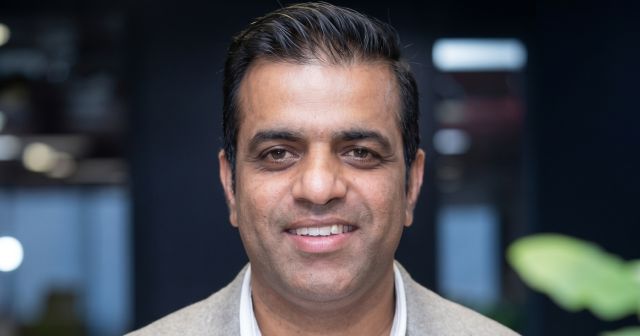
New Delhi, June 22 -- The UK is emerging as a springboard for Indian technology companies seeking a larger role in global enterprise and public-sector transformation, according to Parameshwaran Iyer, Executive Vice President and Head - UK & Europe at Hexaware Technologies. The recently concluded UK-India trade agreement is expected to strengthen collaboration between the two countries across innovation, digital trade and talent, he said.
As Indian IT services firms look beyond traditional outsourcing, the UK is increasingly becoming a market where they can participate in AI-led transformation, public-sector digitisation and frontier technology development. The country is Hexaware's second-largest market globally.
"The UK-India trade agreement heralds a new chapter in closer collaboration for both countries on innovation, digital trade and talent," Iyer told TechCircle. "As India's tech sector grows in influence globally, the UK is becoming the door a lot of Indian companies walk through to participate in enterprise and public-sector transformation."
Iyer said the importance of the UK extends beyond revenue. The market combines mature financial services, a government pushing AI adoption and regulators looking for partners with deep domain expertise. "The value of the UK market does not lie in the scale of contracts. It lies in access to the table where decisions are made," he said.
According to him, India and the UK should be viewed as complementary ecosystems rather than competing markets. While the UK provides research, intellectual property and frontier science, India offers the engineering talent and execution capabilities needed to commercialise innovation at scale.
"The UK acts as a centre for R&D and pioneering science, whereas India offers scale and execution. Together, they form a seamless innovation pipeline," he said, describing the UK-India technology corridor as a "single engine".
Hexaware is increasingly seeing opportunities beyond banking, insurance and travel. Governments are adopting AI technologies to improve citizen services, digital inclusion and operational efficiency, opening up a new growth avenue for technology companies.
"Governments are turning to technology companies the same way enterprises do," Iyer said.
The company is also expanding its collaboration with universities and research institutions in the UK. Its new R&D centres in Manchester, Leeds and Birmingham will work with academia on AI, healthcare and biotech innovations, including software layers, hybrid optimisation models and early-stage compilers.
Hexaware is already applying AI in healthcare through partnerships such as Healthcare Business Solutions UK (HBSUK), where automation is being used to streamline clinician onboarding and compliance processes. It is also supporting life sciences customers with digital platforms for decentralised clinical trials and cell and gene therapy workflows.
Iyer said the global AI debate is increasingly shifting from innovation to resilience and sovereignty.
"It's not just about innovating more quickly anymore. The question is how vulnerable we are," he said. "If nations rely entirely on systems, compute or cloud infrastructure controlled elsewhere, they lose control over decisions made outside their borders."
While the UK is strengthening its AI research ecosystem, India is building indigenous models and domestic compute capabilities. Hexaware's GIFT City facility reflects this approach, focusing on AI and cloud services for BFSI clients and small language models (SLMs) tailored for industry-specific use cases.
"For regulated industries, SLMs make more sense because they run in controlled environments, are easier to govern and can reduce compute costs significantly compared with large general-purpose models," he said.
The executive also dismissed concerns that AI would destroy entry-level technology jobs, arguing that work is changing rather than disappearing. New roles are emerging in AI orchestration, governance, monitoring and quality assurance.
"The tasks AI replaces are repetitive and rules-based. What's replacing them is more interesting but also harder," he said. "People will need to work alongside AI systems, apply judgment and understand when the model is wrong."
As part of its UK expansion, Hexaware plans to hire 1,200 people over five years and introduce cross-training programmes between India and the UK to prepare employees for AI-led roles.
Iyer believes India's next challenge is to move beyond being a consumer of AI and become a creator of intellectual property. "The future probably doesn't belong to whoever has the biggest model," he said. "It belongs to whoever builds the right model for the right job while keeping control of their own data and infrastructure."
Published by HT Digital Content Services with permission from TechCircle.