
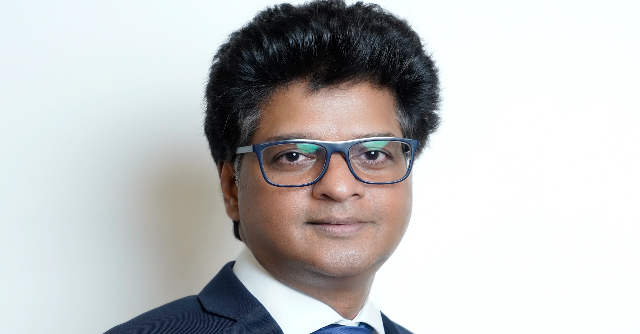
New Delhi, April 15 -- Enterprises are rethinking their positioning as AI moves from experimentation to core infrastructure, particularly in regulated sectors like banking and insurance. In a conversation with TechCircle, Srikumar Kumar, President - Data, AI & Software at GTT Data Solutions, discussed how the company is repositioning itself around agentic AI, domain-specific solutions, and outcome-based delivery models. He also outlined shifts in AI adoption, data strategy, and regulation across global markets.
Edited Excerpts:
How do you define what GTT Data Solutions is today and what it is becoming?
We looked at the market and at similar IT companies, and we wanted to differentiate ourselves, especially since we work with large enterprise clients like HDFC Bank, ICICI Bank, and large insurance companies. The idea was to build a differentiated offering.
That's where combining structured and unstructured data into an agentic AI platform made sense for our clients. If you look at the Antworks platform we acquired, it was built on what the founders called a fractal intelligence platform. In simple terms, we were able to read unstructured documents and convert them into structured content.
We are focusing on insurance as a key industry because we believe solutions need to be domain-specific when we engage with clients. At the same time, we have a base platform, CMR, that works across industries like banking, pharmaceuticals, and airlines.
What we're seeing is that customers want to do more with AI. AI itself isn't new, but with tools like ChatGPT becoming mainstream, even consumers are more accepting of it. Now, with agentic AI, both our partners and our internal teams are building solutions, and customers are looking to automate business processes end-to-end.
We've built capabilities through acquisitions and now have about 500 people, most with data and AI expertise. This allows us to move beyond just offering services. Traditionally, many competitors rely on time-and-material contracts, which people call "bums on seats." But those models are declining.
Customers are now looking for outcome-based solutions. We've been doing fixed-price, outcome-driven work for years. So today, we combine product platforms, services, and domain expertise. That combination is what will shape our future and help us deliver outcomes for clients.
What fundamental shift are you seeing in how organisations, especially insurers, approach data and decision-making?
If you look at insurance in India, a large segment of the population is still uninsured, though awareness has improved over the past two to three years due to government initiatives and general awareness.
In non-life insurance, one major challenge is the lack of customer loyalty. For example, if I buy motor insurance today and someone offers a cheaper option next year, I'll switch. So insurers struggle to understand customers and improve loyalty.
With traditional technologies, it was very difficult to understand customer behaviour and expectations. There's also high churn in general insurance. At the same time, the range of insurance products has expanded significantly.
To remain profitable, insurers now realise they need to understand customers better and offer improved experiences. That requires a strong data foundation. Without a centralised data repository, what we call master data management, and a customer 360 view, you can't build governance or trust the data.
If you can't trust the data, you can't use it effectively for AI. So a strong data foundation is essential.
Initially, companies used AI to improve individual productivity. Now they are moving toward organisation-wide improvements-customer service, reducing operational costs, improving supply chains, and reducing fraud in claims processing.
As insurance adoption grows, fraud also increases. AI is now being used to detect and prevent fraud before it happens. Overall, insurers are using AI to improve revenue, reduce costs, meet compliance requirements, and enhance customer experience. It's being applied across business processes.
Is regulation a barrier or a catalyst for AI adoption in BFSI globally?
It can be a barrier in some regions. For example, in the European Union, the European AI Act introduced strict requirements and penalties for non-compliance, including around bias detection and preventing incorrect outputs.
This has forced companies to implement strong AI governance frameworks. In markets like India and the US, such regulations are not yet mandatory, partly to allow innovation to continue.
In Europe, after implementing the rules for several months, there have already been adjustments to make them more practical. Governments are realising that regulations need to be adaptable so organisations can comply without slowing innovation too much.
Initially, regulation acted as a barrier, but with recent changes, it is becoming more supportive for startups and companies building AI applications.
How do you see the evolution of AI from here?
It's a long road ahead. Right now, we are in what I would call the agentic AI era, where AI agents are starting to replace humans for specific tasks and can communicate with each other to achieve business outcomes.
A lot of this is still being tested by organisations. As we move toward more advanced stages-like artificial general intelligence (AGI) or beyond-that's when stronger regulation will become necessary. But at this stage, we are still evolving.
What does "Make in India for the world" mean in practice for your company?
Traditionally, the advantage was cost arbitrage, delivering services from India at a lower cost. But that advantage is gradually diminishing as the cost of doing business in India rises with economic growth.
The more important shift now is innovation. Compared to three to five years ago, we are seeing much faster innovation in India. This is driven by startups, an entrepreneurial mindset, and government support.
There's a willingness to experiment, if one idea doesn't work, move to the next. That mindset is leading to more solutions being built in India.
So the advantage is shifting from cost to innovation. That's what "Make in India for the world" means in practice for us, building solutions locally that can be applied globally.
Published by HT Digital Content Services with permission from TechCircle.