
New Delhi, May 14 -- As enterprises across India accelerate investment in automation, a practical question persists: where does the human worker fit? For Zebra Technologies, the answer is embedded in its product strategy. Ryan Goh, Senior Vice President and General Manager for Asia Pacific and Global OEM, and Subramaniam Thiruppathi, Country Lead for ISC, recently outlined where automation is gaining traction in India, and what is holding it back.
Collaboration, not replacement
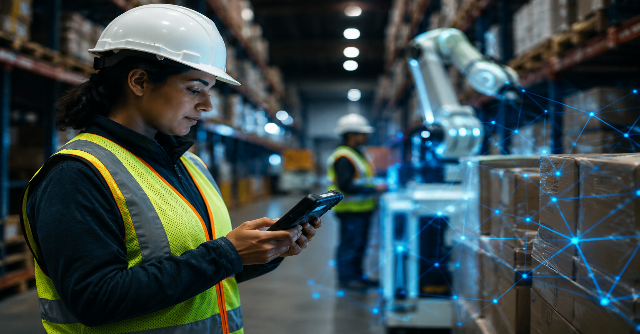
Goh pushed back on the assumption that automation leads to headcount reduction. "It's not about robots replacing humans," he said. "It's about Cobot - human cooperating with robots." He described Industry 5.0 as a shift away from pure efficiency toward human-centred design, where AI derives its value from the people operating alongside it.
"Human relevance will definitely be there. The workflow will shift," he said. "Instead of three steps of a flow, it becomes one step. So it will make you more efficient."
Thiruppathi grounded this in retail operations. Store managers in Delhi and Mumbai now verify shelf layouts by photographing them rather than coordinating via email with supervisors. In healthcare, medication workflows are tracked at the patient level using a combination of barcode scanners, RFID tags, and tablets. "Automation is going to happen. Human experience is going to be there," he said. "It's an efficiency enhancement."
RFID and real-time inventory
Both executives pointed to RFID as a technology reshaping inventory management. Goh described how fashion retailers, exposed to short selling windows of roughly three months, have moved toward source tagging, applying RFID at the point of manufacture, to get real-time visibility across the supply chain.
"In the past, you would need to scan barcodes. Sometimes you get it wrong because people don't scan. But with RFID, now you get real-time visibility. At every moment, you know what is going on, what is not doing well," he said.
Thiruppathi illustrated the logistics side, describing how RFID-tagged containers moving through ports like Adani or DP World allow insurance ownership to transfer automatically at each handoff. He also cited Kavach, the Indian Railways collision-avoidance system, as a large-scale public deployment. "We have added RFID tags in every lane at a periodic interval of every kilometre, and RFID readers in every coach in India. This ensures that accidents are avoided."
India's quick commerce advantage
India's quick commerce infrastructure, where consumer goods are delivered within minutes, gave both executives a concrete example of what real-time data enables commercially. Thiruppathi pointed to how deeply the model has penetrated even low-frequency, high-consideration purchases, noting instances where items such as a tuxedo were available for delivery within twenty-five minutes of an order being placed.
He explained the infrastructure behind each fulfilment. A store participating in quick commerce needs a barcode printer, a scanner, and a live feed of stock data pushed back to the platform. "Their AI will decide, place this order on this vendor because the customer is here, it will go in 15 minutes." The decision, he said, is automated, but it depends entirely on the store's inventory data being current and accurate. A mismatch between the system record and the physical shelf produces a no-pick, a failed order, which is now the metric retailers track most closely.
Goh was direct about what makes that speed possible at the backend. "You cannot deliver in minutes if you do not have the right stock in store. If you do not have the right, accurate data, you cannot achieve that. This is becoming a competitive advantage for many retailers in India." He added that the dynamic is specific to India in a way that sets it apart from other markets he covers across the Asia Pacific. "It is only happening in India. Nowhere else in the world have I seen that level of quick."
Goh connected this to Zebra's broader frontline AI argument. "Real-time visibility makes a world of difference. If you know right away how much has moved in and out of your warehouse or your store, you could intelligently commit to an order when it is placed, and you do not lose revenues." For retailers competing on delivery windows measured in minutes, inventory accuracy is no longer an operational metric - it is a revenue variable.
The gap: Data and connected workers
On the investment-to-outcome gap, Goh identified data quality as the primary constraint. "The biggest gap today is data availability. If the data is wrong, whatever forecast you do is completely wrong."
Thiruppathi added that partial device rollouts undermine the returns enterprises expect. "People believe that if I equip 20% of my staff with a device, I could achieve that. But if every associate is connected, you could communicate, you could send out the task right away, immediately." He described connected workforce deployment as the missing step between intention and realised visibility.
Looking ahead, Thiruppathi pointed to edge AI, processing that runs on the device rather than querying cloud models, as the next shift. "Putting AI on a device will shape the way enterprises can realise the value of AI without having to pay a significant amount of money to interrogate data using tokens."
Goh closed with the scale of what remains to be done in India. Of approximately 153,000 registered factories in the country, he said, only around 10% are automated. "Somebody who started without a barcode now jumps to RFID. India has huge potential for all these micro-SMEs."
Published by HT Digital Content Services with permission from TechCircle.