
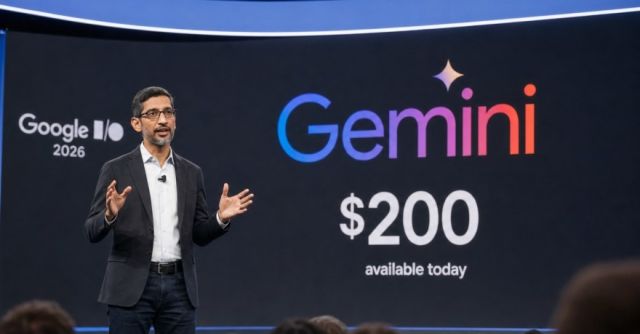
New Delhi, May 20 -- Google I/O 2026 marks a turning point in enterprise AI strategy. Moving beyond copilots and chat interfaces, the company used this year's keynote to outline what it calls the "Agentic Era" - a future where AI systems operate less like assistants and more like autonomous digital workers. For CIOs, CTOs and operations leaders, the announcements suggest a shift from deploying AI tools to orchestrating networks of AI agents across workflows. Here are seven takeaways enterprises should watch closely.
1. AI is evolving from assistant to autonomous operator
The biggest shift came with the introduction of Gemini Spark, Google's "long-horizon" AI agent designed to run continuously in the cloud and execute multi-step tasks without constant prompting.
For enterprises, the implications go beyond productivity gains. Functions such as inbox triage, project brief generation, workflow monitoring and administrative coordination could increasingly be handled by AI systems operating in the background.
The larger takeaway: businesses may be entering an era where AI performs work, rather than merely helping employees complete it.
2. Speed and efficiency are becoming as important as intelligence
Google introduced Gemini 3.5 Flash as its default global model, positioning it as a faster and lighter AI engine capable of delivering strong reasoning and coding performance.
For enterprises deploying customer support systems, analytics engines or large-scale AI applications, responsiveness and operational cost are emerging as critical factors. The race is increasingly shifting from "biggest model" to "most efficient model."
This could become especially important as enterprises scale AI deployments across functions. Moreover, Google AI chief Demis Hassabis also highlighted tools such as Gemini for Science and discussed AI's role in accelerating discovery. This suggests industries such as pharma, manufacturing and R&D-heavy businesses could increasingly use AI systems not only for productivity but also for experimentation and discovery.
3. Software development may move toward AI-driven production lines
One of the most consequential announcements for CTOs came through Antigravity 2.0, Google's AI-powered development environment featuring multiple parallel sub-agents.
Instead of a single coding assistant, enterprises can deploy AI agents handling front-end work, back-end architecture, testing and security simultaneously.
The result could significantly compress development cycles and accelerate the rise of "vibe coding," where teams increasingly describe intent while AI systems generate products.
For engineering leaders, the question may shift from using AI to redesigning development workflows around it.
4. Infrastructure may become the hidden battleground of AI adoption
Google also unveiled its eighth-generation TPU systems designed specifically to support AI "swarms" - groups of multiple agents collaborating on tasks. The TPU 8i and TPU 8t architecture aims to reduce delays between interacting AI systems and improve efficiency for large-scale workloads.
For enterprises, scaling AI may increasingly depend on backend infrastructure choices rather than model capabilities alone. As organisations deploy larger fleets of agents, computing economics and latency management could become strategic priorities.
5. Search is becoming an always-on intelligence layer
Google's overhaul of Search points to a larger shift: moving from active queries to persistent AI monitoring.
Instead of users repeatedly searching for information, AI agents could continuously track updates, monitor topics and surface relevant intelligence automatically.
For enterprises, this could reshape competitive intelligence, procurement tracking, research and internal knowledge management workflows.
The shift suggests search itself may evolve into an enterprise operating layer.
6. AI adoption is entering a scale phase
Google disclosed that it now processes trillions of AI interactions at unprecedented scale, while enterprise usage across cloud customers continues to expand rapidly.
That matters because many organisations are moving beyond experimentation and pilot programmes into production deployments.
As AI becomes embedded across workflows, enterprise conversations may increasingly shift from proof-of-concept discussions to governance, ROI measurement, and cost optimisation.
Google CEO Sundar Pichai revealed that Google now processes 3.2 quadrillion AI tokens every month, up sharply from a year earlier, while hundreds of Google Cloud customers crossed trillion-token usage thresholds.
This suggests AI experimentation is increasingly becoming production deployment. CIOs may now face questions around AI governance, cloud spending optimisation and ROI rather than proof-of-concept adoption.
7. AI is becoming infrastructure, not just software
A broader message throughout I/O was Google's ambition to make Gemini a connective layer spanning Search, Workspace, Cloud, Android and commerce experiences.
This suggests AI may increasingly function as enterprise infrastructure rather than a standalone application.
For businesses, that could require rethinking technology architecture itself. AI systems may need to be treated as foundational layers embedded across platforms and workflows rather than productivity add-ons.
CIO Takeaway
Google I/O 2026 suggests the next phase of enterprise AI may be less about deploying copilots and more about redesigning workflows around autonomous systems. For CIOs, the challenge is no longer choosing an AI model; it is deciding how AI agents, search, infrastructure, and governance fit into the business's operating architecture.
Published by HT Digital Content Services with permission from TechCircle.