
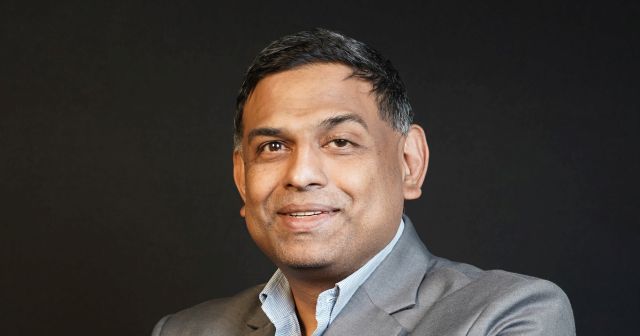
New Delhi, Aug. 17 -- Indian enterprises are entering a more demanding phase of artificial intelligence adoption, with boards increasingly scrutinising deployments for measurable gains in revenue, cost, and productivity, according to Ganesh Gopalan, co-founder and chief executive of voice AI startup Gnani.ai.
"The experimentation era was generous with ambiguity," Gopalan said in an exclusive interview. "Enterprises are now asking which deployments generated measurable revenue or cost outcomes, and the ones that cannot answer that question are getting cut."
The shift is forcing companies to move away from broad mandates to "implement AI" and instead identify specific business problems such as reducing delinquency rates, lowering the cost per customer interaction or improving first-call resolution, he said.
According to Gopalan, enterprises achieving scale are also integrating AI with existing customer relationship management, collections and compliance systems instead of treating it as a standalone layer. "AI deployed against a vague mandate stays in pilot. AI deployed against a measurable outcome, through a system that fits how the enterprise actually operates, becomes infrastructure," he said.
Founded in 2016 by Gopalan and Ananth Nagaraj, Bengaluru-based Gnani.ai develops speech and language models and voice-led AI systems for enterprise customers and serves more than 200 enterprises and processes over 30 million voice interactions a day, according to the company. It is also among the companies selected under the IndiaAI Mission to develop sovereign foundational AI capabilities.
Narrow agentic AI use cases gain ground
Gopalan said agentic AI is currently delivering the clearest results in narrowly defined, high-volume activities such as collections, insurance follow-ups, service bookings and lead re-engagement. These applications work because customer intent is relatively easy to classify and the range of decisions available to an AI agent is restricted.
Gnani.ai's deployments across banking, financial services and insurance, telecom, consumer durables and hospitality have resulted in improvements in contact rates, resolution times and interaction costs, he claimed, without disclosing customer-specific figures. However, the capabilities of AI agents in open-ended business processes are sometimes overstated, he cautioned. Workflows that involve multiple steps, ambiguous instructions or consequential decisions still require human intervention.
"The companies getting the most out of agentic AI are treating it as supervised autonomy-AI owning high-volume, defined interactions and humans handling escalations and judgment calls," Gopalan said.
He expects contact centres to become increasingly automated, but not entirely devoid of people. AI can manage repetitive interactions such as policy renewals, payment collections, appointment reminders and initial service queries, while human agents remain necessary for disputed claims, distressed customers and complex escalations.
"The contact centre is not becoming humanless; it is becoming better designed," he said. "The ones treating headcount reduction as the primary metric will miss the bigger opportunity."
Voice could widen digital access
Gopalan expects voice to emerge as a key interface for India's next wave of digital users, particularly those constrained by literacy, device capabilities or low-bandwidth connectivity.
However, expanding voice AI across India will require models to handle language switching within conversations, regional dialects, noisy telephone audio, and low-latency responses at scale. Gnani.ai says its models support more than 40 languages and dialects and are designed for enterprise voice interactions involving accents, background noise and code-switching.
India's linguistic complexity could also give domestic AI developers an advantage in overseas markets, Gopalan said. Technology built to handle Hindi-English code-switching and low-resource Indian languages could be adapted for Spanish-English conversations in the US and Latin America, as well as linguistically diverse markets in Eastern Europe, Southeast Asia and the Middle East.
"Companies that solve for India are not solving a local problem. They are building capability the rest of the world needs," he said. While access to computing infrastructure has improved, partly due to capacity being added under the IndiaAI Mission, it remains a constraint for startups training models for low-resource languages, Gopalan said. The larger challenge, however, is finding engineers who can convert AI research into reliable production systems capable of managing millions of interactions.
Trust depends on system architecture
As enterprises deploy AI in regulated industries, reliability cannot be defined merely by whether a model produces an incorrect response, Gopalan said. Instead, systems must be able to identify uncertainty and prevent an erroneous response from becoming an unauthorised action. For banks, insurers and other regulated businesses, this requires compliance logs, audit trails, real-time intervention and explicit limits on the decisions an AI system can make. "Trust is ultimately an architectural property, not a model property," he said.
Earlier this year, the company raised $10 million in a Series B round led by Aavishkaar Capital, with participation from Info Edge Ventures. Gnani.ai said it will use its recent funding to deepen its presence in sectors where it already has deployment experience, build its voice AI application programming interface platform and expand internationally. The company is targeting markets including the US, Southeast Asia, Eastern Europe and the Middle East over the next 18-24 months.
For AI startups, Gopalan said the test in this phase will be whether their products can operate reliably at enterprise scale and demonstrate an impact on the profit and loss account. "India was the proving ground," he said. "The next 18 to 24 months are about taking what we built here to the world."
Published by HT Digital Content Services with permission from TechCircle.