
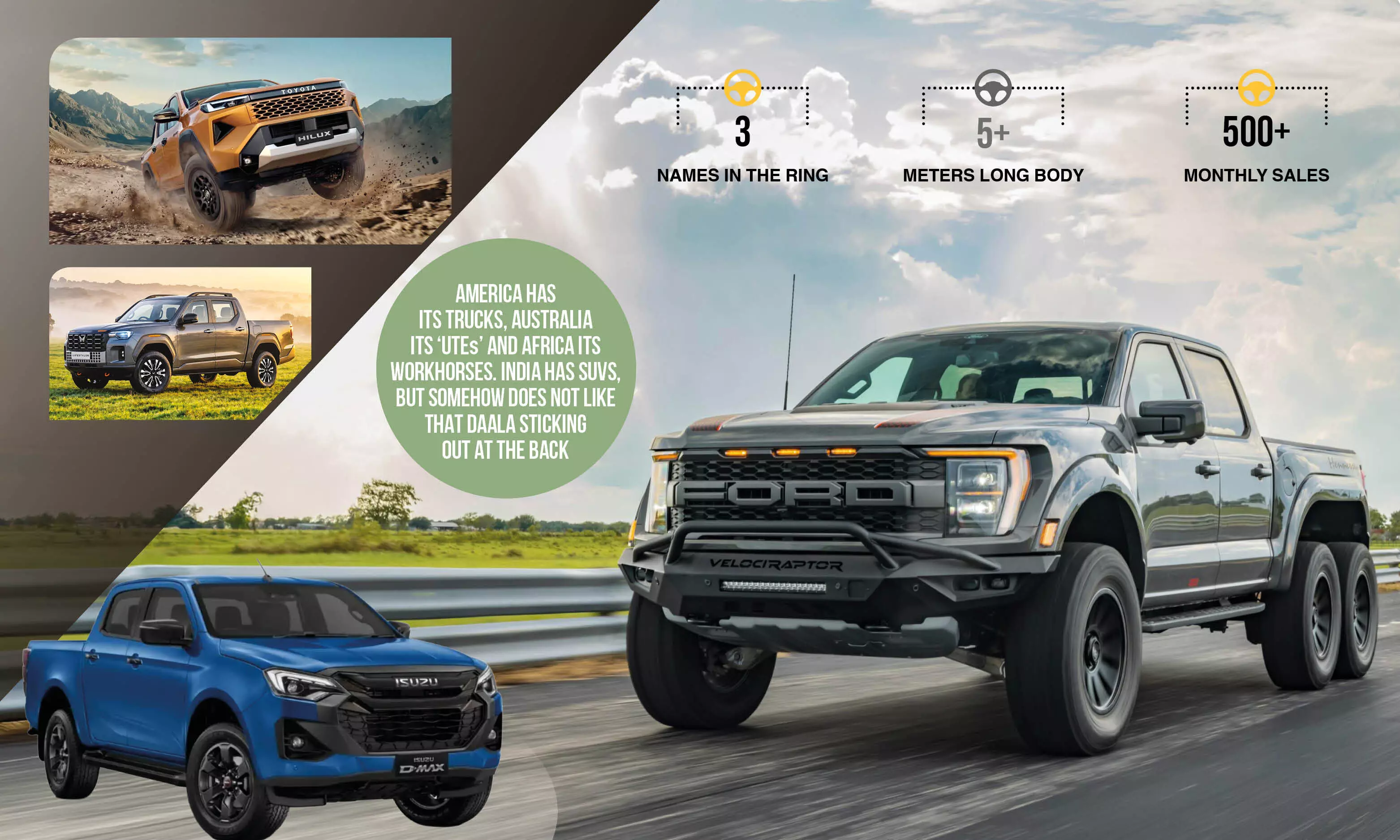
New Delhi, Sept. 26 -- There is something peculiar about the Indian auto market. We love big cars. We love SUVs. We love vehicles with enormous wheels, high ground clearance, aggressive grilles and enough road presence to hatchback drivers reconsider their life choices. We even love off-roaders that spend 99 per cent of their lifetime negotiating parking lots. But show India a pickup truck and India becomes practical.
"What will I do with it?" is a perfectly reasonable question. It is also a question that scores of Americans, Australians, Africans and Latin Americans stopped asking a long time ago. They fell in love with pickups.
Tiny Indian Clan
India has had pickups forever. The difference is that most of them have been bought because somebody needs to carry something. Farm produce. Cement bags. Building material. Shop supplies. Machinery. The pickup has traditionally been a vehicle of work, not aspiration.
The lifestyle pickup is a different animal. The Toyota Hilux and Isuzu D-Max V-Cross have occupied this tiny niche for years. Their sales remain minuscule compared with even moderately successful SUVs. And now, Mahindra is joining the party with the Scorpio Lifestyler. That is interesting not because M&M is entering a 500-odd-units-a-month market. It is interesting because it seems to believe that the pickup market may eventually become more than a rounding error.
The new Mahindra is being developed as a global product, aimed at Australia, New Zealand, South Africa, Africa, the Middle East and Latin America. Which raises a question: Why did India never take to the pickup?
World Got Trucked
In America, a pickup is not a commercial vehicle. It is the family car. It is the brute parked in the driveway. It tows a boat on Saturday, lugs furniture on Sunday and spends Monday commuting to work with nothing in the back. And nobody finds this contradictory. The truck itself has become part of American lifestyle.
Australia has its 'ute' culture. South Africa and some African markets have a strong tradition of pickups that combine work and personal use. Latin America has its own pickup-heavy markets, with the open bed being a feature, not a liability. India drove off in another direction many moons ago. It took the same basic idea of toughness and versatility and then put a large cabin around it. It then called it an SUV.
India Chose Comfort
Perhaps comfort is the reason. Indians want the appearance of ruggedness but the comfort of a drawing room. Air-conditioning is non-negotiable. The seats must be comfortable. The luggage must be protected. Relatives must fit in. Shopping must fit in. The dog must fit in. And nobody should have to worry about whether the luggage will still be there when they return from dinner.
An open cargo bed does not exactly inspire that confidence. It has another problem, in that it is exposed. To rain. To dust. To the sun. To curious hands. To everything else India and Indians can throw at it. The pickup 'daala' is brilliant, but only if you regularly carry things. If you don't, it can look like an expensive piece of unused real estate.
Too Big? Not Really
Then there is the size. The Hilux and V-Cross are big machines. In India, that is not always an advantage. Parking is difficult. Roads are crowded. Lanes are narrow. And there are moments when negotiating a supermarket basement in a large SUV requires holy awareness or the reflexes of a fighter pilot.
But size cannot be the only explanation. Indians buy large SUVs all the time. The Toyota Fortuner is hardly compact. So, India is willing to tolerate size when the vehicle gives it something more. And SUVs give India a lot more. Seven seats. A proper boot. A comfortable cabin. Family practicality. And social legitimacy.
The pickup throws up awkward questions: And what exactly is that empty bed in the back for?
Price, Then Desire
Price has not helped matters. The new Hilux starts at Rs 31.99 lakh ex-showroom. That is serious money for a vehicle that most Indians will use exactly like an SUV, except that they will have less enclosed luggage space. The Scorpio Lifestyler is being priced at Rs 19.79 lakh upwards, which could change the conversation. But cheaper does not always mean desirable. A buyer may happily spend Rs 20 lakh on an SUV because he knows why he wants it. The pickup, meanwhile, needs to create a reason.
This is where the global comparison gets interesting. The pickup became popular not simply because it was practical. It became desirable. It became associated with independence, outdoor life, adventure, work, recreation and an identity. India has the adventure. It has the road-trips. It has the 'look at my enormous vehicle' bit. What it doesn't is the cultural habit of wanting an empty space behind the back row.
Global Experiment
Mahindra clearly sees something beyond India. The Lifestyler is being developed for global markets and the company already has evidence that pickups can find customers abroad. It has announced a 35,000-unit order for Scorpio Pik-Ups from Indonesia for 2026. Mahindra does not need India alone to make a business case. It can build a global pickup, sell it where pickups are culturally accepted and offer it to Indians at a price that makes the package very compelling.
That may be the beginning of something new. Or it may produce a larger clan of attractive vehicles parked outside homes whose owners have no idea what to put in the back. That is the real test. The Indian pickup does not need to become a workhorse. It needs to become a lifestyle.
We buy SUVs for what they might do, not what they actually do. We buy off-roaders that rarely see mud. We buy seven-seaters that usually carry two people. We buy cars capable of 200 kmph and drive at 40. Perhaps we are ready for a pickup whose most important cargo is. Nothing.
In the end, the question is not whether India can use a pickup. Sure, it can. The question is whether India can learn to want one. And that, unlike the luggage in the back, cannot be delivered in 20 minutes.
Published by HT Digital Content Services with permission from Millennium Post.