
MADRID, Nov. 12 -- Spain witnessed widespread disruption on Wednesday as millions of workers participated in the country's first general strike in 14 years to protest soaring housing costs and stagnant wages, with demonstrations turning violent in Madrid and Barcelona as protesters clashed with police, set fires and damaged shops.
The 24-hour nationwide strike, organised by Spain's two largest trade unions, the General Union of Workers (UGT) and Workers' Commissions (CCOO), disrupted public transport, manufacturing operations and businesses across the country. The protests came less than three weeks before the November 29 general election, placing additional pressure on Prime Minister Pedro Sanchez's government.
The demonstrations, held under the slogan "Salaries. Housing. Prices.", drew hundreds of thousands of people onto the streets, with protesters demanding affordable housing, higher wages and stronger protections against evictions.
According to Reuters, around four million workers, representing approximately one-fifth of Spain's workforce, participated in the strike. Union leaders described the mobilisation as a success, although business organisations disputed the scale of participation.
In Madrid, approximately 120,000 demonstrators marched through the city centre despite heavy rain. Protesters carried placards shaped like houses and raised slogans demanding affordable accommodation as they moved through major streets.
Tensions escalated near Plaza de España, where riot police used tear gas, pepper spray and crowd-control projectiles to disperse groups of protesters. Clashes were also reported near Mercamadrid, the capital's main wholesale food market, where picketers confronted police.
On Gran Via, one of Madrid's busiest shopping streets, several major retailers, including Primark, H&M and Pull&Bear, closed their outlets as demonstrators gathered outside. Protesters carrying house keys demanded action against rising rents and property speculation.
Barcelona witnessed some of the most serious disturbances after a largely peaceful demonstration was followed by clashes between masked protesters and riot police.
The city government estimated that around 55,000 people participated in the main march, while housing activists claimed attendance exceeded 400,000.
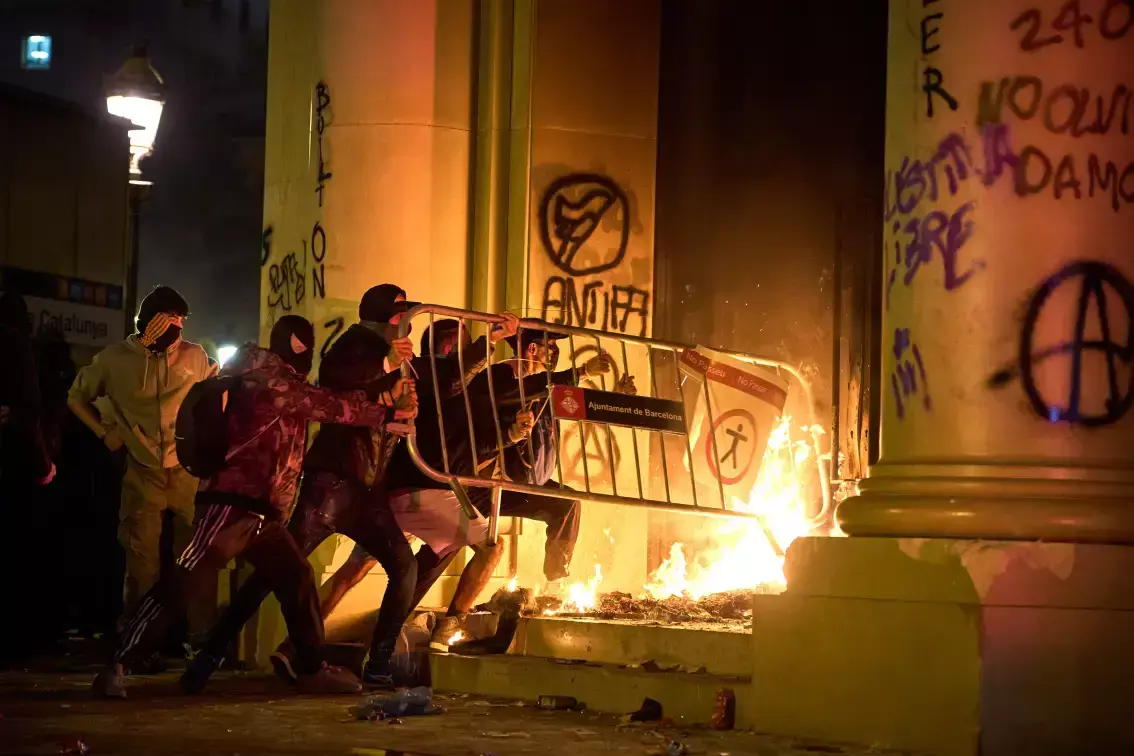
As the demonstration dispersed, groups of protesters began smashing shop windows, overturning rubbish containers and setting street furniture ablaze along Passeig de Gracia and surrounding streets.
An Apple Store was among the establishments targeted, with protesters attempting to force their way inside using a metal barrier. Fires were reported outside the premises, while police moved in to prevent further damage.
Videos circulating online showed burning barricades, shattered storefronts and protesters throwing fireworks, bottles and other objects at officers. Police responded with crowd-control measures as clashes continued into the evening.
Several businesses had already boarded up their windows or closed early in anticipation of possible disturbances.
Authorities reported at least 73 arrests nationwide by Wednesday evening, following more than 1,000 incidents linked to the strike, including blockades at offices and industrial estates and the burning of rubbish containers.
At least 20 people were reported injured during the unrest, according to Reuters.
Despite the violence in some areas, most demonstrations across the country remained peaceful, with thousands of workers and housing activists demanding government intervention to address the growing affordability crisis.
The strike significantly affected Spain's industrial and transport sectors. Union officials reported particularly high participation in automotive manufacturing, ports and other strategic industries, with stoppages reaching 90 per cent in some sectors.
Production was halted at Volkswagen and SEAT factories, while public transport services were reduced in several cities. Barcelona's metro and public buses operated limited services outside peak commuting hours.
Electricity demand also declined during the strike, reflecting reduced industrial activity.
Business organisations, however, questioned the unions' participation figures and maintained that many companies continued operating despite the disruptions.
The nationwide mobilisation was driven by growing frustration over Spain's housing shortage, rising rents and the increasing difficulty faced by younger workers in securing accommodation.
According to estimates from Spain's central bank, the country faces a shortage of approximately 750,000 homes, a figure that could exceed one million by 2028.
The average monthly rent has climbed to around 1,176 euros, equivalent to nearly 99 per cent of the average monthly income of a young worker, according to the Youth Council of Spain.
Housing activists argue that wages have failed to keep pace with property prices, forcing many young adults to remain with their parents or share accommodation well into their working lives.
The protests intensified following the eviction of 87-year-old Maricarmen Abascal from her Madrid apartment in September. She had lived in the property for more than seven decades but was reportedly unable to afford substantial rent increases.
Abascal died several days after being removed from her home, prompting public anger and renewed demands for stronger tenant protections.
Her case became a rallying point for housing campaigners, triggering demonstrations and an extended protest occupation of Madrid's Puerta del Sol square.
Activists have demanded measures to curb speculative property investment, strengthen protections against eviction and expand the availability of affordable public housing.
The strike also carries significant political implications for Sanchez, whose Socialist Party faces a difficult electoral contest later this month.
The prime minister called the November 29 snap election after his minority government failed to secure parliamentary approval for a package of housing measures.
Sanchez has defended his government's response to the housing crisis and argued that the strike reflects a broader demand for coordinated action by public authorities.
Opposition parties, including the conservative Popular Party and far-right Vox, have criticised the industrial action, accusing unions of politicising the housing issue ahead of the election.
Popular Party leader Alberto Nunez Feijoo questioned the timing of the strike and warned that unions risked becoming closely associated with the governing Socialists.
The unrest has brought Spain's widening housing affordability crisis to the forefront of the election campaign, with workers demanding immediate relief from rising living costs.
As businesses reopened and transport services began returning to normal, the demonstrations left the government facing renewed pressure to address housing shortages, rental inflation and the growing gap between wages and accommodation costs.
Published by HT Digital Content Services with permission from Millennium Post.