
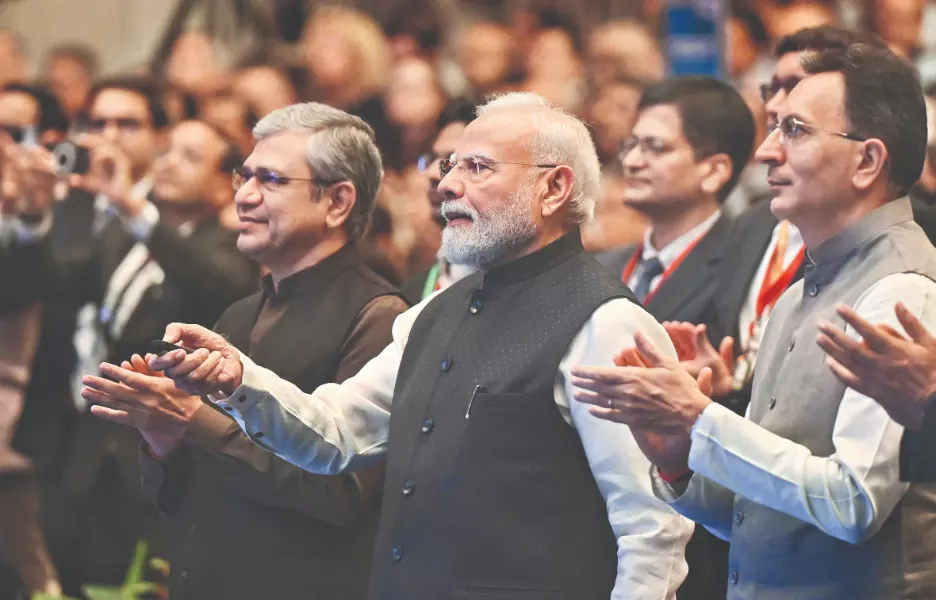
New Delhi, Sept. 17 -- SEMICON India 2026 opened on Thursday with Prime Minister Narendra Modi positioning India as a trusted destination for semiconductor manufacturing, as global companies announced fresh investments and partnerships across chipmaking, materials, packaging, research and talent development.
The three-day event, being held from September 17 to 19 under the theme "Silicon to Systems: Building the Ecosystem", comes as the government steps up its semiconductor programme. Electronics and IT Minister Ashwini Vaishnaw said investment interest of about USD 11-12 billion, or nearly Rs 1 lakh crore, has emerged following the launch of Semicon 2.0.
Approved in July 2026 with an outlay of Rs 1,27,500 crore, the second phase is expected to create close to one lakh jobs, with scope for more, Vaishnaw said.
Inaugurating the event, Modi said India was "taking every step needed to become a preferred destination for the semiconductor industry". He said chips made in India had started reaching customers domestically and overseas, while commercial production had begun at new facilities in Mohali and Surat.
Modi also pointed to India's 7.8 per cent quarterly GDP growth, a recent sovereign rating upgrade by a Japanese rating agency and the New Delhi Declaration adopted at the BRICS summit hosted by India this month. He urged semiconductor companies to expand R&D partnerships with Indian institutions, strengthen domestic supply chains, increase the number of fabless companies and locally developed intellectual property, and explore silicon photonics for AI infrastructure.
The government, he said, was also expanding solar and nuclear power capacity to support the growing energy requirements of AI data centres and semiconductor plants.
Vaishnaw outlined six pillars of Semicon 2.0: chip design, machines and materials, fabrication, advanced packaging, R&D and talent. The government plans to support at least 200 chip design startups and companies, compared with about 105 that attempted chip design under Semicon 1.0. Around 20 of those secured venture capital funding totalling about Rs 800 crore.
About 70,000 design engineers have already been trained against the first phase's 10-year target of 85,000. More than 400 universities have access to electronic design automation tools from companies including Cadence, Siemens and Synopsys. The new phase will also target one lakh skilled technicians and cleanroom personnel.
Global companies announced significant commitments. Applied Materials unveiled "India Vision 2035", committing USD 5 billion over the next decade, including a 140-acre semiconductor research park, while targeting a tenfold increase in India-based supply chain capacity by 2035.
Micron CEO Sanjay Mehrotra said the company would scale up its assembly and testing facility in India by a multiple next year. "Potential does not ship products. What I see in India today is execution," he said.
Tata Electronics announced partnerships with Nexperia, Fujifilm, Besi, Semiconductor Laboratory and Gati Shakti Vishwavidyalaya, covering manufacturing, materials, advanced packaging, technology and workforce development. The company plans 16 agreements during the conference with partners from Europe, Japan, Singapore and India.
Fujifilm will invest about Rs 800 crore to establish a semiconductor materials plant in phases at Dholera, Gujarat, supplying materials for Tata Electronics' upcoming fab.
Infineon Technologies said its confidence in India had "never been stronger", citing more than 1,200 customers and a 28 per cent increase in its Indian workforce over the past year to more than 2,800 employees. It also announced a Centre of Excellence with NIELIT.
Intel said India accounts for about a fifth of the global chip design and VLSI workforce, with more than 85,000 skilled professionals and over 355 universities offering advanced VLSI programmes.
NXP Semiconductors said India was evolving from primarily an R&D and talent base into a market for smart, connected systems. UST, meanwhile, said India could build an AI-native semiconductor ecosystem without having to retrofit older infrastructure.
The conference has more than 500 exhibitors from over 20 countries, showcasing technologies across the microelectronics ecosystem.
Published by HT Digital Content Services with permission from Millennium Post.