
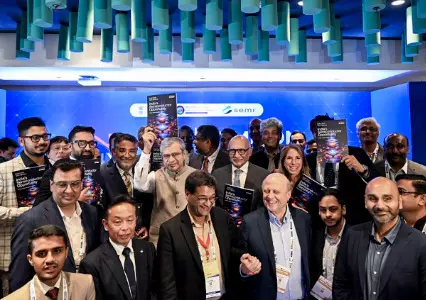
New Delhi, Sept. 18 -- The second day of SEMICON India 2026 witnessed 25 major announcements and partnerships focused on strengthening India's semiconductor ecosystem, encompassing manufacturing, materials, logistics, chip design, advanced packaging, power electronics & workforce development.
Union Electronics & IT Minister Ashwini Vaishnaw said the event witnessed a healthy business-to-business engagement, with several deals concluded between Indian and global companies.
While the first day of the event saw around 12,000 visitors, the exhibition now has over 600 exhibitors, including around 300 international exhibitors.
Among the highlights of the day was the unveiling of India's first indigenous System-on-Module, ISC-VEGA-SOM, launched by IndieSemiC in partnership with C-DAC.
This module comprises C-DAC's VEGA Thejas32 processor and IndieSemiC's LoRa-RF module and was developed as part of C-DAC's Industry Support Centre initiative. Vaishnaw said the product was a testament to the growing capabilities of Indian design houses to develop semiconductor products.
Several partnerships were announced to enhance local supply chains for materials and manufacturing.
Tata Electronics announced partnerships with INOX Air Products for high-purity gases, Sumitomo Chemical for materials, Kelington Engineering for fabrication infrastructure and Enomoto for lead-frame manufacturing.
The India Semiconductor Mission also signed an MoU with Nippon Express to bolster semiconductor logistics & supply-chain infrastructure.
In the power electronics space, L&T Semiconductor Technologies announced partnerships for silicon-carbide power modules, renewable-energy applications, AI data centres and smart-metering solutions.
Kaynes Semicon also announced partnerships in advanced packaging, semiconductor manufacturing and energy-metering chips.
Several partnerships were announced to enhance workforce capabilities in semiconductor design and manufacturing.
NIELIT signed agreements with Siemens EDA, Tata Electronics, Singapore Polytechnic International, SCL, IESA and SEMI University for this purpose.
The event also saw the launch of an indigenous 0.8-micron open-source Process Design Kit that has been uploaded on NIELIT's eChipHub portal.
Vaishnaw said the increasing international participation was
a sign of growing confidence in India's semiconductor ecosystem.
Published by HT Digital Content Services with permission from Millennium Post.