
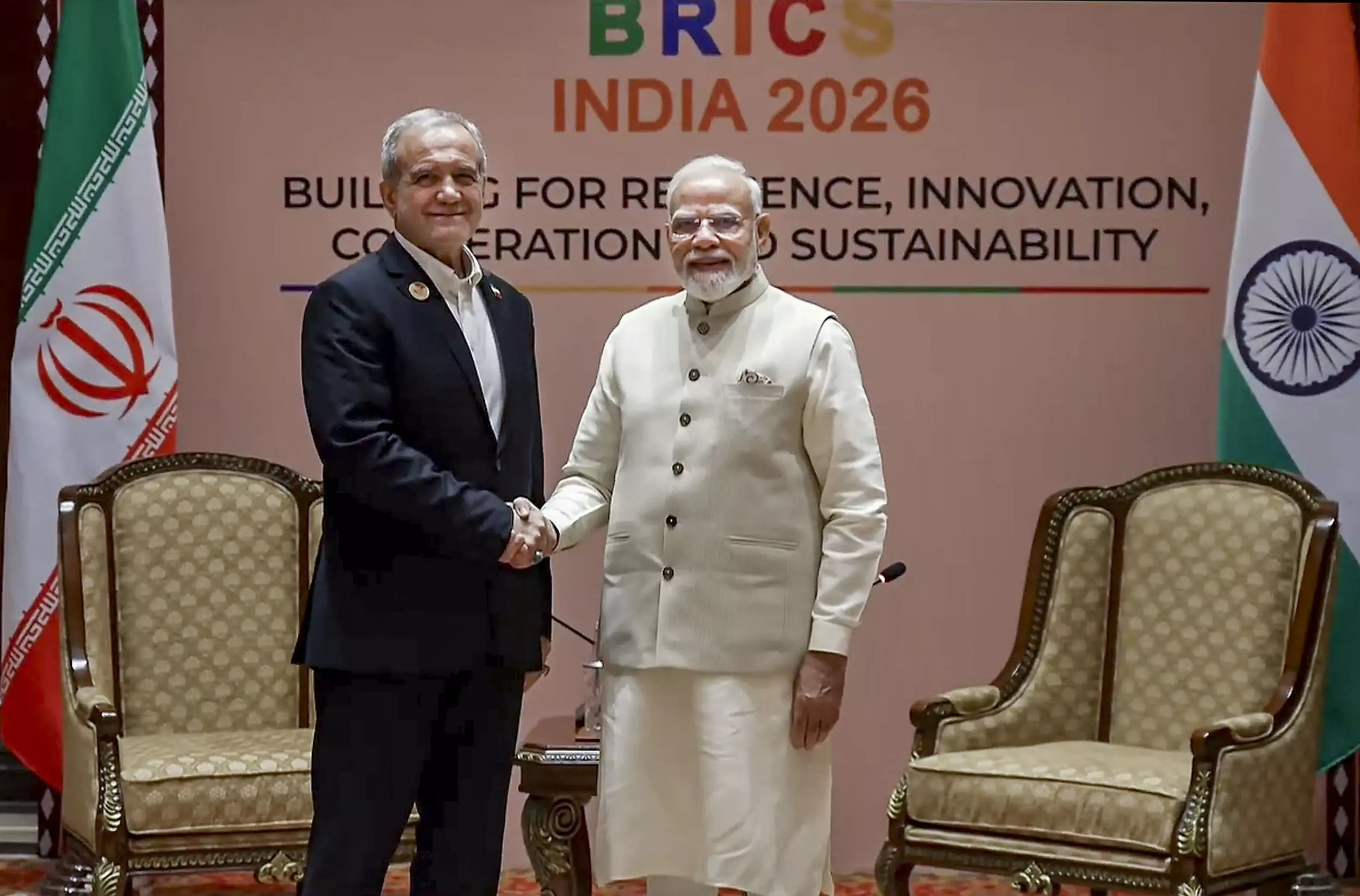
New Delhi, Sept. 11 -- Prime Minister Narendra Modi on Friday impressed upon Iranian President Masoud Pezeshkian to resolve the West Asia conflict through dialogue and diplomacy while highlighting the vital need for safe navigation and safety of seafarers.
In their talks, the two leaders also discussed various aspects of the India-Iran relationship. It was the second meeting between the two leaders in less than two weeks.
The talks took place hours after the Iranian leader arrived in the national capital to attend the BRICS summit. It is Pezeshkian's first visit to India as the president.
His visit assumes significance as it comes amid sudden spike in overall tensions in West Asia following the US slapping new punitive economic measures against Iran.
"The two leaders exchanged views on recent developments in West Asia. The Prime Minister reiterated India's consistent position that all issues must be resolved through dialogue and diplomacy," the Ministry of External Affairs (MEA) said.
The prime minister also "underscored the need for continued efforts to ensure lasting peace and stability in the region, safeguarding freedom of navigation and commerce, and the safety and well-being of seafarers", it said in a statement.
The MEA said Modi and Pezeshkian discussed various aspects of the bilateral relationship and that the Prime Minister thanked Iran for its regular, high-level participation in BRICS-related meetings despite the challenging circumstances.
"He noted the potential for BRICS in building the spirit of resilience, innovation, cooperation and sustainability among countries in the Global South," it said.
The MEA said Modi appreciated the continued cooperation between the two sides on issues of mutual interest in multilateral organisation, including BRICS.
Modi had met the Iranian leader on the sidelines of SCO summit in Bishkek on August 31 and conveyed that India supports all efforts toward ending the conflict.
In the talks this evening, the Indian side is learnt to have again underlined the importance of free flow of shipping. Global oil supplies have suffered severe disruptions following Iran's blockade of the Strait of Hormuz -- considered the world's most critical energy chokepoint, through which roughly 20 per cent of global petroleum flows.
Importantly, as per MEA, Modi also highlighted the significance of the freedom of navigation and trade and also emphasised the safety of seafarers. It indicates India's concerns related to the security of maritime trade routes and the implications of regional instability on India's energy imports, trade and shipping operations.
Consequently, for India, engagement with Iran has moved far beyond the realm of regular bilateral diplomacy. It now relates to India's larger strategic interests in energy security, maritime safety, connectivity, and access to the markets of Central Asia. The need for alternative trade routes becomes all the more relevant in light of the challenges faced by the traditional routes due to geopolitical rivalries.
The two sides also recognised the cooperation that exists between India and Iran on various issues at the multilateral level, which include the grouping of BRICS. As Iran's membership of the grouping is increasing, India sees room for engaging with Iran on issues of the Global South, economic cooperation, connectivity and even institutional reforms.
The quick sequence of Modi-Pezeshkian meetings also underscores the diplomatic strategy of India vis-a-vis the region. While keeping up with the strategic and economic partnership with Gulf nations and other regional/global actors, India has continued engaging Iran and promoting peace and not war.
With the regional security situation in West Asia remaining volatile, India's engagement with Iran will assume added strategic significance in the coming days.
Published by HT Digital Content Services with permission from Millennium Post.