
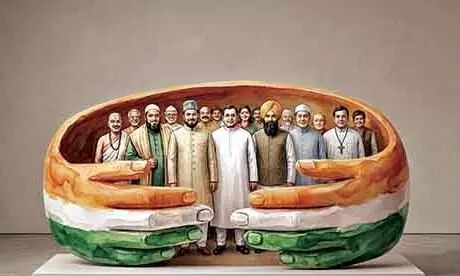
New Delhi, March 25 -- In contemporary public discourse, the word secularism is invoked with great frequency, yet it is seldom defined with adequate clarity. The term often becomes a rhetorical instrument in political debates rather than a carefully understood philosophical concept. Much of this confusion arises from the fact that the idea of secularism has travelled across civilisations and historical contexts, acquiring different meanings in different societies. What is commonly described as secularism in the West is not identical to the idea that evolved in India. Indeed, the Indian conception of secularism represents a profoundly distinct civilizational philosophy - one that neither denies religion nor banishes it from public life, but instead creates a framework in which multiple faiths may coexist with dignity and mutual respect.
In the classical Western understanding, secularism is largely defined by the separation of church and state. This principle emerged from a particular historical experience marked by centuries of conflict between religious authority and political power. In Europe, the dominance of ecclesiastical institutions often intertwined governance with theology, leading to intense struggles over authority, doctrine, and political legitimacy. The eventual emergence of secular states in the West was therefore an attempt to disentangle political power from religious control, ensuring that governance would remain neutral in matters of faith. Consequently, Western secularism frequently came to be interpreted as the removal - or at least the minimisation - of religion from the public sphere.
India's historical trajectory, however, unfolded along a very different path. Unlike societies shaped by a single dominant church, India evolved as a vast civilizational mosaic where numerous religious traditions flourished simultaneously. Over millennia, the subcontinent became home to an extraordinary range of spiritual paths: Hinduism, Islam, Christianity, Sikhism, Buddhism, Jainism, and Zoroastrianism, among others. Each of these traditions found space to grow, interact, and influence the cultural life of the land. The Indian social order, therefore, never required the rigid separation of religion from public life; rather, it demanded a philosophy capable of accommodating diversity without descending into conflict.
From this historical experience emerged a uniquely Indian understanding of secularism. In India, secularism does not signify irreligion, nor does it imply hostility toward faith. Instead, it embodies the principle that the state must maintain principled equidistance from all religions, granting equal respect and protection to each. The role of the state is not to erase religious identity but to ensure that no single tradition receives undue privilege or discrimination. In this sense, Indian secularism is less about exclusion and more about harmonious coexistence.
At the heart of this philosophy lies an important distinction between tolerance and acceptance. Tolerance, though often praised as a virtue, carries within it a subtle condescension. To tolerate something is to endure it despite disagreement - to say, in effect, "I believe you are mistaken, yet I will allow your beliefs to exist." Acceptance, by contrast, represents a far more generous and profound moral attitude. Acceptance recognises that different traditions may embody their own valid insights into truth and spiritual experience. It acknowledges that the diversity of human belief is not merely something to be endured but something that enriches the collective wisdom of humanity.
Few thinkers have articulated this distinction with greater clarity than Swami Vivekananda. In his celebrated address at the World's Parliament of Religions, he proclaimed that the Indian spiritual tradition does not merely preach tolerance but "accepts all religions as true." These words were not a rhetorical flourish; they reflected the deeper philosophical ethos of the civilisation from which he emerged. Swami Vivekananda presented to the world a vision of religious pluralism rooted not in reluctant coexistence but in genuine reverence for diversity. His message resonated profoundly because it expressed a civilizational truth that had long been embedded in the spiritual traditions of India.
Within this broader civilizational framework, Hinduism occupies a distinctive place. Unlike many religious systems founded upon a single prophet or unified doctrinal structure, Hindu thought developed organically over thousands of years. It encompasses an astonishing spectrum of philosophical schools, devotional practices, and spiritual disciplines. Within its expansive intellectual universe, one encounters rigorous metaphysical inquiry, fervent devotional worship, austere asceticism, and even strands of philosophical scepticism. The same tradition can accommodate the devotional poetry of saints, the metaphysical speculation of philosophers, the ritualistic practices of temple worship, and the contemplative silence of meditation.
This remarkable breadth gives Hinduism a uniquely accommodating character. It possesses the intellectual flexibility to embrace theism and atheism, personal devotion and abstract metaphysics, ritual practice and philosophical inquiry. Such plurality does not weaken the tradition; rather, it forms the very essence of its strength. The underlying intuition is that the ultimate truth may be approached through multiple paths, each reflecting the varied temperaments and experiences of human beings. In this sense, Hindu philosophy has historically fostered an environment where diversity of belief is not perceived as a threat but as a natural and enriching feature of spiritual life.
This pluralistic ethos also explains why India has historically served as a refuge for persecuted communities. Across centuries, groups fleeing religious oppression elsewhere found sanctuary on Indian soil, where they were able to preserve their faith and traditions. The presence of diverse religious communities living side by side became an enduring feature of Indian civilisation, reinforcing the principle that coexistence was not only possible but profoundly enriching.
Therefore, the Indian idea of secularism must be understood not as the negation of religion but as the harmonious orchestration of many religions within a shared civic order. It is rooted in the recognition that spiritual diversity is a permanent feature of human society and that peace can only flourish when this diversity is acknowledged with respect and fairness. The state, in this framework, becomes a guardian of equality rather than an arbiter of belief. Ultimately, what makes India truly secular is not the absence of faith from its public life but the generous civilizational space it creates for many faiths to flourish together. It is a vision shaped by centuries of cultural interaction, philosophical reflection, and spiritual experimentation. The pluralistic spirit embedded in Hindu philosophy - and articulated so powerfully by thinkers like Swami Vivekananda - continues to illuminate this distinctive model of secularism.
In an age when societies across the world grapple with questions of identity, belief, and coexistence, the Indian experience offers an enduring lesson: that unity need not demand uniformity, and that a civilisation confident in its own foundations can embrace diversity without fear. True secularism, in this sense, is not the silencing of faith but the creation of a civic culture in which many faiths may live, grow, and contribute to the moral richness of the nation.
Views expressed are personal. The writer is a Brain and Spine Surgeon, currently the Director of Neurosurgery at C. K. Birla Hospitals | CMRI, Kolkata
Published by HT Digital Content Services with permission from Millennium Post.