
New Delhi, Feb. 14 -- The worst time for any salesman is when he gets into the high curve of his spiel and realizes that the prospective customer is not just tuning off or turning acerbic, but looking vomit-ready. Alarmingly for those in the frontline inside India's car showrooms, customer heaves-ho are getting increasingly commonplace. Just as the sales litany is in full-bloom - mileage, touchscreen size, waiting period - today's buyers often cut in with the one question that does not belong to any car dealer's sanitized choreography. "What happens when things go wrong?"
We are not talking of scratches or service intervals, nor of flat tyres or busted speedometers. We are talking the real deal. Of the violent arithmetic of speed meeting steel. Ka-boom! In that dreadful moment, the glossy floor, bright lights and rehearsed rhetoric become irrelevant. The buyer is not picturing the glitz and oohs and aahs that dot modern car dashboards, but a rear seat occupied by people he loves. And his car is headed straight for the divider or a looming mountain wall. His car is no longer an object of aspiration. But tell me, is it a shield?
Brain Twist: Boom to Doom
This buyer hesitation underlines a slow but very real transformation in India's auto-consciousness. For decades, car buying revolved around thrift, resale value and gadgetry that photographed well in advertisements. Safety existed, but as a footnote. It was assumed, rarely interrogated. Today, a growing number of buyers are treating survivability not as a premium add-on, but as the moral centre of their purchase. At least in their mind. The question is no longer what a car can do on the road, but what it can endure when that road meets the roof.
The shift is emotional before it is technical. Viral crash footage circulates freely now. Stories of near-misses travel faster than sexy brochures. Families discuss protection in the same breath as affordability. The modern Indian car-buyer is suddenly becoming aware that ownership is not just about motion, it is about consequence too.
Power of Crash Stars
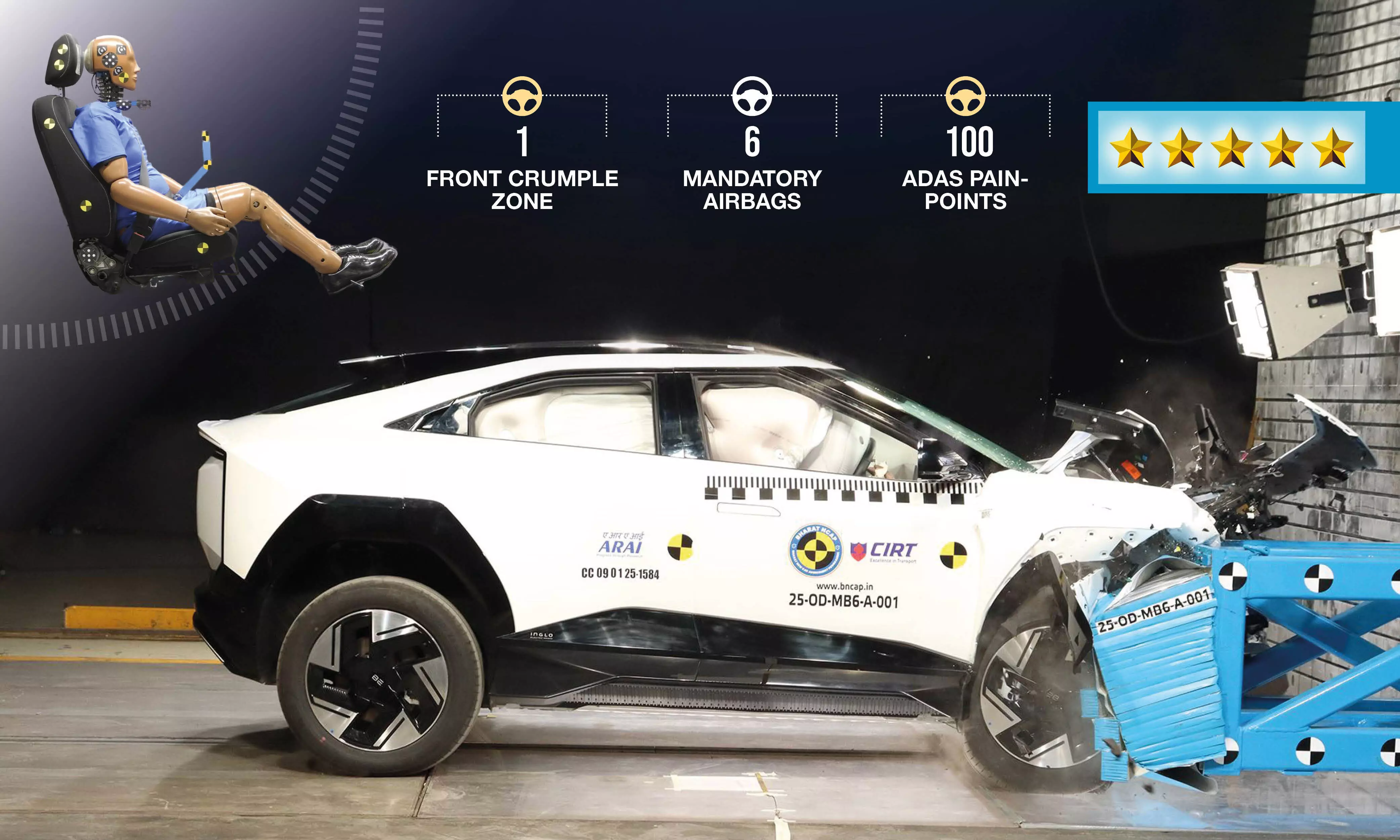
Into this changing psychology stepped Bharat NCAP, our desi crash-assessment framework that morphed the complex science of impact testing into a lingo even our the 'grameen' buyers could readily grasp. Stars. A visual shorthand running from a puny 1 to a muscular 5, one that turned safety from abstract engineering arguments to showroom currency. A 5-star safety badge now represents emotional weight. It suggests intent, diligence and the willingness on the part of carmakers to submit their creations to scrutiny. Even public admiration, if you recall Tata's ads for the new Sierra. A spanking yellow SUV head-slamming into its own buttery sister (brother?) as if for laughs. And to prove a point that is having surgical ramifications in India.
The cultural ripple has been fast. Ads croon crash ratings with the same gusto once reserved for fuel efficiency. Kitna Deti Hai has turned into Jaan Bach Jaayegi Kya. Sales staff are practising a new shtick on structural integrity alongside horsepower. Buyers are arriving armed with printouts and comparison charts. The presence of a rating does not just inform anymore. It shapes perception, nudging safety into the realm of brand identity.
This evolution echoes the groundwork laid by Global NCAP, a few of whose assessments exposed unsavoury truths about occupant protection. Bharat NCAP localized that scrutiny, aligning it with Indian regulatory realities and amplifying consumer agency. The result is a market in which crash test ratings are no longer a borderline concern for enthusiasts, but a mainstream benchmark.
Theatrics of Engineering
This said, public metrics inevitably invite performance. Bharat NCAP testing is voluntary, allowing carmakers to decide which variants should face (read 'are ready to face') the test. The optics are hard to ignore. Car firms submit their strongest contenders. 5 stars generate headlines, reinforce brand credibility and reassure buyers. Models that may not shine as brightly remain untested, leaving the public with a cheesy-holed safety map.
This dynamic is less conspiracy and more manoeuvring, a subtle reminder that ratings reflect both engineering prowess and strategic presentation. A high score is meaningful, but not a stated guarantee. Differences between trims, equipment levels and structural execution can influence real-world outcomes. A well-equipped top variant earning top marks does not percolate down to budget siblings delivering identical protection.
There is also the temptation to conflate visible safety hardware with holistic crashworthiness. Airbags, stability control and child-seat anchors are critical layers, but they function best when paired with a robust structural shell. After all, impact energy must be absorbed and redirected with precision. Without the underlying integrity, technology becomes ornament, not armour. The star system rewards overall design, but discerning buyers understand that the badge is only an entry point to murkier questions.
More Than Just Hot Air
For all the scepticism, the progress is real and measurable. Indian carmakers are now investing more in crash engineering, treating occupant protection as a core design pillar, not a policed obligation. Companies like Tata Motors are demonstrating that structural resilience need not be confined to premium variants. Maruti Suzuki has publicly expanded its devotion to safety, betraying a realization that consumer expectations are shifting.
We are not speaking of cosmetic adjustments but of a deeper recalibration of priorities. Buyers are demanding answers by asking informed questions. The psychological frame of a car is evolving - from a mobility appliance to a protective capsule navigating chaotic urban ecosystems.
The societal implications are difficult to overstate. India continues to shoulder a heavy burden of road trauma. While crash ratings cannot weed out collisions, they do influence survivability in critical times. Each incremental improvement in structural integrity, restraint design or energy management compounds into lives altered or saved. The once-peripheral topic of safety awareness is now part of a national conversation about responsibility on our dangerously crowded roads.
Cooking Up a Culture
The challenge is to convert momentum into durable culture. Stronger testing protocols, wider participation and transparency around variant safety would deepen public trust. Expanding tests to include pedestrian protection and a mandate on advanced driver-assistance systems would align domestic benchmarks with evolving global expectations. Automakers face a defining choice. Safety can remain a marketing crescendo, wheeled out only for flagship announcements, or it can become a baseline philosophy embedded in every design blueprint.
The market is displaying its appetite with clarity. Consumers are interpreting crash ratings not as decorative stars but as indicators of seriousness. of whether or not a company respects the physics of impact. For India, the lesson is practical as well as moral. A five-star badge should provoke curiosity, not complacency. Buyers must ask what lies beneath the rating. Regulators must close informational gaps. Automakers must treat protection as a non-negotiable promise, not a competitive flourish. No buts. No ifs. No pauses.
Because any showroom pause can stand out like a pregnant virgin, with a customer asking what happens when things go wrong. The answer has to be all-pervading, for it defines more than a sale. It reflects an industry's maturity, a society's priorities and a shared recognition that progress is measured not only in speed and features, but also in people reaching home safely. 'Kitna deti hai' is not dying, but it has certainly developed a stutter.
Published by HT Digital Content Services with permission from Millennium Post.