
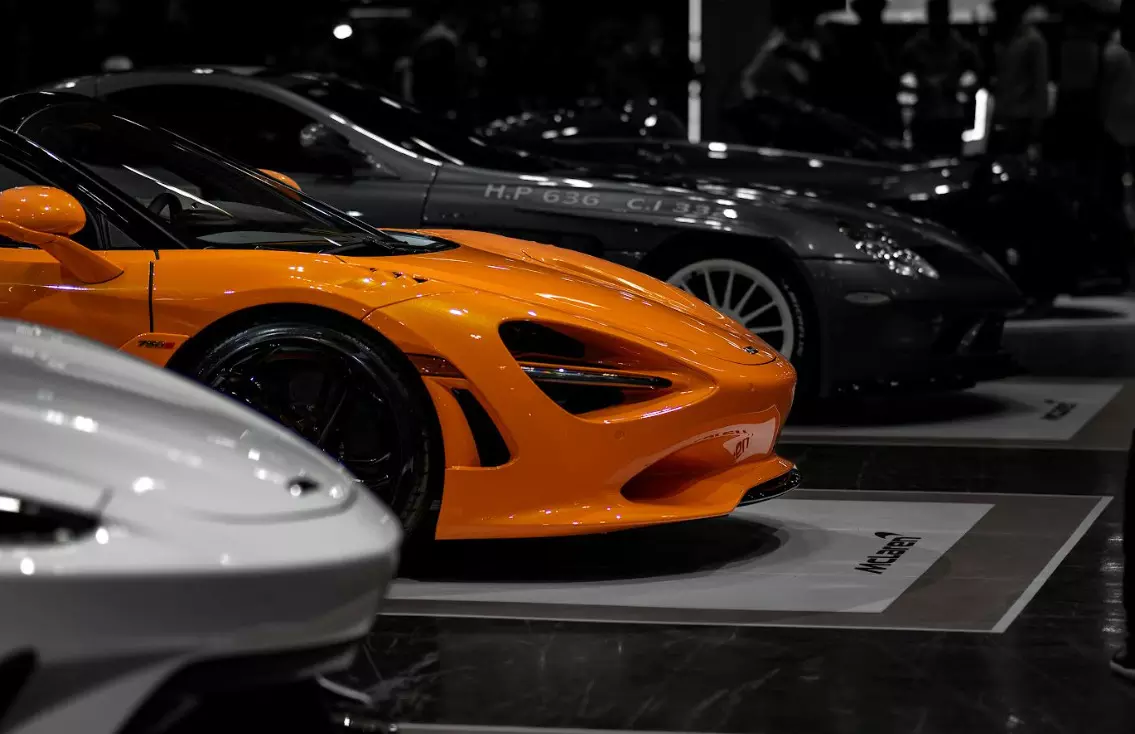
New Delhi, Sept. 19 -- There is something almost indecent about watching a legend check its bank balance. Take McLaren Automotive, one of the greatest names in motor racing. Alain Prost drove for it. Ayrton Senna drove for it. Lewis Hamilton drove for it. Championships, podiums, technological audacity and some of the most memorable machines ever to emerge from Britain have all carried that famous name.
Yet, somewhere between the chequered flag and the balance sheet, the maths went horribly wrong. McLaren Automotive has suffered enormous losses, including more than £900 million in 2023. Its financial troubles have required repeated injections of capital, changes in ownership and restructuring. Its latest saviour, Abu Dhabi-backed CYVN Holdings, has committed billions to rebuilding the business.
Now comes the next act: a £500-million investment in British manufacturing, a new assembly facility, more in-house powertrain capability. and soon, sacrilege to some traditionalists, McLaren's first SUV. The irony is delicious. A company whose name is synonymous with racing cars that hugged the tarmac at absurd speeds needs a family-friendly, high-riding vehicle to help pay the bills.
That is not the death of McLaren. Far from it. It is the downsizing of a legend into a business that makes economic sense.
Podiums to Pounds
Motor racing is fantastic at creating mythology, but far less so at creating profits. That distinction has haunted McLaren. A Formula One victory can make a brand desirable across the world. It can fill showrooms with lust and internet pages with envy. It can turn a badge into a cultural object. But the accountants remain unimpressed, for they do not accept podiums as payment.
McLaren's accounts tell the story more brutally than any racing statistic. The company has remained loss-making for years, although the scale of the losses has fluctuated. Hence, the response is quite rational. Build more cars. Reach more customers. Spread development costs across a larger volume. Enter the lucrative SUV market, just as Ferrari, Lamborghini and Aston Martin have done.
Except that rationality can look strange wearing a McLaren badge.
The automaker will focus on hybrid power rather than immediately chasing a fully electric range, while its SUV will bring in customers who may admire McLaren but cannot realistically live with a two-seat supercar. The joke, then, writes itself: McLaren may have discovered that the road to financial salvation has four doors and a large boot.
Enter the Giant
Then there is Volkswagen. If McLaren is the boutique aristocrat discovering that kingship is expensive, VW is the empire finding out that empires are steep to maintain. VW spent decades assembling an extraordinary collection of brands-VW, Audi, Porsche, Lamborghini, Ducati, Bentley, Škoda. There was a time when the logic was unassailable: if one brand did not satisfy a customer, another would. Today, that portfolio looks less like a trophy cabinet and more like a cupboard being cleaned out.
Volkswagen is in the middle of one of the biggest restructurings in its history, battling excess capacity, weak profitability, fierce Chinese competition and the enormous costs of transitioning its business. The group is contemplating further job cuts, while its German plants face the possibility of losing production or being repurposed. In a way, a giant is learning that size can be an asset only till the moment it becomes a liability.
The Indian Mirror
India provides a neat little mirror to the VW story. Škoda Auto Volkswagen India and JSW Group have signed a non-binding MoU to explore a strategic partnership, with a proposed 51:49 structure that would give JSW the majority stake if the final transaction goes through. The stated objective is to strengthen competitiveness, localisation and the product portfolio.
There is nothing surprising about a global firm seeking a stronger local partner. It is the timing that is revealing. VW and Audi have superb products; that has never been the problem. But India is an unforgiving market. Products have to be priced right, volumes have to justify the investment, service and localisation have to work, and brands have to remain visible in a hyper-competitive market.
Škoda's Kylaq has provided a bright spot. But one product cannot carry an entire empire.
That is why the JSW proposal matters beyond the mechanics of a prospective 51:49 partnership. It is another example of a global giant deciding that it does not have to do everything itself. Sometimes, the cleverest thing an empire can do is invite somebody else into the palace.
Selling the Jewels
Then there is the itchy matter of the jewels. Porsche completed the sale of its stakes in Bugatti Rimac and Rimac Group on September 9, bringing in about €1 billion. Porsche says the move is part of its effort to focus on its core business; €250 million of the proceeds will go towards pension obligations.
There is nothing desperate about selling an investment. Companies buy and sell assets all the time. And Porsche's explanation-concentration on the core business-is legitimate. But put the transaction beside VW's restructuring, its job cuts, plant rationalisation and the pressures facing its European business, and the symbolism becomes difficult to ignore. Bugatti is not exactly a spare tyre. It is Bugatti.
Somewhere at this point, the McLaren and VW stories unexpectedly meet-one a racing legend trying to make road cars profitable, the other an industrial giant trying to decide which pieces of its empire still deserve a place in the future. Neither is disappearing. And that is precisely the point.
Legends do not necessarily die. Sometimes they are recapitalised. They restructure. They sell a jewel or two. They build an SUV they once might have laughed at. And they simply become smaller. There is nothing shameful in that. The auto industry is littered with companies that refused to shrink when they should have, and disappeared altogether as a result.
The test for McLaren and VW is not whether they can preserve every piece of the past. It is whether they can sacrifice enough of it to remain relevant to the future. Because a crown can survive the loss of a jewel. The danger begins when the king discovers that he has been selling the jewels simply to keep the crown on his head.
Published by HT Digital Content Services with permission from Millennium Post.