
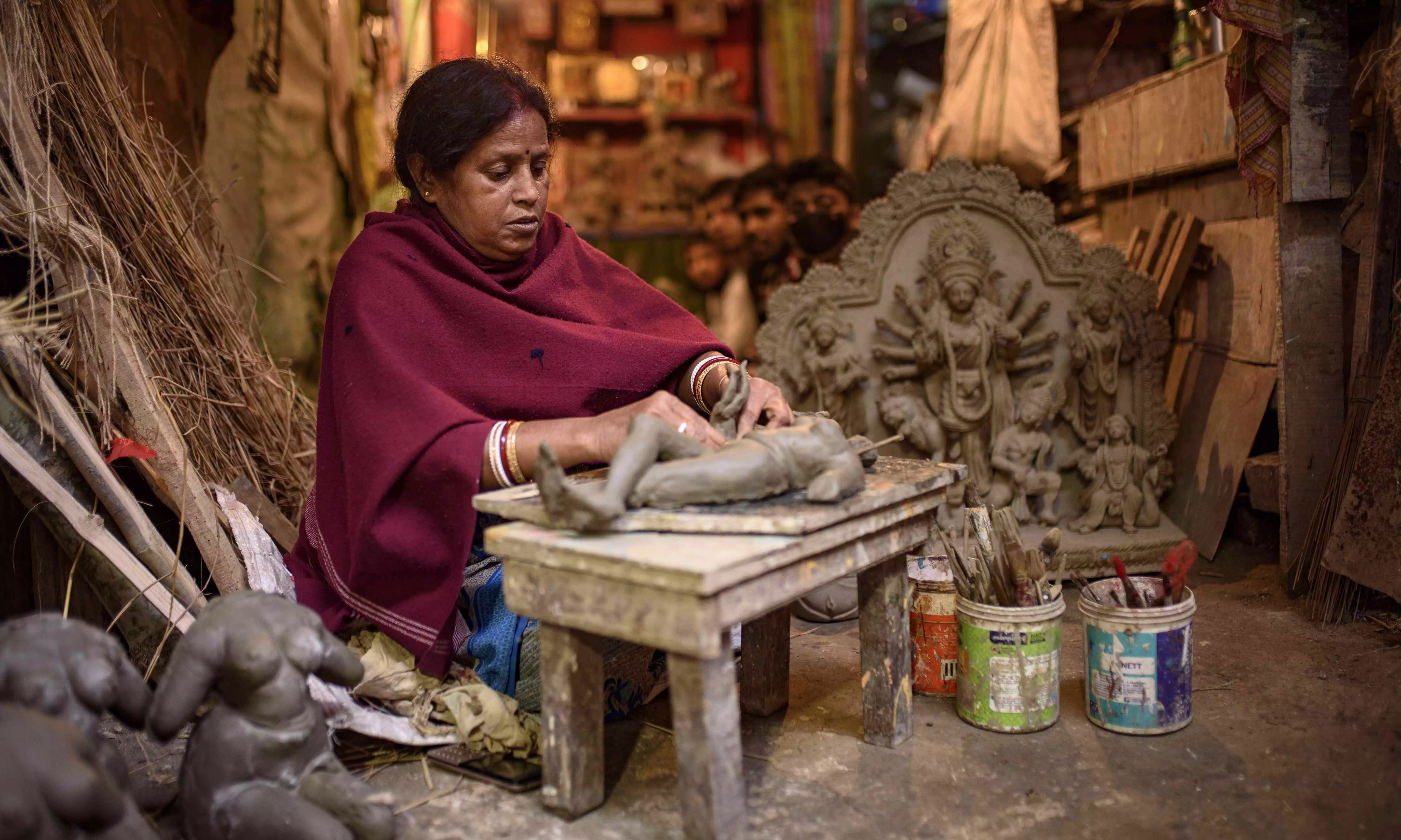
New Delhi, March 9 -- A pathbreaking repertoire for the first time celebrates 'Indian Women at Work' by one of India's finest visual storytellers, Kounteya Sinha, that has taken a mammoth 124 days to create and over 40,000 kilometres of travel, is all set to regale the art world in Kolkata on March 10 at the iconic Kolkata Centre for Creativity.
'Blurring of the Margins: Women at Work', a landmark piece of work, will unveil over 70 photographs taken from the farthest regions of India - from Kerala to Kashmir, Manipur to Arunachal Pradesh, Uttar Pradesh to Rajasthan, Karnataka to Bengal documenting for the first time - the wave of women participation at work across sectors, becoming the main driving factor for India's economy.
Commissioned by artist Jitavati Das, journalist and photographer Kounteya Sinha searched out the most incredibly inspiring stories from across the country and photographed them in his inimitable style - raw and real.
From the carpet weavers of Mirzapur who dressed up India's new parliament building to the Women's Soccer Team, to saffron farmers of Kashmir to Katha artists of Bengal, from the first women vice chancellors to those heading India's administrative services to fisherwomen in Kerala and Andamans, to coffee planters of Karnataka, from 'dokra' artists in Naxal infested villages of Bastar to a stone pelter turned football goalkeeper of the women's team, the repertoire is gigantic.
The who's who seem to be flying into Kolkata to open the show. From the Chief of Mission of the UN Women in East Timor Nishtha Satyam to Bollywood bigwigs Divya Dutta, Shantipriya and Lilette Dubey; the Maharaja of Ayodhya Yatinder Mishra to Padma Shri and Arjuna awardee Mouma Das and the first Indian woman to win best director at Venice Film Festival last year Anuparna Roy to Bengal's most talented singer, actor and lyricist Anirban Bhattacharya of the 'Hooliganism' fame.
The stories in this show are powerful. An illiterate Rajasthani farmer who took to work after her husband passed away, Satbiri Dev did the impossible - she successfully planted over 6,000 olive trees on the edge of the Thar Desert, defying doubts about cultivating olives in the region. She then started producing one of India's most virgin olive oils from her farm. In one of the most powerful stories of women's empowerment, 'Dhaak', which is the drum and is synonymous with Durga Pujas, was always intrinsically played by men. Gokul Dhaki trained women from his village to become self-reliant through the instrument and today has over 100 women, who are professional 'dhakis' in a remote village of Bengal and the sole breadwinners for their families.
The repertoire also looks at Afshan, a stone pelter-turned footballer, who is the captain and goalkeeper of the J&K women's football team and also plays for a Mumbai club and has inspired a Bollywood biopic.
'Patron of the Show' by Jitavati Das, Founder of the non-profit Sheelpovaas Foundation, said, "'Blurring of the Margins: India at Work' is a landmark photographic exhibition that explores both visible and hidden economies led by Indian women. It advocates for placing women's labour at the centre of current development narratives. The concept began when I founded Sheelpovaas Foundation to support rural artisans, which led to the development of this repertoire. As a female artist, this project is both personal and essential. My work with rural artisan communities and women-led informal economies across India raised a persistent question: why is women's labour, a cornerstone of economic production, still so often overlooked?"
"At its core, 'Blurring of the Margins' addresses a persistent imbalance: women's work is often informal, undervalued or hidden within supply chains, diminishing their recognition. Culturally, the exhibition celebrates skill; economically, it highlights productivity. Structurally, it affirms that women are central to development. The true significance lies in rewriting the narrative and shifting the structure. This exhibition challenges outdated perceptions by presenting women's labour as a driving force in the economy rather than merely a supporting role," she added.
The exhibition that features 73 photographs is being directed by Oiendrila Ray Kapur. Giving a slight peek into her creative curation of the space, Kapur said, "Growing up in a village environment, I've always seen women as the epitome of Durga - 10 hands juggling life like a pro. I've watched women with just as much dexterity at craft and muscle power in the fields as men. I've watched them carry their children tied to their chests while they went about their day as if the little human they carried wasn't an extra load but a blessing of the universe."
"My aim was to portray this side of a working woman in India. A home they leave behind every day to go to work. I have decided to showcase Kounteya's inspiring repertoire through the everyday unseen effort of hanging out clothes. We printed these photographs on cloth and hung them out on clotheslines. A simple tribute to the woman who does it all," she added.
Oiendrila further shared, "Women have always been a part of the workforce quietly, silently, more out of need than aspiration. I think it is important to acknowledge their presence and resilience and encourage their aspirations to grow beyond their boundaries."
"Art is an absolute medium for storytelling. While words tell you the exact story, art always leaves room for imagination and interpretation. Kounteya Sinha is a master storyteller of human emotions. He tends to find moments in the ordinary and pierce deep into his heart to capture an emotion that would have been lost without care. He finds the person behind the face, the emotions buried deep within their souls, the untold stories in their eyes - only because he asked, he saw, he felt in his heart and he captured all of it in a single shot," she commented.
The shift from 'women development' to 'women-led development' remains a key focus for India's economic growth - with the country experiencing a significant surge in female workforce participation and the Labour Force Participation Rate (LFPR) for women rising from 23.3 per cent in 2017-18 to 41.7 per cent in 2023-24, nearly doubling.
Das added that India's long-term growth is directly tied to women's participation. She signed off by saying, "Women comprise nearly half of India's human capital, yet female labour force participation remains below potential. This gap is not just a social statistic; it is an economic constraint. When women join and remain in the workforce, three measurable shifts occur: Productivity rises because the talent pool expands. Household incomes increase, strengthening consumption demand. Enterprise formation is increasing, especially in the small and medium sectors. Economic studies estimate that improving gender parity in workforce participation could add hundreds of billions of dollars to India's GDP over time. However, the issue extends beyond statistics; structural change is at stake. Excluding women weakens growth, while inclusion strengthens and stabilises it. If India seeks to be a stable, competitive and high-growth economy, full economic participation of women is essential. It is foundational."
Published by HT Digital Content Services with permission from Millennium Post.