
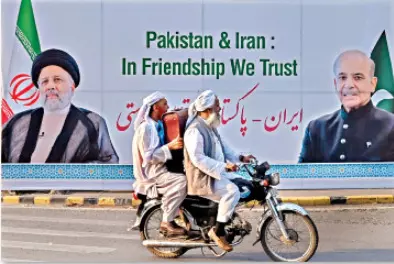
New Delhi, March 15 -- Pakistan seems to be confused as to how to deal with the recent crisis emanating from developments in the aftermath of the US and Israel attack on Iran and the elimination of Khamenei. There are mixed signals within the Pakistani establishment as to whether to take a pro-US stance or a pro-Iran stance. Pakistan appears to be in a quandary: if it criticises Israel/US for the military incursion inside Iran, it will incur the wrath of the US; and if it does not, it faces a hostile reaction within Pakistan from the clerics and the Shia community in particular over the killing of Iran's spiritual leader.
As soon as news of Khamenei's death reached Pakistan, a huge mob gathered in front of the US Consulate in Karachi and held violent demonstrations protesting against the attack and the extermination of Ayatollah Ali Khamenei. The law-enforcing authorities had to resort to firing, killing 22 people and causing huge discontentment among a large segment of the Pakistani population. Similar demonstrations were held in front of the US Consulates in Lahore and Peshawar. Both the consulates have since been shut down, and non-essential embassy employees have been sent home.
Obviously, there is considerable discontent among Pakistanis amid unconfirmed reports that Pakistan had allowed its airspace to be used by US aircraft or missiles to attack Iran. Pakistan's political and military leadership have been claiming a close relationship with the US for the last year, and now they are going through a testing time. The military hierarchy, particularly Field Marshal Asim Munir, is on the defensive because all along he basked under the compliments of President Donald Trump, who had not only hosted a lunch for him last year but also occasionally praised him. Prime Minister Shehbaz Sharif and Asim Munir are both facing criticism in their domestic constituencies for their alleged roles in handling the Iran-linked crisis. Their tall claims of proximity to the US seem to be getting deflated now, and they are in the midst of a delicate balancing act.
Meanwhile, the eight Islamic nations targeted by Iran for being allies of the US are also expecting some form of solidarity from Pakistan for being victimised. Pakistan has no clue as to how to address this dilemma, as the military skirmishes are heating up and the region is steadily becoming more volatile, pushing Pakistan further on the back foot. In an apparent damage-control exercise, the government on March 4 told political and parliamentary leaders that Pakistan will avoid getting directly embroiled in the ongoing Iran and US-Israel conflict, while pursuing diplomatic efforts aimed at de-escalation. The assurance came during the closed-door briefing organised for the heads of political parties and parliamentary leaders at the Prime Minister's House.
Chaired by Prime Minister Shehbaz Sharif, the briefing was attended by representatives of the Pakistan People's Party (PPP), Muttahida Qaumi Movement-Pakistan (MQM-P), Jamiat Ulema-e-Islam-F (JUI-F), Balochistan Awami Party (BAP), and others. Key attendees included PPP Chairman Bilawal Bhutto Zardari, JUI-F Chief Maulana Fazlur Rehman, Deputy Prime Minister and Foreign Minister Ishaq Dar, National Assembly Speaker Sardar Ayaz Sadiq, Deputy Speaker Ghulam Mustafa Shah, Information Minister Attaullah Tarar, Law Minister Azam Nazeer Tarar, Planning Minister Ahsan Iqbal, and Minister for Parliamentary Affairs Dr Tariq Fazal Chaudhry. Also present were Pakistan Muslim League-Nawaz's (PML-N) Pervaiz Rasheed, Sherry Rehman, and Naveed Qamar. Other party leaders included Khalid Maqbool Siddiqui from the MQM-P, Faisal Subzwari, Farooq Sattar, Abdul Aleem Khan from the Istehkam-e-Pakistan Party (IPP), Khalid Hussain Magsi from BAP, and Pakistan Muslim League (Quaid-i-Azam)'s Chaudhry Salik Hussain and BAP's Manzoor Ahmed Kakar. However, the Pakistan Tehreek-e-Insaf (PTI) and part of the grand opposition alliance stayed away from the in-camera briefing, drawing a strong reaction from Prime Minister Sharif, who alleged that the PTI often prioritised politics over national interests.
Significantly, according to an editorial on the subject by Dawn, the most widely read English daily in Pakistan, the country finds itself at a similar juncture vis-a-vis its foreign policy. A brutal war is being waged against its western neighbour, Iran, and Pakistan has feebly condemned the aggression against it. Yet, it is also a fact that Pakistan has a defence pact with Saudi Arabia, which, along with other Gulf Cooperation Council (GCC) states, has come under Iran's counter-attack. Foreign Minister Ishaq Dar has claimed that the defence pact was mentioned to Iran and that Tehran had tempered its attacks against the kingdom. He also condemned the targeting of GCC states. Pakistan has long-standing cultural, economic and political links with the sheikhdoms, and keeping quiet was not an option. Where the US is concerned, while the American-Israeli aggression against Iran is utterly indefensible, Pakistan has condemned the hostilities in general terms, perhaps not wanting to rub President Donald Trump the wrong way. It is indeed a tough situation for Pakistan to be in, as it has to maintain a delicate balancing act between friends, neighbours and benefactors while condemning aggression against a sovereign state and the assassination of its leadership. It is therefore expected that solid suggestions were made at the in-camera briefing that could help Pakistan ride out this perilous regional storm. This comes even as Pakistan signalled that it could get drawn into the Iran conflict due to the defence pact with Saudi Arabia.
Pakistan's indecisive stance in handling the Iran conflict with the US and Israel could perhaps cost it dearly. Any tilt towards Iran would mean certain angst from the US, and any visible soft corner for the US is bound to anger Iran, which is strategically located on Pakistan's west and may not hesitate to hit back hard when driven against the wall. Pakistan, as it is, is embroiled in a deep military conflict with Afghanistan, and any inept handling arising out of the Iran crisis may further compound its security concerns. According to analysts, at this juncture, Pakistan cannot afford to do that. During its recent military engagements with Afghanistan, the trilateral pact has not come into effect, as Saudi Arabia and Turkey-the other two partners in this defence treaty-remained indifferent to Pakistani concerns. Therefore, Pakistan is deeply entrenched in a quagmire as the Iran-Israel-US conflict assumes serious proportions.
Views expressed are personal. The writer is a retired IPS officer, Adviser NatStrat, and a former National Security Advisor in Mauritius
Published by HT Digital Content Services with permission from Millennium Post.