
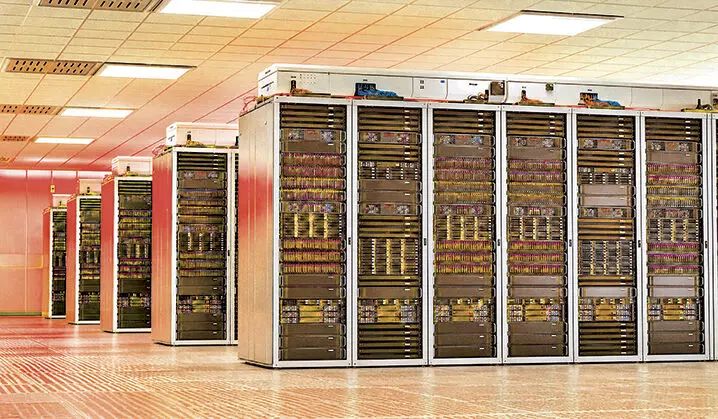
New Delhi, Sept. 8 -- India's enthusiasm for data centres comes with a premium. They consume enormous amounts of electricity and precious water and can have a serious environmental impact. There is already considerable backlash against new data centres in parts of the United States, making it legitimate to ask: while data centres are being restricted there, why is India extending a red-carpet welcome with fiscal and non-fiscal incentives, tax benefits, land and easier clearances? Romanticism over data-centre projects without understanding their long-term repercussions would not be in the correct order. But data centres have their merits too, and the economic and strategic reasons behind India's approach deserve to be weighed carefully.
India is still building its digital and AI infrastructure. It does not want to remain merely a country where sons of the soil become software engineers and build applications for foreign companies. It now wants to capture the physical infrastructure layer too - servers, cloud computing, AI compute, storage and networking. India's data-centre capacity has grown from roughly 375 MW in 2020 to around 1,500 MW in 2025. If global companies are willing to spend billions here, bringing investment, technology and infrastructure, there is a strong case for welcoming them. Such investments can also attract AI companies, startups, semiconductor and electronics suppliers, financial services and enterprise-technology businesses, creating an ecosystem around these facilities.
Foreign exchange is another straightforward motivation. Investments in data centres bring foreign capital into infrastructure, fibre networks, servers, renewable-energy generation and maintenance without India having to fund the entire infrastructure itself. There is also intense competition for such investment. Companies can go to Malaysia, Singapore, Indonesia, the Middle East or elsewhere if India does not seize the opportunity. India could then lose billions of dollars in investment, high-value digital infrastructure, AI computing capacity and associated industries.
But the uncomfortable question remains: why should India accept environmental and infrastructure costs that communities elsewhere increasingly resist? Google's planned $15-billion AI/data-centre investment in Visakhapatnam has already attracted criticism over land, water and subsidies. India is essentially making a policy calculation that the long-term economic and strategic benefits will outweigh these costs. Whoever controls chips, electricity, data centres, cloud, AI models and networks will command enormous economic and geopolitical power.
The real question, therefore, is not why India wants data centres, but who captures the benefits and who ultimately pays for the infrastructure. India offers rapidly growing AI demand, a huge engineering workforce, relatively inexpensive land, expanding renewable-energy capacity, improving fibre connectivity and a massive consumer and enterprise market. At the same time, American data-centre developers are encountering electricity and grid constraints. India can turn this situation into an opportunity - provided it does not simply import the resource costs while exporting the profits.
A better model can be seen in Jamnagar, Gujarat, where Reliance and Meta have signed an MoU and Meta is leasing a 168 MW AI-enabled data centre. The facility is designed around renewable energy with desalinated seawater for cooling, and Meta will cover the energy and water costs supporting its facility. That is a better proposition than the government providing cheap electricity, subsidised water and land, taxpayers paying for grid upgrades, and the foreign company ultimately taking the computing profits. If foreign companies genuinely pay for the resources and infrastructure they consume, the economics become favourable for India.
There is also a need to be cautious about tax holidays. The 2026 Budget proposes a tax holiday until 2047 for qualifying foreign companies providing global cloud services using Indian data-centre infrastructure. That is difficult to justify without stronger evidence of corresponding benefits. The government may be betting that collecting less tax will bring more investment, infrastructure and economic activity and create an AI ecosystem whose indirect benefits eventually compensate for the sacrificed revenue. But data centres do not necessarily provide large numbers of permanent jobs. A gigantic facility may involve billions of dollars of capital expenditure but, once operational, can be surprisingly automated. The legitimate question is whether such a long tax holiday is justified for that level of employment.
There is, however, an even stronger strategic argument - AI compute sovereignty. Ten years from now, AI could become as fundamental as electricity, banking or telecommunications. Depending entirely on computing capacity located outside the country would not be ideal. India needs Indian data, Indian cloud, Indian compute, Indian AI companies and Indian enterprise workloads. Strategically and geopolitically, AI compute is becoming the infrastructure of the future.
The comparison with America should therefore not be oversimplified. The US already has enormous data-centre capacity, leading AI companies, major cloud providers, an advanced semiconductor ecosystem and massive existing AI investment. India has enormous potential demand and a rapidly growing digital economy, but substantially less installed AI compute. The two countries are at different points on the infrastructure curve. India cannot afford to miss the next infrastructure revolution merely because mature markets are encountering constraints.
India should welcome data centres that become platforms for economic growth, but it should not subsidise their consumption blindly. The ideal bargain is simple: foreign companies bring capital and technology; India provides infrastructure and talent; companies pay fairly for electricity, water and grid upgrades; Indian startups, manufacturing and services capture more of the supply chain; and India eventually owns a meaningful part of the AI value chain.
If that happens, data centres can be an enormous win for India. But if India simply offers cheap land, cheap power, subsidised water and long tax holidays while foreign companies capture most of the economic value, the country could end up carrying huge environmental and infrastructure costs without receiving a proportional share of the profits. That is the real issue that needs to be carefully considered.
Views expressed are personal. The writer is a senior IAF officer
Published by HT Digital Content Services with permission from Millennium Post.