
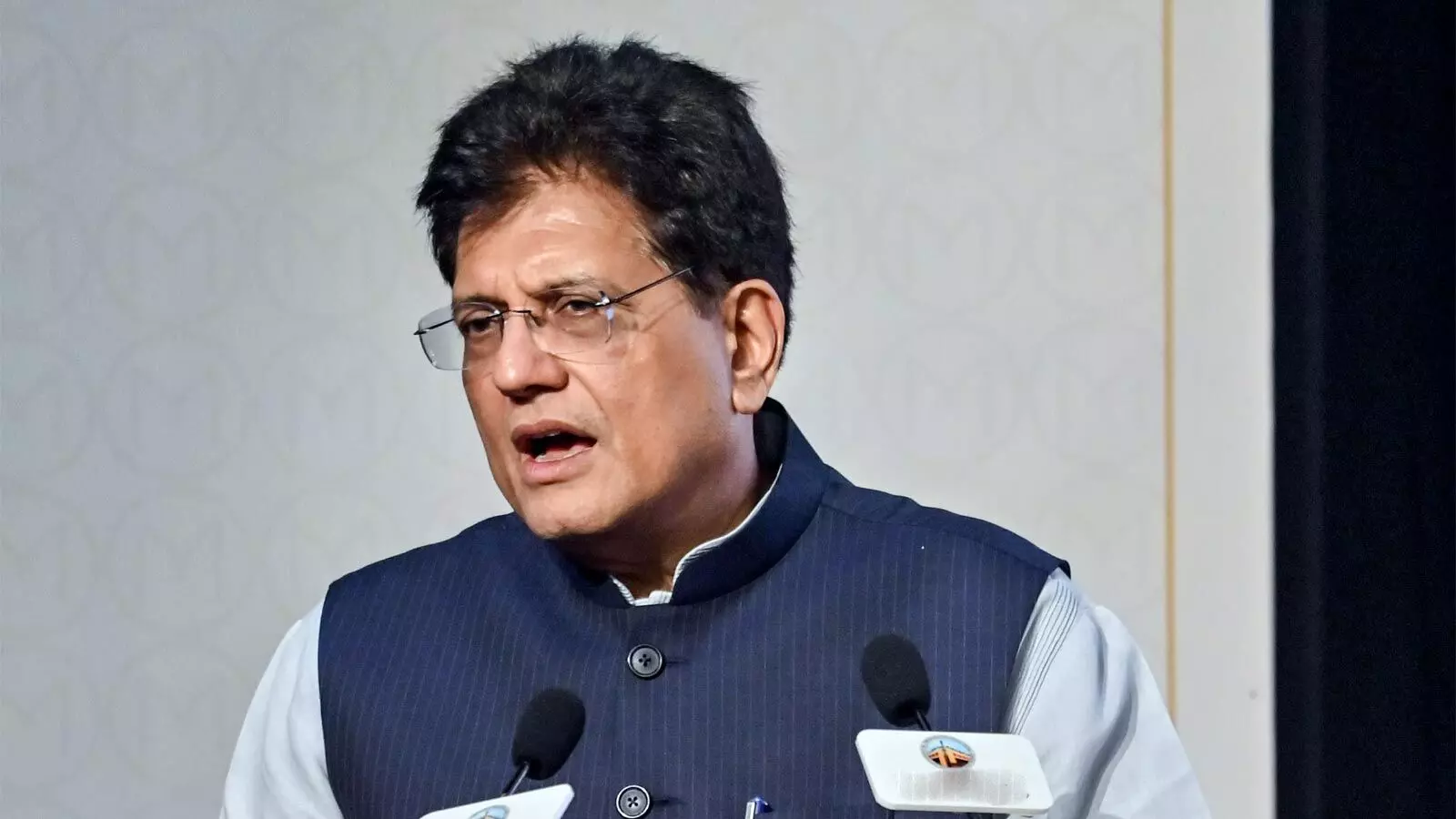
Hague, Oct. 27 -- India is negotiating free trade agreements (FTAs) with several countries and groups, with talks with Chile "quite ripe" for conclusion and negotiations with Canada making good progress, Commerce and Industry Minister Piyush Goyal has said.
He said that negotiations with the South Africa-led SACU (Southern African Customs Union) group have started. The two have inked terms of reference (ToR) to formally start negotiations towards a preferential trade agreement in August. The five members of SACU are Botswana, Eswatini (formerly Swaziland), Lesotho, Namibia and South Africa. "I can see Chile's quite ripe for conclusion; Canada is making very good progress. We have just started SACU negotiations, so it may take some time (for conclusion)," Goyal told reporters here.
He was here for a two-day official visit. Talking about other pacts, he said Mexico is "very" keen to have an early harvest trade agreement. Meanwhile, Commerce Secretary Rajesh Agrawal is in Mexico City for a two-day visit to advance India-"Mexico trade and economic ties. "The visit will see the launch of PTA negotiations with the signing of the Terms of Reference (ToR), alongside engagements with the Mexican government and business community to deepen bilateral cooperation," the department of commerce said in a social media post. The bilateral trade between India and Mexico dipped by over 9 per cent to USD 7.83 billion (exports USD 5.72 billion and imports USD 2.1 billion) in 2025-26. The trade gap is in the favour of India. Goyal expressed hope that the continuity of the government in Brazil following the election would help speed up negotiations to expand the Preferential Trade Agreement (PTA) with the Mercosur bloc.
Mercosur is a trade bloc in South America comprising Brazil, Argentina, Bolivia, Uruguay, and Paraguay. The India-Mercosur PTA came into effect on June 1, 2009. The agreement provides preferential tariff concessions on 450 tariff lines or product categories by India and 452 tariff lines by the Mercosur side. Now both sides are looking to expand the scope of the pact. He added that negotiations with the Gulf Cooperation Council (GCC) and Israel for "obvious" reasons are slow due to the West Asia crisis, and it may take some time. "Though we are ready to speed up negotiations," he said. The GCC comprises Bahrain, Kuwait, Oman, Qatar, Saudi Arabia and the United Arab Emirates and was established in 1981 as a political, economic and security grouping. India already has a trade pact with the UAE and Oman. "Eurasia FTA is only about goods; it doesn't include services. Hence, we are still assessing the benefits of entering into that agreement," Goyal said.
India and the five-nation grouping, the Eurasian Economic Union (EAEU), on August 20 last year, inked the terms of reference to formally start talks for the agreement. The first round of negotiations was held in November 2025. "Many other countries are talking to us. Ecuador (a South American nation) wants to do an FTA. Egypt has invited us to Egypt to discuss potentially how we can work more. Other African countries have been approaching us, either to have an FTA with all of Africa, or with the African Union or the sectoral FTA's," he said. In the trade pact with the US, he said India will have a comparative advantage over other countries and get preferential access. India and the US, in February, announced finalisation of the framework for the first phase of the bilateral trade agreement (BTA). However, changes in the tariff landscape in the US have led to further negotiations on the pact. When asked about capacity building for conducting these negotiations, the minister said Prime Minister Narendra Modi has been very focused on ensuring that the negotiations, along with all the learnings and efforts involved, do not become a one-time affair. "And therefore, in the last three years or so, we've prepared proper manuals, which are a guide like a standard operating procedure (SOP) towards proper and organised FTA negotiations," he said, adding, "Every FTA that we enter into, we prepare a lot of documentation for future reference and to help guide officers in the future, because people keep changing." The minister is here on a two-day official visit. He is accompanying a business delegation.
Published by HT Digital Content Services with permission from Millennium Post.