
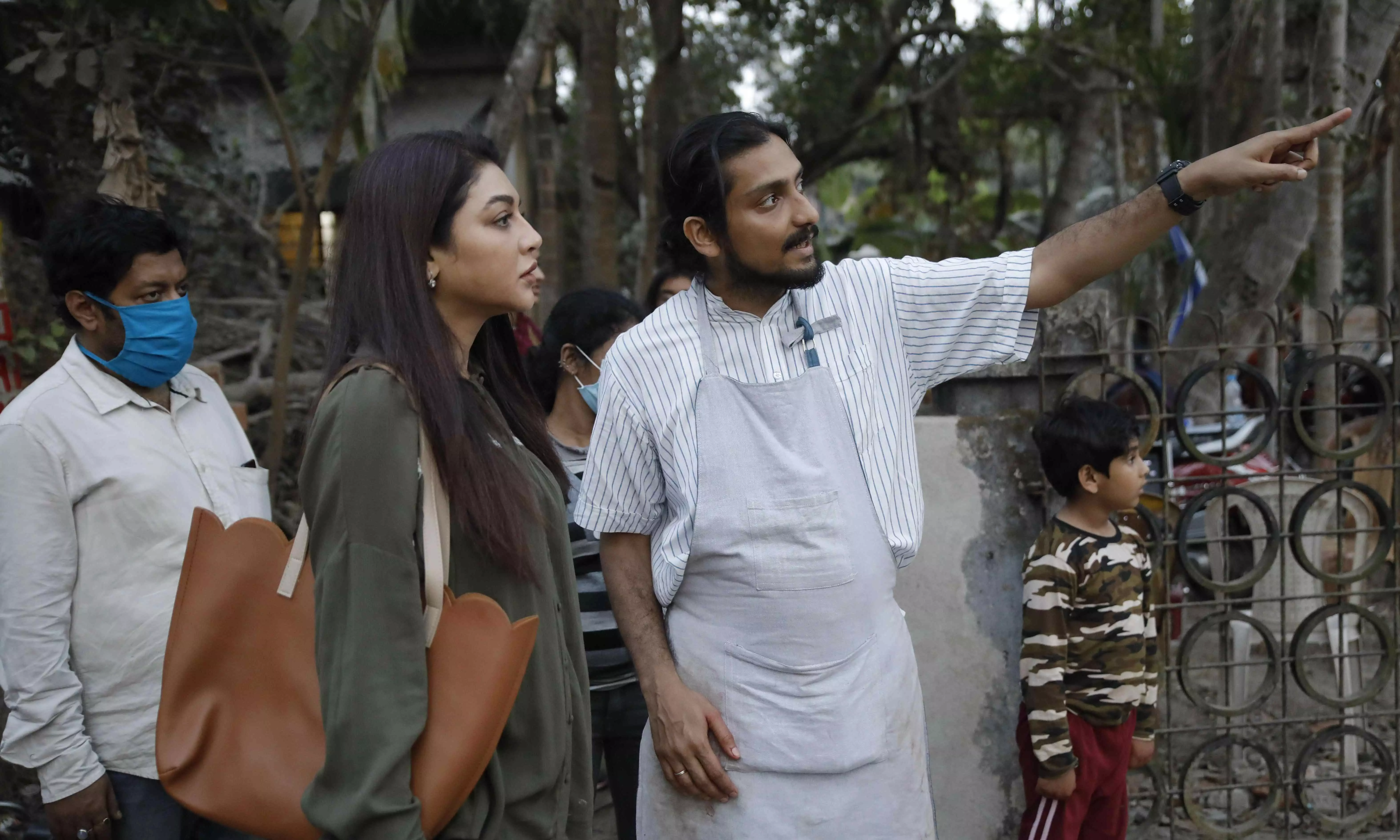
New Delhi, Feb. 11 -- In 12 years, director Soukarya Ghosal has made seven Bengali films. Some may feel the number could have been higher, but Ghosal has always moved at a pace of his own since his debut Bengali feature, 'Pendulum' (2014). He writes his own stories, screenplays and dialogues, a process that, he said, demands time, patience and energy. With films like 'Rainbow Jelly', 'Bhootpori' and 'Pokkhirajer Dim', Ghosal has carved a space for himself as a filmmaker who delivers quality cinema. He believes in the process and at the heart of that process lies trust. According to him, an actor must trust the director. He is not fond of actors asking too many questions on set.
His latest Bengali film, 'OCD', features Bangladeshi actress Jaya Ahsan, who reunites with Ghosal after 'Bhootpori'. The director said that one of the reasons he enjoys working with her is her complete faith in him. "Let's understand, a film is a director's medium. When I am making a film, I know what I want. I have always written the story, screenplay, built the characters and crafted the dialogues. There have only been two or three instances where actors have surpassed what was written. I am convinced that Anirban Bhattacharya in 'Pokkhirajer Dim' and Ritwik Chakraborty in 'Bhootpori' did better than what I wanted them to do. But funnily, the producers weren't convinced. They said that when I narrated or enacted it, I did better," he smiled.
However, the 'Rawkto Rawhoshyo' director clarified that he does believe in conversations on the floor. "Conversations are very much needed. Actors should know the backstory of their characters. They may ask why a character is behaving a certain way and I am willing to explain as many times as required. But if they feel it should be done differently because they think it is better that way, I don't like that," he said.
Ghosal also makes it clear that while he values collaboration, his creative inputs on set are limited. "Of course, I take input from my crew, especially the art director and costume department. But on the floor, I only take inputs from the cinematographer and my creative director," he said.
To some, this may appear rigid. Ghosal acknowledged that. "If you say so, then it's rigid. But after watching my films, there have been actors who came to me and asked why someone else looked better on screen or why a child actor performed better. The reason is simple - the child did exactly what I told him to do. He trusted me completely. You have to trust the director, no matter how big an actor you are. A film director is the medium. That's how it is. And in 'OCD', Jaya placed all her trust in me."
Although titled 'OCD', his new film goes far beyond the surface and delves into the highly sensitive and urgent issue of child abuse. Interestingly, Ghosal has frequently worked with children, from 'Rainbow Jelly', one of Bengali cinema's finest fantasy films, to 'Bhootpori' and 'Pokkhirajer Dim', both rooted in fantasy as well. "But I realised that certain realities, like trauma and attacks, leave permanent mental scars on children. I had never addressed this before. I felt I was doing an injustice to myself by not speaking about such an important issue, especially when I make films with children," said the young filmmaker.
He also pointed out a troubling societal contradiction. "When a woman is abused or molested, we rightly support movements like #MeToo and stand beside her. But if that same woman becomes a mother and something similar happens to her child, especially within the family, she is often compelled to stay silent. Child abuse is frequently dismissed as imagination or brushed under the carpet because it happens within the family. That is why I think 'OCD' is important," he said.
Before entering films, Ghosal worked as an illustrator. He believes the Bengali literature he read as a child has influenced him a lot. Ask him why children are so important in his films and he said, "I've realised that all my heroes are from children's literature. Bishe from Leela Majumdar's 'Tongling' is my hero. Feluda is my hero." Our conversation on child abuse inevitably led to references to films like Imtiaz Ali's 'Highway', Mira Nair's 'Monsoon Wedding' and Nagesh Kukunoor's 'Rockford'. Ghosal admitted that not enough films explore such crucial subjects.
Within the corridors of the Bengali film industry, there were whispers about how 'Bhootpori' and 'Pokkhirajer Dim' found their way to the International Film Festival of India (IFFI) when many popular films did not. "I did not send my films to IFFI. Both were backed by big producers in Bengal and they submitted them," he smiled.
The Bengali film industry is currently in the news over the 'unofficial' sidelining of actors like Anirban Bhattacharya and Riddhi Sen. Ghosal does not mince words here either. "An actor like Anirban not getting work or not doing work is a loss for cinema. I hope this is resolved soon," he mentioned.
His next film, 'Kalantar', will revolve around the Partition of Bengal, though he chooses not to reveal much about it yet. When asked about the Screening Committee's plan to structure a release calendar for Bengali films, he smiled. "In 2018, when 'Rainbow Jelly' was released, we didn't get enough cinema halls because of big releases. So, this is nothing new," he signed off.
Published by HT Digital Content Services with permission from Millennium Post.