
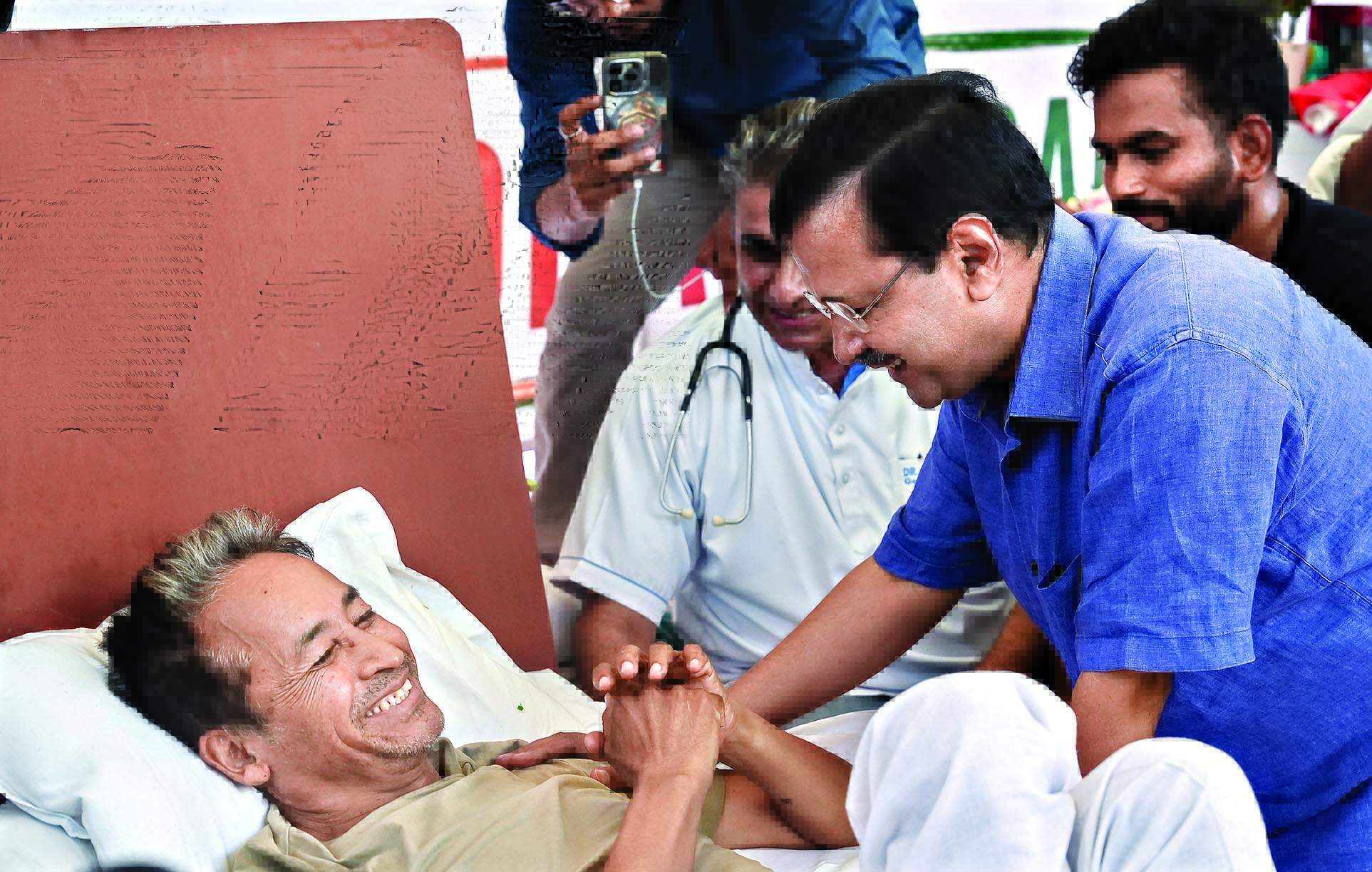
New Delhi, July 16 -- The Delhi High Court on Thursday directed authorities to monitor activist Sonam Wangchuk's health every day and provide immediate medical intervention if his condition worsens, as doctors warned that his prolonged hunger strike had entered a critical phase with the risk of organ damage. The order came while the court was hearing a public interest litigation (PIL) expressing concern over Wangchuk's deteriorating health. Even as political leaders, legal bodies, public figures and supporters urged him to end his indefinite fast, Wangchuk said he would not withdraw the protest without a response from the government, arguing that doing so would send the wrong message. Instead, he called on people to strengthen the Cockroach Janta Party's (CJP) planned Parliament march on July 20.
A bench comprising Chief Justice D K Upadhyaya and Justice Tejas Karia observed that the life of every citizen was precious and directed government doctors to clinically monitor Wangchuk's condition on a daily basis. The court said authorities should provide whatever medical intervention was required if doctors found his health deteriorating.
"We observe that life of any citizen is precious and all medical efforts ought to be made by government authorities to save the same," the bench said while disposing of the PIL.
Solicitor General Tushar Mehta, appearing for both the Centre and the Delhi government, told the court that there was no objection to regular medical examinations of Wangchuk. He said health checkups were already being carried out whenever Wangchuk permitted government doctors to examine him and that private doctors also visited him.
The court, however, insisted that government doctors should regularly assess his condition and intervene whenever necessary. "Life is precious," the bench remarked, while directing authorities to act on the basis of medical opinion.
The PIL, filed by Rakesh Kumar Saini, sought directions to authorities to intervene in Wangchuk's case, discuss the issue with him and ensure timely medical care. It also sought a direction for force-feeding the activist. The petition argued that while peaceful protest was a democratic and fundamental right, the state should not allow a citizen to voluntarily die of hunger due to inaction.
Wangchuk has been fasting since June 28 after joining the CJP protest at Delhi's Jantar Mantar over alleged irregularities in the NEET examination and the demand for Union Education Minister Dharmendra Pradhan's resignation. The protest itself has continued for more than 25 days.
Doctors attending to Wangchuk said his condition had become increasingly serious. According to the latest medical bulletin issued by Dr Satish Lamba, the activist has lost more than nine kilograms since beginning his fast and now weighs 56.9 kg.
Lamba said Wangchuk had entered a critical stage of prolonged fasting. He explained that after the body's glucose reserves are exhausted, it starts consuming fat, followed by muscle tissue. Wangchuk's ketone level, which had reached 3-plus, had reduced to 2-plus after improved hydration, but his uric acid remained high, indicating muscle breakdown.
"The next stage can be alarming. Organs can be impacted. We are keeping him under 24x7 vigilance and hope it does not reach that stage. I urge the government to intervene as soon as possible because he is a precious gem and we do not want to lose him," Lamba said.
Despite the medical warning, Wangchuk remained firm in continuing the fast. In a video message released late Wednesday, he said medical tests had not indicated immediate danger and maintained that he could continue for many more days.
"My condition is not such that I will die in two-four days. Many medical tests have been conducted and the results are quite normal for an 18-day fast. An ECG was also done and it is not bad. I can continue for many more days. Yes, there is weakness and my muscles are getting weak, but my heart and core are still fine," he said.
Calling the movement "a real lesson in political science and democracy", Wangchuk appealed to people to register for the Parliament march through the campaign website or missed-call initiative. The CJP said around 1.5 lakh people had confirmed participation in the July 20 march.
The agitation also includes students affiliated with the All India Students' Association (AISA), some of whom are on indefinite hunger strike. AISA said the health of Neha, Manish and Aameen had reached severe stages. It claimed Aameen faced the risk of hypovolemic shock due to dehydration, Neha's blood sugar had fallen to around 49 mg/dl, and Manish had lost more than 10 per cent of his body weight.
Support for Wangchuk continued to grow across political parties and civil society. AAP national convenor Arvind Kejriwal visited Jantar Mantar along with party leaders, expressing solidarity with the protesters. "Every year, exam papers get leaked and youth pay the price. I appeal to the government to listen to the students and Wangchuk," he said, while also demanding Pradhan's resignation.
Samajwadi Party MP Dimple Yadav, accompanied by party leaders, and farmer leader Rakesh Tikait also met Wangchuk. Jammu and Kashmir Chief Minister Omar Abdullah criticised the Centre for not engaging with him.
The Congress appealed to Wangchuk to end his hunger strike, saying "his concerns are our concerns" while continuing to seek the education minister's resignation. Congress general secretary K C Venugopal said the party shared Wangchuk's anguish over the "collapse of the examination system".
West Bengal Chief Minister Mamata Banerjee criticised the Centre for not initiating talks with the activist. She said it was difficult to understand why no government representative had met Wangchuk despite his prolonged fast and worsening health.
The Supreme Court Bar Association also appealed to Wangchuk to end his fast, saying the country needed him "alive, active and engaged" rather than risking his health. SCBA president Vikas Singh personally handed over the appeal during a visit to Jantar Mantar.
Music composer Vishal Dadlani, actors Sonakshi Sinha, Sayaji Shinde, Atul Kulkarni, comedian Vir Das, author Shobhaa De, Maharashtra Navnirman Sena chief Raj Thackeray, former Congress MP Priya Dutt, and economists Jean Dreze and Reetika Khera were among those who either visited the protest site or publicly expressed concern over Wangchuk's health while urging the government to engage with him.
Published by HT Digital Content Services with permission from Millennium Post.