
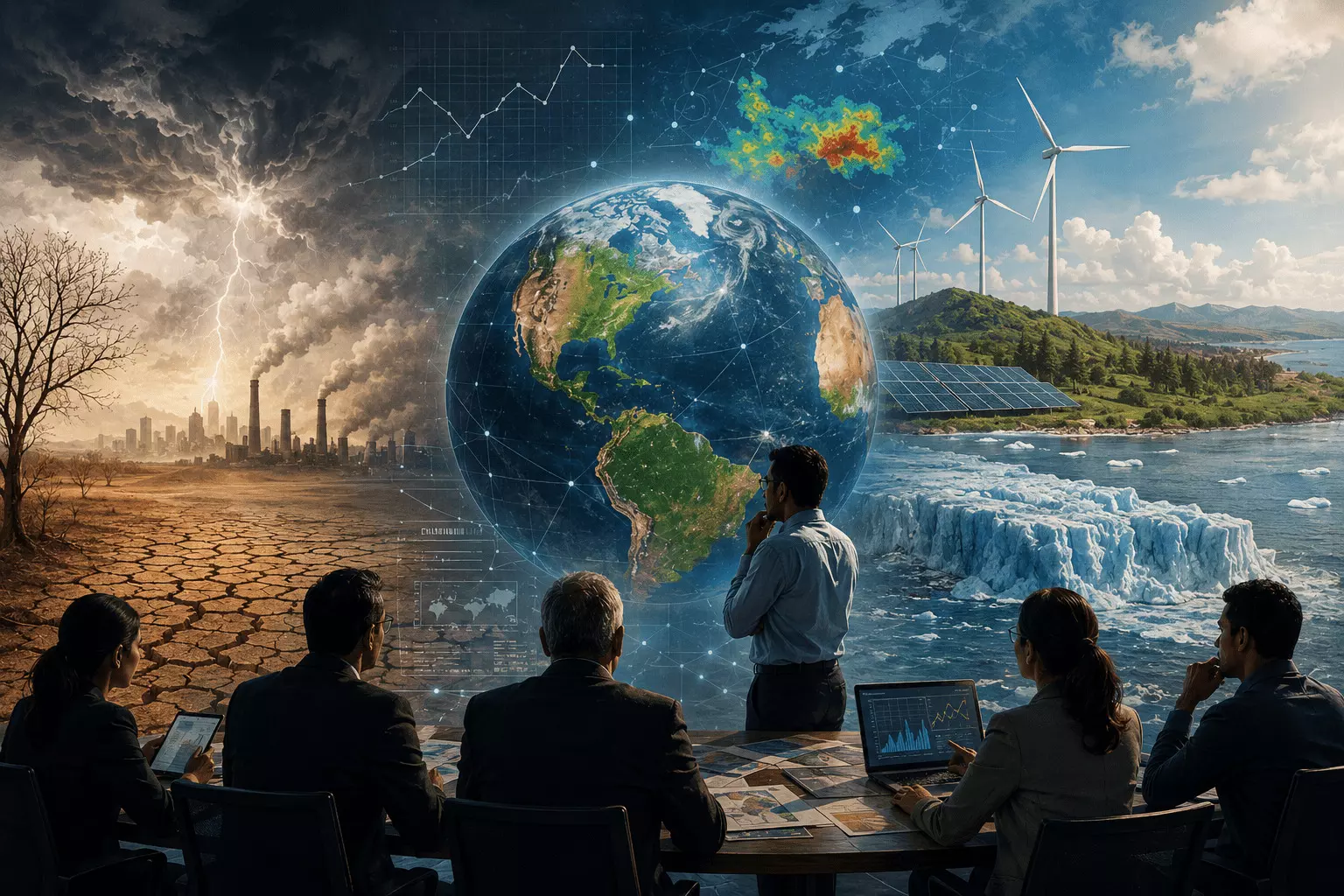
New Delhi, May 16 -- We saw that climate models are not ideally suited to predict climate decades or centuries from now. This is because climate is changing in unpredictable ways and the rate of change itself is uncertain. To add to that, many of the assumptions made in climate models to represent local or small-scale processes (referred to as parameterisation) pose problems in prediction. Finally, many of the IPCC models, such as the Representative Concentration Pathways (RCPs) and Shared Socioeconomic Pathways (SSPs), which have been referred to above, have made some implausible assumptions. For example, one of the RCP models assumes that the use of coal in the next 70-80 years will rise six-fold by 2100, when it may have already peaked. The problem is that the IPCC models are used in many research papers in the sciences and social sciences, and the errors creep in there as well. We are back to the question: how can climate models help in public policymaking and decision-making? Let us discuss this in greater detail.
Applications to Public Policy
Outputs of climate change models, such as temperature, rainfall, wind velocity, etc., are generally available at the grid level, which tends to be a cell of dimension 100 km by 100 km. To make this useful at the local level, results of GCM simulations are integrated with historical observations at the regional or city level. One such attempt was made by combining GCMs with Auto Regressive Integrated Moving Average (ARIMA) models to give city-based predictions for temperature and rainfall for engineering applications (for more details, the article by Lai and Dzombak, published in the Journal of Meteorology and Climatology in May 2021, may be referred to).
In his book Predicting Our Climate Change, David Stainforth has argued that GCM or ESM models have limitations and cannot be used to predict climate accurately. Instead, he says that an alternative would be to look at local time series of important variables such as temperature, rainfall and humidity, and assess the probability of their crossing a defined threshold. These thresholds could be those that are important for various things, such as overheating risks or the ability of humans to work beyond a certain temperature. Stainforth also warns against pushing for the "perfect" climate model, for there can be no such thing. Instead, the focus should be on how best to achieve specific objectives to reduce the risks from climate change and better adapt to climate change. Stainforth also lays great store by a multidisciplinary approach to climate change and its consequences, where social science and physical science should be in constant dialogue.
Another approach was proposed by Swiss researchers Reto Knutti and Markus Huber, who looked at a time series of data on temperature and humidity from around the world for each day since 2000. From this data, they extracted a "fingerprint" of radiative forcing (warming caused by greenhouse gases, aerosols, etc.) and used this to separate anthropogenic warming from natural warming. They take this to be evidence of global warming and climate change.
Another recent example of climate models being used in policy is that of the UK Climate Projections 2018 (UKCP18 for short). The UKCP18 used GCMs and Regional Climate Models to predict rainfall, temperature, storm intensity and sea-level rise till 2100, and used these projections to make an infrastructure plan to mitigate flood risks. Similarly, NASA's sea-level rise prediction model has been used by New York City planners for better coastal planning.
In the Climate Change series of articles over the last year or so, we have covered various aspects of mitigation and adaptation. Many of these, such as policies in the energy, transport, agriculture and industry sectors, have benefitted from the various outputs of climate models and the comparisons run under CMIP by the IPCC. Issues such as Net Zero pathways, to which each country has committed, decarbonization, energy transition, creation of climate-resilient infrastructure and the phase-out of fossil fuels have perhaps been decided on the basis of climate model simulations.
Conclusion
Climate change models are a useful tool, but not a panacea for managing all climate change consequences or even for predicting future climate. Economic models such as the Integrated Assessment Models (IAMs) also have their limitations, as we discussed in an earlier article. It is also true that the basic laws of physics have established that climate change is a reality, and that global warming has not only been happening as a result of human intervention but will also accelerate if timely action is not taken. Hence, the best way forward is to recognise the limitations of models and work with the data to see how our objectives on mitigation and adaptation can be met.
Published by HT Digital Content Services with permission from Millennium Post.