
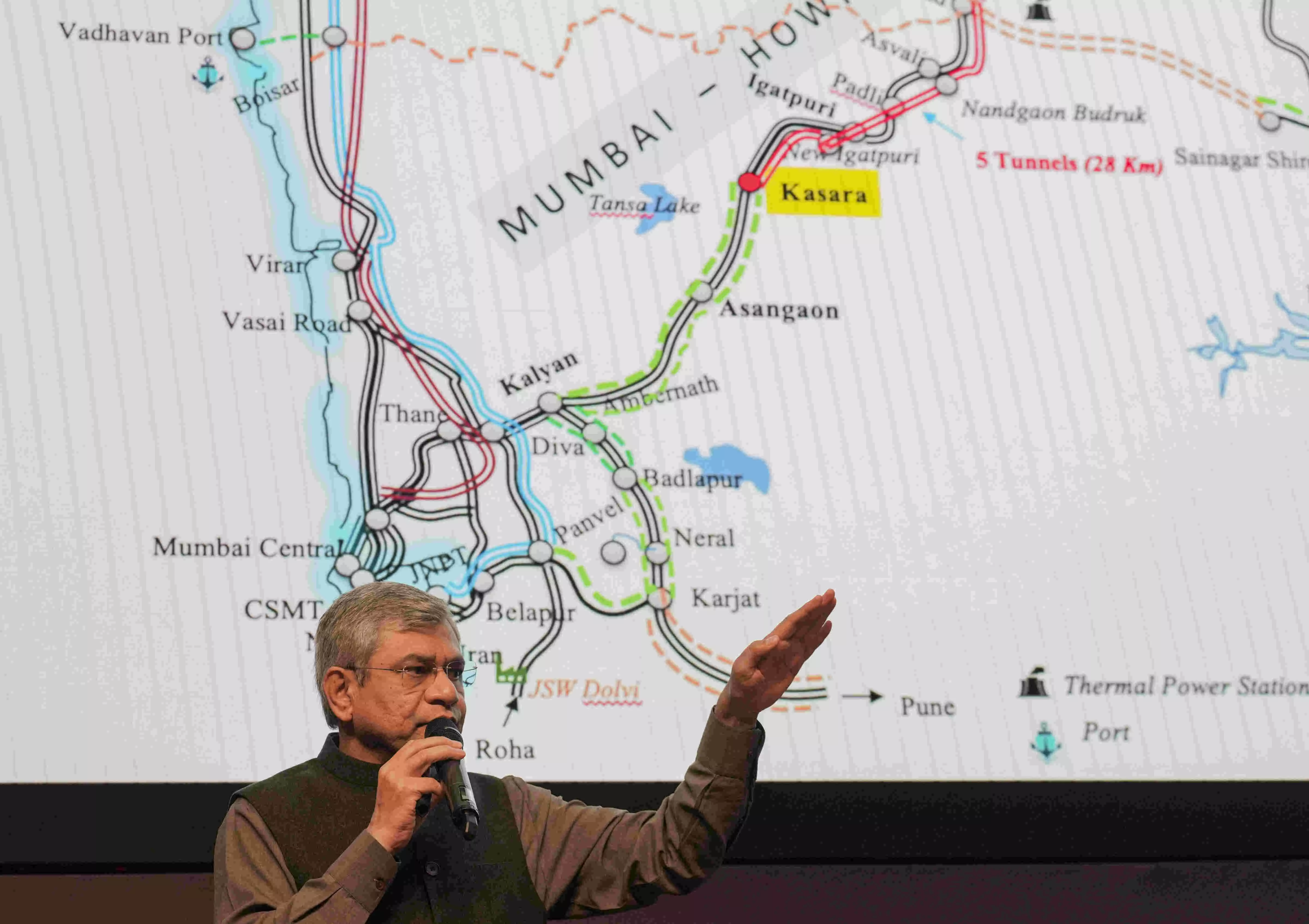
NEW DELHI, Feb. 14 -- In a major boost to urban infrastructure, the Union Cabinet has approved the launch of the Urban Challenge Fund (UCF) with a total central assistance of Rs 1 lakh crore, Union Minister Ashwini Vaishnaw said on Saturday.
Under the scheme, central assistance will cover 25 per cent of a project's cost, provided that at least 50 per cent of the funding is mobilised from the market.
In a statement, the government said the initiative will lead to a total investment of Rs 4 lakh crore in the urban sector over the next five years.
The move marks a paradigm shift in India's urban new development approach from grant-based financing to a market-linked, reform-driven and outcome-oriented infrastructure creation, it said.
The UCF will leverage market financing, private sector participation and citizen-centric reforms to deliver high-quality urban infrastructure, it said.
The fund aims to build resilient, productive, inclusive and climate-responsive cities, positioning them as key drivers of the country's next phase of economic growth, according to the statement.
The UCF will be operational from FY 2025-26 to FY 2030-31, with an extendable implementation period up to FY 2033-34
It gives effect to the government's vision announced in Budget 2025-26 to implement proposals relating to cities as growth hubs, creative redevelopment of cities, and water and sanitation.
According to the government, a minimum of 50 per cent of project financing must be mobilised from market sources, including municipal bonds, bank loans and Public-Private Partnerships (PPPs).
The remaining share can be contributed by states, Union Territories, Urban Local Bodies (ULBs) or other sources.
Projects will be selected through a transparent and competitive challenge mode, ensuring support to high-impact and reform-oriented proposals, it said.
The fund will cover cities with a population of 10 lakh or more (2025 estimates); all state and Union Territory capitals not included in that category, and major industrial cities with a population of 1 lakh or more, the statement said.
The UCF is expected to catalyse large-scale private investment, strengthen urban governance, and accelerate the creation of future-ready cities aligned with national development priorities, it said.
According to the government, projects under the fund will be selected through a challenge-based framework including transformative impact, sustainability and reform orientation.
In another infra-related project, the Union Cabinet approved a Rs 18,662-crore project to construct a four-lane access-controlled greenfield corridor between Gohpur and Numaligarh, featuring India's first road-cum-rail tunnel under the Brahmaputra river in Assam.
Currently, the connectivity between Numaligarh on NH715 and Gohpur on NH-15 is 240 km -- from the existing Kaliabhambhora road bridge near Silghat on NH-52, which takes 6 Hours passing through Numaligarh, Kaziranga National Park, and Biswanath Town, the Ministry of Road Transport & Highways (MoRTH) said in a statement.
The Cabinet Committee on Economic Affairs has approved the construction of a four-lane, access-controlled greenfield road connecting Gohpur on NH-15 to Numaligarh on the 715 section, including a 15.79 km road-cum-rail tunnel under the Brahmaputra River, to be developed at a total cost of Rs 18,662 crore in Assam, it added.
The project will be developed on an engineering-procurement-construction (EPC) model, MoRTH said.
This will be the first underwater road-cum-rail tunnel in India and the second in the world. The project will provide significant benefit to Assam, Arunachal Pradesh, Nagaland and other northeastern states. It will also enhance the efficiency of freight movement, reduce logistics costs and drive socio-economic growth in the region.
The project provides seamless connectivity to key economic, social, and logistics nodes across Assam. Additionally, the project will enhance multi-modal integration by connecting with 11 economic nodes, 3 social nodes, 2 tourist nodes and 8 logistic nodes, providing enhanced connectivity with 4 major railway stations, 2 airports, and 2 inland waterways, thereby facilitating faster movement of goods and passengers across the region.
Upon completion, the project will play a pivotal role in strategic considerations, regional economic growth, strengthening connectivity between major economic centres and opening new avenues for trade and industrial development.
The project will also generate approximately 80 lakh person-days of direct and indirect employment, and will open new avenues of growth, development and prosperity in surrounding regions
Published by HT Digital Content Services with permission from Millennium Post.