
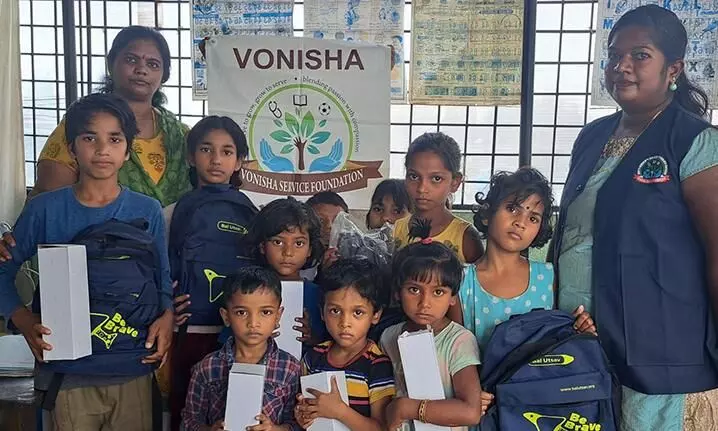
New Delhi, Sept. 2 -- Vonisha Service Foundation, a Section 8 not-for-profit organisation, was established in April 2017 to work with underprivileged children and marginalised women. From the beginning, there was a belief that poverty and exclusion cannot be addressed through a single intervention. Education without health, skills without livelihood opportunities, or empowerment without dignity can only provide partial solutions. An integrated approach was adopted across Education, Skills, Health, Sports and Environment. Vonisha gave a presentation on its recent activities at an event organised by the Bengaluru Chapter of Nexus of Good.
The approach was simple. Sustainable social impact begins by listening to people, understanding their circumstances and responding to their actual needs. The early work focused on children who had dropped out of school, particularly those living in vulnerable communities around Bengaluru. An attempt was made to help them bridge educational gaps and enrol in government schools or affordable English-medium schools, according to their parents' aspirations.
Getting children into school was only the beginning. Many returned to the same environment and dropped out again. The teachers went into the communities, found them and brought them back. During the first year, there were just three teachers who engaged with 50 out-of-school children. Another barrier was soon discovered. Parents wanted their older children to attend school, but at the same time, they wanted them to take care of their younger siblings. So, this led to the older children dropping out to take care of their younger siblings. We responded by starting a day-care centre for the younger siblings. That simple intervention improved attendance and retention.
COVID-19 became another defining moment. The organisation stayed connected with the families. They were served and provided dry ration support worth about '1,000 per family during the uncertainty. After the pandemic, something changed. Children who earlier had to be encouraged to attend began coming in large numbers. Their experience created trust. Demand grew. Additional space was rented. More teachers were recruited. What began as a small educational initiative grew into an engagement supporting around 250 children.
Across the education and livelihood initiatives, the numbers reflect this journey of growth. Close to 5,000 first-generation learners were mainstreamed, bringing them back into school and giving them a foothold in formal education. Livelihood skills were imparted to 500 women, an effort that, in turn, led us to think more deeply about what sustainable livelihood really means for them and eventually shaped Project VISILITES.
The engagement with women followed a similar journey of learning and adaptation. During community surveys in peri-urban areas, interactions with migrant families took place. In many households, the man was the primary breadwinner, while women remained at home because of family responsibilities, though they wanted to contribute to the family income.
Free, structured four-month tailoring programmes across these communities were started. It was initially believed that training would naturally lead to employment. However, a six-month review revealed otherwise. Many women could not work every day because of responsibilities at home. Available employment did not fit their circumstances. Instead of treating the programme as successful because many women had been trained, the organisation was confronted with a more important question: what kind of work will actually work for these women?
That question led to Project VISILITES, Vonisha Inclusive Skills & Leadership Initiative for Women through Training, Empowerment & Sustainability. Genuine market needs were identified. Working women, families and communities needed reliable tailoring and garment alteration services, while trained women were looking for flexible livelihood opportunities. An attempt was made to connect the two.
Skill meets Need.
VISILITES brings together trained women, a refurbished solar-powered mobile tailoring unit and an app-based order management system. Women receive a minimum guaranteed payment along with a work-linked variable component. The mobile unit can travel to corporate offices, residential communities, apartments and other locations where alteration orders are aggregated.
Customers can view services, place orders and make online payments. Feedback is collected to improve the service. VISILITES is more than a tailoring project. It makes women's empowerment practical by connecting skills with market demand.
The work of the organisation extends beyond these initiatives. Through the Vonisha Skill Enhancement Project, English communication and life skills training are also provided. In Tamil Nadu, a Miyawaki forest has also been created on a government school campus at Vayapatti village in Theni district, linking community development with environmental responsibility.
At Vonisha, the aspiration is not merely to serve communities. It is to create opportunities that help people become more confident, skilled, independent and capable of shaping a better future for themselves and their families by bridging gaps and unlocking potential.
What has been attempted under Vonisha is a small beginning that has already travelled some distance. It is a wonderful model of Nexus of Good. This model can be replicated and scaled through public-private partnerships.
Views expressed are personal. The writer is an author and a former civil servant
Published by HT Digital Content Services with permission from Millennium Post.