
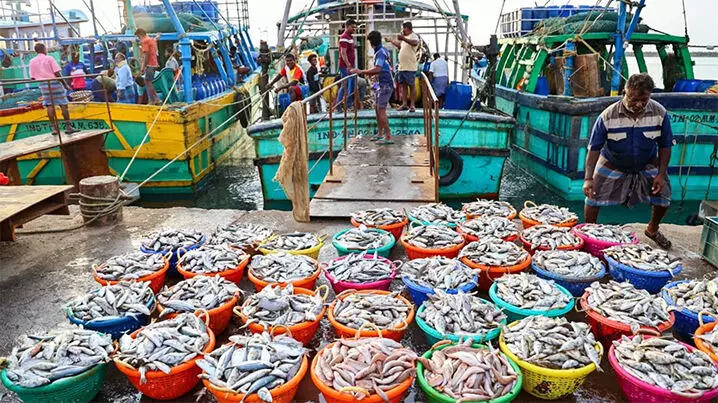
New Delhi, Oct. 22 -- Report Fish Disease" is an online application launched by the Government of India that empowers fishers and fish farmers to report disease outbreaks to field officers and fish health experts. By facilitating early detection and access to scientific advice, this technological innovation aims to reduce disease-related losses and boost livelihood security. Available in eleven regional languages, the application also collects disease data, enabling mapping and, consequently, knowledge-sharing among all stakeholders. This initiative, therefore, contributes to the long-term sustainability and resilience of a rapidly expanding aquaculture sector, with India's fish production touching 197 lakh tonnes!
Surveillance of fish diseases is also critical in the context of our expanding seafood and fish exports. During the last twelve years, these exports have risen by 145 per cent and are valued at Rs 73,890 crore in 2025-26. These largely comprise cultured frozen shrimps exported to the USA. However, during the last year alone, despite the tariffs imposed by the USA, seafood and fish exports have shown resilience, witnessing an increase of approximately Rs 11,000 crore! This has been possible due to aggressive market diversification to countries and regions such as the European Union, China and Southeast Asia, coupled with the signing of Free Trade Agreements (FTAs). But as more global markets open up for our seafood and fish exports, sustainable compliance with international traceability requirements will also necessitate robust disease surveillance, detection and mitigation infrastructure.
The need for a national framework for such infrastructure has been fulfilled by the National Surveillance Programme for Aquatic Animal Diseases (NASPAAD). Following a 'whole-of-government approach', this programme is being implemented in convergence with state fisheries departments, several ICAR R&D institutions and, more importantly, the Marine Products Export Development Authority (MPEDA). Backed by the 'Report Fish Disease' online application, the national programme has strengthened scientific advisory support to fishers and fish farmers for diseases affecting freshwater, brackish-water, ornamental and cold-water aquaculture. It has, in addition, also established mechanisms for the timely, first-time confirmation of emerging diseases.
Experts contend that any national framework must enable state governments to effectively identify the risk factors associated with fish diseases and evaluate the success of control measures at the grassroots level as well. The NASPAAD programme has institutionalised a system of on-site surveillance and sampling, coupled with a network of district, state and referral diagnostic aquatic animal health laboratories across the country. The programme has also made vaccines available. States such as Andhra Pradesh (the largest producer and exporter of fish) have provided the nuts and bolts for the above system by carrying out regular farm and hatchery visits, timely sample collection and laboratory testing across their coastal districts. The dissemination of information on the importance of farm biosecurity and water quality management-related packages of practices has been ensured by state officials through regular fish farmer awareness and training programmes. In fact, the state government has devised a step-by-step demonstration video for the 'Report Fish Disease' app in the local language.
In fact, all the above proactive central and state government measures towards enhancing disease prevention in the fisheries sector have enabled India to contribute to transparent disease reporting as a member of the World Organisation for Animal Health (WOAH). In addition, India is also supporting the responsible exchange of information on fish diseases with organisations such as the Network of Aquaculture Centres in Asia-Pacific (NACA).
The 300-plus-strong fisheries start-up ecosystem, too, is promoting best management practices through the application of varied technologies for disease detection. Bariflo Cybernetics, for instance, is a start-up that monitors aquaculture water quality through the installation of intelligent sensors in fish ponds to provide periodic assessments for early-warning decisions. NatureDots is a start-up that is using AI to empower small and marginal fish farmers with knowledge about healthy and climate-resilient water ecosystems. It provides an end-to-end solution to de-risk fish farmers through a web and mobile interface available in 13 languages. Similarly, Numer 8 Analytics provides a range of solutions that include real-time monitoring of water quality, fish health and automated feeding. Aqua Doctor Solutions provides services, among others, for fish disease laboratory testing.
Against this backdrop, the criticality of last-mile fisheries and aquaculture extension services is of paramount importance. Experts contend that such field extension services should provide entrepreneur-based support to fishers and fish farmers on disease-related issues, the life cycles of improved cultured species, water quality and environmental parameters, among other aspects. Under the national flagship Pradhan Mantri Matsya Sampada Yojana (PMMSY), Matsya Seva Kendras (MSKs) have been envisioned as one-stop solutions to provide a range of extension services through trained aquaculture professionals. Government assistance to set up such Kendras for women and weaker sections is available to the extent of 60 per cent. Funds have been provided to state governments and Union Territories for operationalising 102 such Kendras. For example, the MSK operating in Thrissur district in Kerala has a well-equipped laboratory for water, soil and microbial analysis to conduct request-based disease tests. On the other hand, in Nashik and Sangli districts in Maharashtra, the MSKs organise capacity-building programmes for fishers and fish farmers on varied seed and feed inputs, backed by the required infusion of technology.
To further strengthen fish disease mitigation, steps are being taken to institutionally converge the above initiatives with the already networked field extension machinery of over 700 ICAR-driven Krishi Vigyan Kendras (KVKs) and the extension services established by state governments and Union Territories. All the above efforts align with the Viksit Bharat@2047 vision to empower fishermen's families to thrive and contribute to the nation's Blue Revolution.
Views expressed are personal. The writer is Secretary, Department of Fisheries, Ministry of Fisheries, Animal Husbandry & Dairying, GoI
Published by HT Digital Content Services with permission from Millennium Post.