
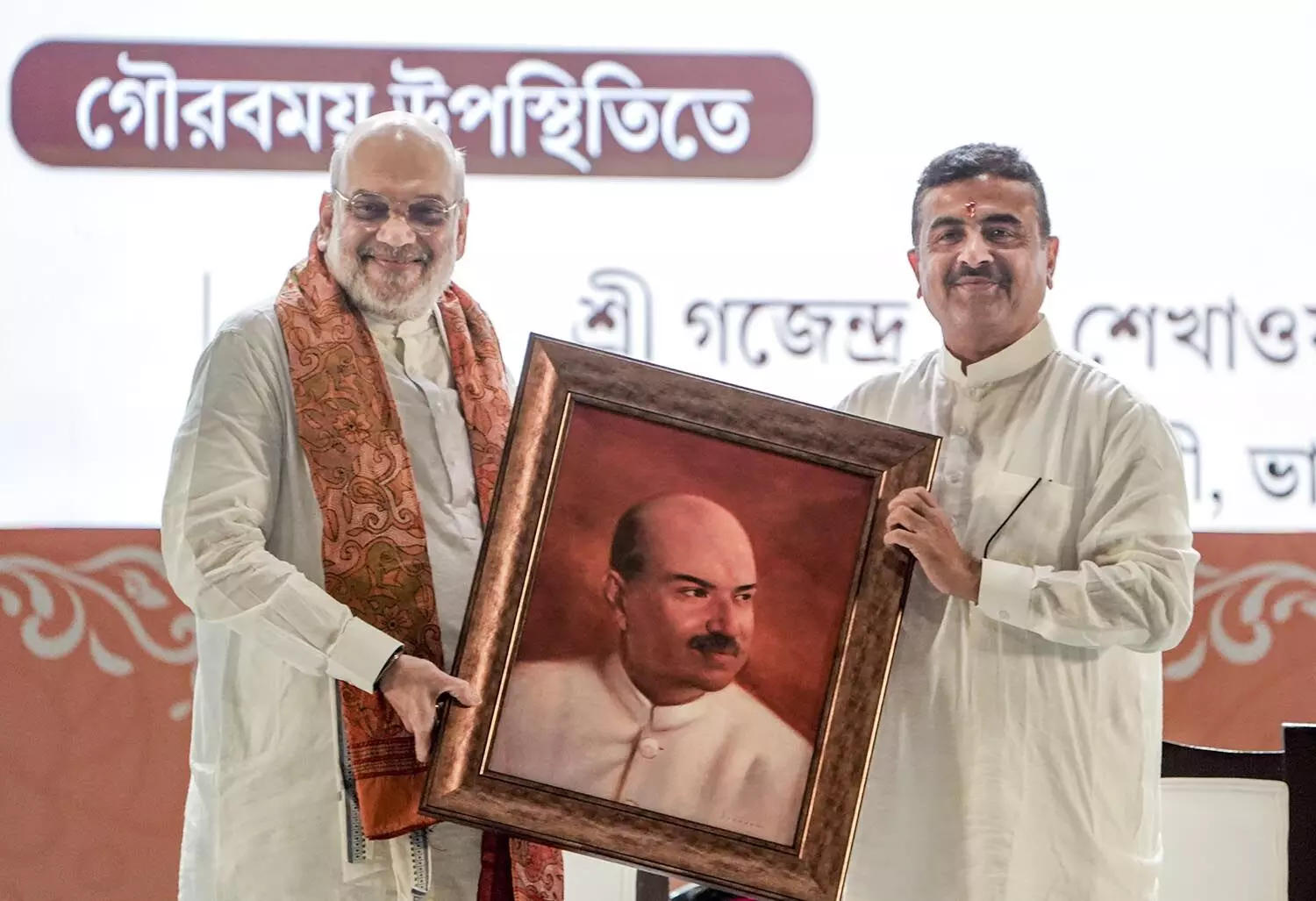
Kolkata, July 6 -- On the occasion of the 125th birth anniversary of Syama Prasad Mookerjee, while Union Home Minister Amit Shah said the BJP government in West Bengal was delivering on the promises made in its election manifesto and asserted that the vision of a "Sonar Bangla" was steadily taking shape under Chief Minister Suvendu Adhikari, the CM announced that the state would propose the inclusion of Mookerjee's life and contributions in school and university curricula from the next academic session.
Shah also highlighted the BJP's commitment to tackling illegal immigration, saying every infiltrator would be identified and the country's security strengthened.
"We are fulfilling the promises we made in our 'Sankalp Patra' during the Bengal elections," Shah said.
Speaking at Mitra Institution, Mookerjee's alma mater, CM Adhikari said the proposed syllabus would include Mookerjee's role in the creation of West Bengal, his vision of national unity, his contribution as Independent India's first Industry minister and as vice-chancellor of the University of Calcutta.
He also said references to the Singur movement introduced during the previous government would be removed from school textbooks, subject to the syllabus committee's approval.
Shah, after reaching the city on Monday, laid the foundation stone for a 125-foot statue of Mookerjee at Eco Park in New Town in the presence of Adhikari. Calling the ceremony the beginning of a larger vision, Shah said: "I see this bhoomi pujan differently. Today marks the beginning of fulfilling the resolve to build a Sonar Bangla."
Shah later visited Mookerjee's ancestral residence in Bhawanipore before making an unannounced visit, along with Adhikari, to veteran Bengali actor Prosenjit Chatterjee's Ballygunge residence. BJP leaders Locket Chatterjee and Nisith Pramanik were also present. The meeting, which was not part of Shah's official itinerary, has fuelled speculation over a possible Rajya Sabha nomination for the Padma Shri awardee.
Addressing a public meeting at Milan Mela Prangan, Shah said Mookerjee had opposed the Nehru-Liaquat Pact for failing to safeguard Hindus in East Pakistan and asserted that the Citizenship (Amendment) Act had fulfilled his vision by granting citizenship to persecuted Hindus. He also said the abrogation of Article 370 realised Mookerjee's long-standing demand for full integration of Jammu and Kashmir.
Praising the Adhikari government, Shah highlighted the rollout of central welfare schemes, the passage of the Anti-Goonda Bill, steps towards implementing a Uniform Civil Code, corruption probes, and measures against illegal infiltration. He warned that those found guilty of corruption would face action once inquiry reports were submitted.
Published by HT Digital Content Services with permission from Millennium Post.