
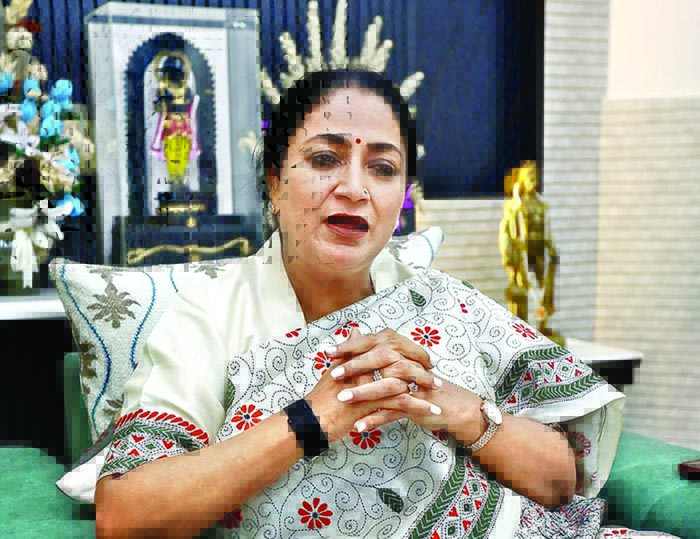
New Delhi, July 8 -- More than a year into office, Delhi Chief Minister Rekha Gupta says her government's focus is on moving beyond announcements to implementation. From tackling air pollution through the newly launched Electric Vehicle Policy and strengthening monsoon preparedness to addressing water supply challenges, accelerating Yamuna rejuvenation, improving accountability in the health sector and expanding opportunities in higher education, the Chief Minister outlines what she describes as a governance-first approach.
In an exclusive interview, Gupta speaks about the rationale behind key policy decisions, the status of flagship projects, the future of the Mahila Samman Yojana, concerns raised by independent mechanics over the EV transition, and her long-term vision for Delhi. She also discusses the government's strategy to reduce pollution, improve civic infrastructure, modernise drainage systems and build institutions that can serve the Capital for decades.
Five months into office, what do you consider your government's biggest achievement so far?
If I had to describe our biggest achievement in one sentence, I would say that we have brought governance back to the centre of government. For too long, Delhi witnessed announcements over execution. Our focus has been on delivery, accountability and measurable results. Whether it is cleaning the Yamuna, introducing a comprehensive EV Policy, strengthening monsoon preparedness or improving public services, our approach has been to identify problems honestly, create a clear roadmap and ensure implementation. I believe governments should provide solutions, not excuses. While long-standing challenges cannot be solved overnight, citizens should see steady and visible progress. Success is not measured by the number of schemes announced, but by the number of lives improved. My vision is to build strong institutions and infrastructure that will serve Delhi for the next twenty-five years.
Delhi's pollution is caused not just by vehicles but also by construction dust, industries and stubble burning. How much improvement in AQI does the government realistically expect?
Delhi's pollution cannot be solved by targeting a single source. Vehicular emissions account for nearly 23% of winter pollution, according to the Commission for Air Quality Management (CAQM), making them a key focus of our EV Policy. We are prioritising the electrification of two-wheelers, three-wheelers and commercial goods vehicles, which contribute significantly to emissions.
At the same time, we are addressing other major pollution sources through mechanised road cleaning, stricter dust control, scientific waste management, improved public transport, greening initiatives and coordination with neighbouring states and the Central Government. Our goal is not to make unrealistic promises but to deliver measurable improvements in air quality through a comprehensive, data-driven strategy.
How will the new EV Policy ensure that subsidies reach beneficiaries quickly and transparently? How is the government addressing charging infrastructure?
One of the biggest complaints people have about government schemes is that benefits often get stuck somewhere between the announcement and the citizen. We wanted to change that. Our EV Policy has therefore been designed with technology at its core. Eligible buyers will receive incentives through a Direct Benefit Transfer (DBT) mechanism directly into their bank accounts after fulfilling the prescribed eligibility conditions within 60 days. The entire process will be managed through a digital portal so that applications, verification and approvals remain transparent and trackable. This reduces paperwork, eliminates unnecessary middlemen and significantly cuts processing time.
We are also introducing digital monitoring so that every subsidy is linked to a genuine Delhi registration, ensuring that public money reaches the right beneficiary. Vehicles receiving incentives cannot simply leave Delhi immediately because safeguards have been built into the policy to prevent misuse.
Simultaneously, to address charging infrastructure concerns, we have adopted a shared responsibility model. Manufacturers, dealers, RWAs, institutions and the private sector will work alongside the government to install charging points at dealerships, housing societies and commercial spaces. The Power Department is also working actively to support the expansion of Delhi's EV charging network. Every rupee spent by the government comes from taxpayers. It should reach citizens, not files. Governance today is not about opening more counters; it is about reducing queues. Our effort is that citizens should spend more time enjoying the benefits and less time visiting government offices.
Many independent mechanics say they cannot afford expensive EV diagnostic tools and equipment. Will the government provide financial assistance or subsidies to small workshops?
This is a very genuine concern, and I appreciate that independent mechanics are raising it. Whenever technology changes, there is always anxiety among people whose livelihoods depend upon the existing system. My message to them is very clear: our government wants to take them along, not leave them behind. Delhi has thousands of skilled mechanics who have built their businesses over decades. They possess valuable technical knowledge, and we want that experience to become part of the EV economy.
The policy already focuses on skill development and creating an ecosystem for EV servicing. We are also engaging with industry, manufacturers and training institutions to ensure that mechanics receive affordable training and access to new technologies. As the EV ecosystem grows, we will continue to examine practical support mechanisms, including partnerships that reduce the financial burden of adopting specialised tools. The larger objective is not simply to sell electric vehicles. It is to build an entire service economy around them. The green transition must never become an unemployment transition. Technology should create opportunities for skilled workers, not uncertainty. When Delhi becomes India's EV capital, I want Delhi's mechanics to become India's most skilled EV technicians as well.
Many areas continue to face water shortages and concerns over water quality. What is your roadmap for ensuring reliable water supply?
Water is not a luxury; it is the most basic public service every government must deliver with dignity. Delhi's water challenges have built up over many years due to rapid population growth, ageing infrastructure, leakages and contamination. Our focus is on increasing water availability, reducing distribution losses and improving water quality through pipeline replacement, leak detection, modern monitoring systems, stronger treatment capacity and better local distribution networks. Our goal is clear: every household in Delhi should receive clean, reliable drinking water without having to depend on tankers or irregular supply schedules. We are committed to achieving this, step by step.
Every monsoon, waterlogging disrupts life in Delhi. What is your long-term strategy to address this issue?
Every monsoon, Delhiites should be talking about the rain, not worrying about whether they will reach home safely. Unfortunately, for many years, waterlogging became an annual ritual instead of an exception. Our government is determined to break that cycle. We have approached this challenge in two ways. The first is immediate preparedness, and the second is long-term structural reform. This year, we issued the Flood Control Order 2026 well before the monsoon. Every identified waterlogging point has been assigned a nodal officer with clear responsibility and accountability. A 24x7 Central Flood Control Room is functioning, major and minor drains have undergone extensive desilting, mobile pumping units have been deployed and real-time monitoring systems are in place. For the first time, accountability has names and faces, not just files.
But let me be equally clear, desilting drains every year cannot be Delhi's permanent strategy. If every monsoon begins with emergency meetings and ends with excuses, then governance has failed. That is why we are taking forward the Drainage Master Plan with a long-term perspective. The objective is to modernise Delhi's storm-water drainage network, remove bottlenecks, improve outfall systems, integrate natural drains with engineered infrastructure and use technology to monitor water flow before flooding occurs. Climate change has altered rainfall patterns, and our infrastructure must adapt accordingly.
We are also ensuring that urban planning, road construction and drainage planning no longer happen in isolation. Roads cannot be built without thinking about drainage, and drainage cannot be planned without considering future urban growth. Cities are not judged by how they perform on sunny days. They are judged by how they perform on the most difficult days. Our goal is to build a Delhi that remains functional even during extreme weather events.
Several key infrastructure projects, including Yamuna rejuvenation and sewage works, were pending when your government took office. Where do these projects stand today?
When our government assumed office, we inherited not just pending files but pending responsibilities. Many critical infrastructure projects had remained on paper for years while Delhi continued to bear the consequences in the form of pollution, water shortages and inadequate sewerage infrastructure. We are no longer measuring success by projects announced but by projects completed. The Delhi Jal Board's pending works, including sewage treatment plants, trunk sewer networks and the Yamuna rejuvenation programme, have been placed under continuous review. We have established fixed timelines, strengthened inter-departmental coordination and introduced regular monitoring so that bottlenecks are identified and removed quickly. Wherever approvals were delayed, we have accelerated decision-making. Wherever execution had slowed down, accountability has been fixed.
Let us not reduce Yamuna rejuvenation to merely an environmental project. It is a civilisational responsibility. A river that has nurtured Delhi for centuries deserves much better than becoming a drain. That is why we are approaching this mission scientifically, from interception and diversion of untreated sewage to increasing sewage treatment capacity, improving drain management and restoring ecological health. At the same time, sewer infrastructure is being expanded because a clean Yamuna cannot exist without a modern sewer network. These two issues are inseparable. The Yamuna is not a political issue for us; it is a generational responsibility. People will judge us not by how many review meetings we held, but by whether they can actually see cleaner water, stronger infrastructure and visible progress on the ground. That is exactly the standard we have set for ourselves.
The Mahila Samman Yojana was one of your government's major promises. When can eligible women expect its rollout?
Women's empowerment is not a slogan for our government; it is a governance priority. A developed Delhi is simply not possible unless women feel financially secure, socially respected and economically independent. The Mahila Samman Yojana was conceived with this larger objective. The necessary administrative processes, beneficiary verification mechanisms and implementation framework are being put in place so that the scheme is transparent, targeted and sustainable. Our effort is to ensure that every eligible woman receives the benefit without unnecessary delays or leakages. I have always believed that public welfare schemes should be built on strong systems rather than hurried announcements. Citizens expect delivery, not publicity. That is why we are taking the time to create a robust mechanism before full-scale implementation.
But our commitment to women goes much beyond one scheme. Whether it is improving public safety, expanding opportunities for education and employment, promoting women entrepreneurs or making public transport safer, every department has been asked to place women at the centre of policy making. The measure of a government's success is not how loudly it speaks about women, but how confidently women are able to move forward because of its policies. Our vision is that every daughter, every student, every working professional and every homemaker in Delhi should feel that this government stands firmly beside her aspirations.
There have been allegations of irregularities in the health sector. How many cases have been identified so far, and what action has been taken?
Healthcare is one sector where there can be absolutely no compromise. Every rupee that belongs to patients must be spent on patients. Every hospital must function with transparency, accountability and integrity. Wherever complaints or irregularities have come to our notice, they have been taken seriously. Investigations have been initiated, records have been examined and, wherever prima facie evidence has emerged, appropriate administrative and legal action has been initiated in accordance with the law. We believe that accountability strengthens institutions; it does not weaken them.
At the same time, our objective is not merely to identify irregularities after they occur. We are strengthening systems so that such irregularities become far more difficult in the future. Greater digital monitoring, transparent procurement, improved audit mechanisms and stricter administrative oversight are all part of this reform process. People often ask whether we are conducting a witch hunt. My answer is simple, there is a difference between political vendetta and administrative accountability. We are interested in the latter. The taxpayer's money is sacred. Every rupee diverted through negligence or corruption is a rupee taken away from a patient waiting for treatment. Our focus remains on building a healthcare system that inspires trust, where doctors can work with dignity, patients receive quality care and public resources are used honestly and efficiently.
Delhi currently has no private university. Is the government open to allowing private universities in the future?
Delhi is India's capital and one of the country's biggest knowledge hubs. We have some of the finest public institutions, but as aspirations grow and the demand for quality higher education increases, we must also think about expanding opportunities. We want more seats, better quality and greater access to world-class education for Delhi's students. If reputed private institutions can contribute to that objective while maintaining high academic standards, transparency and affordability, we are certainly open to examining such proposals within the appropriate legal and regulatory framework.
We also want universities to become centres of innovation in artificial intelligence, clean energy research, biotechnology, public policy and advanced manufacturing so that students graduating from Delhi are prepared not just for today's jobs but for tomorrow's economy. The cities that will lead the 21st century will not be those with the tallest buildings, but those with the strongest universities. Our vision is to make Delhi not only the political capital of India but also one of the country's foremost centres of higher education, research and innovation. If that requires new models, new partnerships and new institutions, we will move forward with an open mind, while always keeping students' interests at the centre of every decision.
Published by HT Digital Content Services with permission from Millennium Post.