
Mumbai, Oct. 27 -- Technology is making India's infrastructure smarter, safer, and more resilient, while forcing a fundamental rethink of how projects are planned, built, and managed, writes Manish Pant.
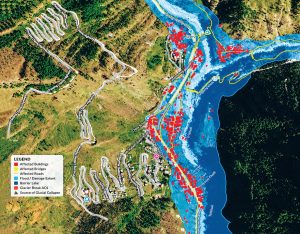
On August 26, India's northeastern neighbour Nepal was wracked by flash floods triggered by a glacier collapse and ice-rock avalanche in the ecologically fragile Himalayas near the Langtang range. The calamity claimed more than 1,450 lives, with 5,285 people, including foreign nationals, reported missing. Termed one of the worst disasters in landlocked Nepal's history, where 2026 GDP per capita is about $1,548, the event created a severe humanitarian crisis in the Betrawati and Trishuli regions along the Trishuli River. Within hours, Suhora Technologies, a Noida-headquartered Indian space-data analytics firm, began sharing satellite analysis to support relief and rescue efforts. Soon after, it launched a free, web-based disaster assessment platform. Suhora, an eight-year-old spacetech startup, analysed data on buildings, bridges, roads, flood damage, barrier lakes, and the source of the glacial collapse. The platform became a vital tool for affected communities, relief agencies, researchers, and media, supported by a feedback mechanism that allowed the company to continuously refine it. Remote sensing plays a critical predictive role in planning and protecting infrastructure in ecologically vulnerable regions such as the Himalayas, which, as the world's youngest mountain chain, remains geologically evolving and prone to seismic activity and landslides. Speaking to Infrastructure Today a few weeks after the calamity, Rupesh Kumar, Chief Technology Officer & Co-founder, Suhora Technologies, said, "Before construction, satellite-based Earth observation can support site suitability assessment by analysing terrain, hydrology, land use, accessibility and other environmental factors. It can also support applications such as cut-and-fill estimation and hydrological assessment, reducing the need for extensive ground surveys in difficult or inaccessible areas and saving time and resources." During the operational phase, technologies such as Interferometric Synthetic Aperture Radar (InSAR) can detect subtle ground deformation and monitor changes around critical infrastructure. "This enables early identification of potential risks, allowing authorities and infrastructure operators to undertake preventive measures before issues escalate." The Nepal floods illustrate the expanding role of technological interventions in infrastructure, reshaping how projects are planned and executed across India, one of the world's fastest-growing construction markets. In August, the National Highways Authority of India (NHAI) tightened its framework for Automated & Intelligent Machine-Aided Construction (AI-MC). The national highways developer introduced stringent provisions governing contractor payments, equipment deployment, and digital ownership of highway project data. Then, on October 6, India approved the creation of the Integrated Transport & Logistics Authority (ITLA) to strengthen research, planning, appraisal, monitoring and impact assessment in transport and logistics. Conceived as a special purpose vehicle, ITLA is intended to foster greater coordination among the Centre, states and transport modes to enhance efficiency and sustainability in infrastructure development. It will also establish a unified transport data repository, drawing on GSTN e-way bills, FASTag, Vahan, GPS-based systems and urban traffic management platforms. The authority will function under the Department for Promotion of Industry and Internal Trade (DPIIT) in the Ministry of Commerce & Industry.
PM GatiShakti's next phase India's infrastructure planning was historically fragmented, with ministries and departments operating in silos. The launch of PM GatiShakti, the national master plan for infrastructure development, in October 2021 marked a decisive shift toward integrated, data-driven planning. As of August 11, 2026, the Network Planning Group, the project evaluation mechanism under the framework, had evaluated 396 projects worth '18.66 trillion, of which 256 had been sanctioned, and 198 were under implementation. Karthikeyan Natarajan, CEO, Infinite Uptime, an industrial AI company, sees the infrastructure masterplan as a watershed moment. "PM GatiShakti is a good example of the shift from siloed planning to a more integrated, data-driven approach. The platform brings together geospatial data, infrastructure networks and project information to enable greater coordination across ministries and states." The next frontier, he argues, is to digitise the entire infrastructure lifecycle, from planning and design to construction, commissioning, operations, and maintenance (O&M), on a common technology backbone. This entails moving from static maps to a dynamic India Infrastructure Digital Twin, combining real-time data on asset health, traffic, weather, and energy consumption with planning datasets. CP Gurnani, Co-Founder & Vice Chairman, AIONOS, an AI technology company, echoes this view, noting that GatiShakti resolved one of India's toughest governance challenges: getting departments to align on a single map. "Today every major ministry and every state is on one platform. Anyone who has tried to align a highway, a rail line and a pipeline across three departments knows what that means. The results are showing; the latest NCAER (National Council of Applied Economic Research) study puts India's logistics cost at 7.97 per cent of GDP." However, stakeholders caution that the next leap must focus on O&M rather than planning alone. "An asset lives for decades, and most of its cost and risk come after the ribbon is cut. We should judge GatiShakti on outcomes-travel time saved, delays avoided-rather than projects approved," observes Gurnani. Policy must therefore evolve. Natarajan calls for robust data interoperability standards, common application programming interfaces (APIs), and frameworks for secure data exchange between public and private stakeholders. Gurnani adds that procurement reform is critical. "The day we consistently reward lifecycle value over the lowest bid, the industry will adopt technology on its own." Together, their insights point to a future where GatiShakti operates not merely as a government portal, but as an open technology platform where companies build services atop interoperable data layers, fostering a broader innovation ecosystem around national infrastructure.
From pilots to platforms India's infrastructure sector features numerous pilots, ranging from AI-enabled monitoring systems to IoT-based asset tracking, including smart sensor deployments in metro projects and predictive maintenance on highway corridors. The challenge remains scaling these initiatives into interoperable systems before pilot fatigue sets in. AIONOS' Gurnani puts it bluntly: "A pilot does well because one passionate officer or one committed project head is driving it. Then that person gets transferred, the budget for the next year isn't there, and the data is locked in a vendor's system nobody else can use. Within a few months, a good idea quietly disappears." The smart traffic management pilots in Delhi illustrate this hurdle; despite successful trials, citywide implementation remains elusive. Gurnani prescribes a clear path forward. First, build common digital rails, similar to the Unified Payments Interface (UPI) for digital payments, by mandating open, interoperable data standards for design, progress, and asset condition across all projects. Second, guarantee automatic scale-up so pilots meeting agreed benchmarks roll out to the next hundred sites without fresh approvals. Finally, orchestrate existing systems before replacing them, designing interoperability from the outset rather than retrofitting years later. In his view, harmonising data and orchestrating systems to function as one is essential to prevent promising initiatives from collapsing after personnel or budget changes. Infinite Uptime's Natarajan adds that policy should focus on API-first architectures, making infrastructure data accessible through secure, standardised interfaces. This allows private enterprises to build applications on top of government datasets rather than creating additional siloed portals. Argenio Antao, Chief Business Officer, Inkers Technology, a construction intelligence company, reinforces the importance of integration. "The real opportunity lies in moving beyond individual digital tools towards an integrated technology ecosystem where data, systems and stakeholders can work together seamlessly across the project lifecycle." Agendra Kumar, Managing Director, Esri India, a geospatial technology company, highlights geospatial intelligence in scaling. "Going forward, the opportunity is to make geospatial intelligence an integral part of the infrastructure lifecycle, from planning and land acquisition to design, construction, asset management and monitoring." Industry and academic estimates-combining research from the National Institute of Technology-Surat and the Indian Institute of Technology-Delhi with International Labour Organisation workplace safety metrics-suggest that between 11,000 and 22,000 fatal accidents occur annually in India's construction sector. AI and digital tools can significantly enhance site safety. "Predictive analytics can help accurately predict residual risk levels and the likelihood of different types of accidents, while AI-generated scheduling recommendations can enhance overall efficiency. VR (virtual reality) and AR (augmented reality) can reduce accidents and enhance worker competence, while AI-enabled technologies can detect, report and offer real-time responses to safety threats," notes Kamarajan M, Head of Education, British Safety Council, a not-for-profit organisation. The consensus is clear. India must transition from isolated pilots to interoperable platforms, embedding technology into infrastructure workflows from inception. Only then can digital twins, AI-led monitoring, and connected workflows deliver efficiency, transparency, and resilience at scale.
Overcoming barriers Even as India accelerates its digital transformation in infrastructure, significant obstacles persist. High upfront costs, fragmented data, interoperability gaps, cybersecurity risks, and a shortage of skilled personnel remain formidable challenges, particularly for smaller contractors. Natarajan stresses that technology adoption must be accessible, interoperable, and outcome-led rather than treated as a capital-heavy expenditure. "For smaller contractors, technology should increasingly be available through modular, cloud-based and subscription-led models that reduce the need for significant initial investment," he explains. Government incentives and industry-led programmes can further ease adoption without creating heavy financial burdens. Gurnani expands on this, highlighting the need for shared national platforms. "We should stop expecting every small contractor to become a technology company. Imagine a platform that carries the heavy load: geological surveys, climate data, PM GatiShakti layers already built in, common data standards embedded, and security managed centrally. Then the contractor needs only a smartphone and the right skills." This vision aligns with the drive for data standardisation and interoperability. Infrastructure assets are inherently interconnected, yet data often sits in incompatible formats across engineering, construction and O&M. Common standards and open APIs create a connected ecosystem rather than additional operational silos. Cybersecurity is another critical priority. As physical infrastructure becomes increasingly connected, the impact of a cyber incident extends beyond IT systems to operational continuity and public safety. Natarajan advocates for security-by-design, stringent access controls, regular audits, and clear accountability across the ecosystem. The skills gap is equally urgent. "The supervisor on a hill road in Uttarakhand needs simple tools in their own language. And on every site, the young engineer fluent with the tablet should work alongside the veteran who knows the soil," adds Gurnani, emphasising inclusive upskilling. Financing mechanisms also provide leverage. The proposed government-backed Infrastructure Risk Guarantee Fund will provide partial credit guarantees to lenders to strengthen confidence in private developers and address risks during the infrastructure development and construction phases.
Shifting to performance The newly released Deloitte Future of Infrastructure Survey 2026 reveals that Indian stakeholders view technology as the primary driver of efficiency. In India, 91 per cent of respondents expect technologies such as generative AI, digital twins, and predictive analytics to significantly impact infrastructure and transportation operations, compared to 57 per cent across Asia-Pacific. Half of Indian respondents believe AI will revolutionise planning and operations, while another half consider digital twins and real-time analytics essential to improving asset performance and enabling predictive maintenance. The India findings are based on 24 respondents. NSN Murty, Government & Public Services Consulting Leader, Deloitte South Asia, points to a broader trend. "Technology is becoming the connective tissue across infrastructure systems. Governments will need to combine AI, digital twins, cybersecurity and real-time analytics to improve project delivery, strengthen resilience and make more informed investment decisions. The next generation of infrastructure will be defined by physical assets and the intelligence embedded within them." If India embeds technology across its infrastructure ecosystem, the rewards could be transformative. The greatest opportunity lies not in technology for its own sake, but in rendering infrastructure more productive, resilient, predictable, and outcome-oriented. At the project level, integrated data, AI, digital twins, IoT, and geospatial tools enhance planning, eliminate coordination gaps, and identify risks early. Antao of Inkers Technology emphasises this integration. "Interoperable platforms, real-time data, AI-led monitoring, digital twins and connected workflows can significantly improve coordination between different teams, reduce information gaps and enable faster, more informed decision-making." At the asset level, connected infrastructure transitions operations from reactive maintenance to predictive and prescriptive interventions. Kumar of Esri India highlights GIS in enabling risk-informed planning and real-time monitoring. "Policy can play a catalytic role by promoting interoperable standards, greater sharing and reuse of public geospatial data, and wider adoption of location-based decision-making across government departments and at the state level. But true scalability can be achieved only through ecosystem alignment and bringing together public and private entities to co-develop solutions and drive innovation." At the national level, compounding benefits emerge. Synchronised coordination across roads, railways, ports, logistics networks, utilities, and industrial clusters reduces delays, boosts asset utilisation, and lowers logistics costs. "Capex [on infrastructure] has grown from '2 trillion in 2014-15 to '12.2 trillion in the current budget. At that scale, every one per cent of cost or time saved is worth more than '120 billion a year," notes Gurnani. The social dividends are equally substantial. Connected and transparent infrastructure grants small enterprises the predictability that large firms pay for, narrowing competitiveness gaps. Transparency fosters public trust. Citizens track progress, contractors receive faster payments, and disputes decrease when all parties reference verified data. This shift is reflected in how legacy industry leaders are repositioning themselves. As Jameson Mendonca, Power Generation Business Leader, Cummins India, explained on a humid September afternoon, the diesel-engine manufacturer is increasingly being perceived as a solutions provider. "Internally, we have invested in green technologies, including batteries, fuel cells and electrolysers. Battery and diesel are not opposites; both are needed. The key is managing the mix optimally as hydrogen and other technologies evolve." The transition is not about abandoning existing assets, but integrating new capabilities to build resilient, adaptive systems. Susanna Zammataro, CEO, International Federation of Consulting Engineers (FIDIC), a global body representing consulting engineering firms, placed this challenge in a broader context during a recent interaction with Infrastructure Today. "It's indeed a complex world out there, and the challenges are multiplying. Of course, this requires us to accept change, which is probably the most difficult part of the conversation. It also calls for greater attention to governance." Ultimately, effective technology adoption could redefine India's infrastructure trajectory. Efficiency becomes the highest return on investment, freeing capital for vital public infrastructure such as schools, hospitals, and rural roads. As India learns to plan, construct, and maintain projects across deserts, coastlines, and the Himalayas, it will create a playbook that few nations can match.
- Manish Pant
Published by HT Digital Content Services with permission from Infrastructure Today.