
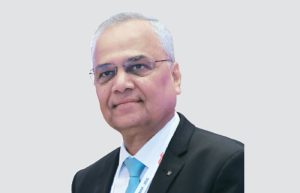
Mumbai, Oct. 27 -- How are the Dedicated Freight Corridors (DFCs)-among the most ambitious railway projects executed globally, with a combined investment of '1.24 trillion-transforming India's freight landscape? Few are better placed to answer than Praveen Kumar, Managing Director, Dedicated Freight Corridor Corp. of India Ltd (DFCCIL), who is often referred to as the 'Freight Man of India'. Taking charge in August 2024, he has overseen the completion of the final and most challenging stretch of the Western Corridor. Recently, Kumar spoke to Infrastructure Today's Manish Pant about the corridors' impact, new technologies, time-guaranteed freight services, private-sector participation, and the planned East-West Dedicated Freight Corridor. Edited excerpts.
How do you see the completion of the entire Western Dedicated Freight Corridor transforming freight movement and economic activity along the Dadri-JNPA route? It is indeed a significant development. The Western Dedicated Freight Corridor (WDFC) spans 1,504 route km as a double-line section. The last stretch, from Vaitarna to JNPT, covering 102 km, was the most challenging. Terrain difficulties, heavy encroachment, extended monsoon seasons, and limited working periods all delayed progress. Access was also problematic, with trucks carrying earth having to negotiate numerous villages. Despite these hurdles, our team at DFCCIL, along with contractors, project management consultants, and engineers, took it as a challenge. With sustained effort, we commissioned the final section in March 2026. I can now say with satisfaction that the entire WDFC is fully operational. This commissioning directly connects the corridor to JNPA, India's largest container port. Earlier, traffic from JNPA had to detour via Central Railway before joining the WDFC network. Now, exports and imports handled at JNPA can move seamlessly on the corridor. Terminals such as Afas siding and others along the western route will benefit. The ability to run double-stack container trains directly to JNPA is a major advantage, making the corridor a strong and economically vital zone.
While the Eastern Dedicated Freight Corridor's core route from Ludhiana to Sonnagar has been operational since early 2024, the final extension to Dankuni has been delayed due to land acquisition hurdles. Have you seen meaningful progress on that front in recent months? The Ludhiana-Sonnagar section is already commissioned. To clarify, some parts between Ludhiana and Khurja are single-line stretches of about 30-37 route km, while the rest are double-line. For Sonnagar-Dankuni, the Government of India initially attempted a PPP model. However, due to the complexity and cost intensity, no private contractor came forward. The project has now been sanctioned under the EPC model, funded by the Government of India through Gross Budgetary Support (GBS). Work is being executed by Eastern Railway and East Central Railway. The Sonnagar-Andal stretch is about 375 km, with 300 km under ECR and 75 km under ER. Progress is underway, though land acquisition remains a challenge.
During our conversation a couple of years earlier, you compared the Dedicated Freight Corridors to trans-oceanic cables that have helped build a highly networked world. In that context, what role are the first two corridors playing in improving India's logistics competitiveness and supporting industrial growth? I compared the corridors to trans-oceanic cables because both represent connectivity. Just as fibre-optic cables transformed communication by linking countries seamlessly, the freight corridors are transforming logistics by segregating passenger and freight traffic. Before DFCs, freight and passenger trains shared the same tracks. Passenger services naturally took priority, leaving freight trains delayed and unreliable. The Government of India rightly decided to segregate them. This has proved a win-win: freight now moves seamlessly, while passenger punctuality has improved. For example, in the NCR and Allahabad areas, punctuality used to be 50-60 per cent. With freight shifted to DFCs, punctuality has risen to about 95 per cent. The Kumbh Mela last year was a success because passenger trains could run in greater numbers, thanks to freight being diverted to DFCs. I often say the freight corridors are the 'spinal cord of India's logistics'. They reduce costs, improve reliability, and attract vendors who value assured, on-time services. We are even deliberating timetable-based freight trains, offering guaranteed transit times from JNPA to Dadri.
Talking about the timetable and time-guaranteed services on WDFC, when is the rollout expected? Studies are underway. We must assess both technical feasibility and financial implications before committing. Timetable and time-guaranteed services are possible, but require coordination with the Ministry of Railways. They will be introduced at an opportune time once the financial aspect is resolved.
How is your strategy to connect multimodal logistics parks and private freight terminals to the Dedicated Freight Corridors progressing? Private players are increasingly attracted to the WDFC network, confident of timely and safe delivery. For instance, at Sanjali near Ankleshwar, a new multimodal logistics park under the Samaria Gati Shakti initiative has been connected to Sanjali station. Traffic such as solar panels will now move by rail instead of road, reaching JNPA and other destinations efficiently. We have identified 36 locations along the corridors for terminals of varying sizes: private freight terminals, Gati Shakti terminals, and multimodal parks. Five to six have already been commissioned, including the Sanjali park. More vendors are expected, and surveys will identify additional opportunities under GatiShakti Cargo Terminals 1 or 2.
Are you seeing greater participation from private freight operators and logistics companies in utilising the Dedicated Freight Corridors year-on-year? Yes. Seven terminals are already operational, and vendors are satisfied with the reliability of the network. It is a win-win situation: DFCCIL and Indian Railways benefit from increased traffic, while private operators gain assured delivery times. The ability to turn around more freight trains within the same timeframe is a major advantage, and participation continues to grow.
What is the current capacity utilisation on the WDFC and EDFC, and how much headroom remains before capacity augmentation becomes necessary? The DFCs are designed with a ten-minute headway, allowing a train every ten minutes. With a daily four-hour maintenance block, each corridor can run 120 trains per direction, or 240 trains in total. Combined, WDFC and EDFC can handle 480 trains per day. Before commissioning the final JNPA section, WDFC carried about 390-400 trains daily. With the new section, this is expected to rise to 420, leaving capacity for another 60 trains. This headroom should suffice for a few years. Beyond that, instead of building entirely new corridors, we may augment capacity by adding lines at stations or improving train paths.
Efficiency is intrinsic to logistics. What new technologies are being deployed on the existing freight corridors to improve operational efficiency, train throughput, and transit times? We are deploying several technologies. One is the Machine Design Inspection System (MDIS), installed at two locations. As trains pass at 100 km/h, MDIS identifies defects in wagons. Critical defects are flagged via Automatic System Monitoring and Logging (ASML), allowing trains to be diverted to loop lines for inspection while mainline traffic continues. Our Dedicated Freight Information System (DFIS), controlled through the Train Management System (TMS), operates from high-tech centres in Prayagraj (EDFC) and Ahmedabad (WDFC). These centres monitor all train movements, ensuring reliability and minimising failures. We have also developed Intelligent Remote Monitoring Systems for signalling and telecom assets, installed on both corridors. For safety, we are rolling out Kavach, Indian Railways' indigenous train collision avoidance system. On EDFC, Kavach is targeted for commissioning on the Sonnagar-Khurja stretch by December 2027.
DFCCIL has also started work on the East-West Dedicated Freight Corridor. Yes. In the last Union Budget, the East-West DFC was announced, running from Dankuni to Surat over 2,300 route kilometres. A gazette notification has been issued, enabling land acquisition under the Railways Act. Given that 67 per cent of Indian Railways' earnings come from freight, the government has rightly prioritised strengthening the supply chain. We have targeted 1.5 years for land acquisition and 4.5 years for execution. Having completed WDFC and EDFC, our team is now highly competent, with lessons learned ready to be applied.
You have already held one stakeholder consultation in this regard. What are some of its outcomes? The consultation gauged vendor and contractor appetite for participation, including through PPP models such as the hybrid annuity model (HAM). The response was positive, though further engagement is planned to identify actual players. Financing will be arranged in conjunction with land acquisition, which is being funded through equity from the Ministry of Railways.
Once the approval is received, how will the learnings from the WDFC and EDFC be incorporated into the planning and execution phases of this project? We have identified the critical factors that caused delays earlier: land acquisition, environmental clearances, and utility shifting. For the East-West corridor, these will be addressed upfront. Forest areas, elephant corridors, and eco-sensitive zones are already being mapped in consultation with state forest officials. Utilities are being identified for pre-emptive shifting before contracts are awarded, so that construction can proceed without interruption. We will also adopt modular construction strategies. Standardised designs and drawings from WDFC and EDFC projects will be reused, saving time and avoiding duplication. Long-lead items, such as tunnels, will be tendered separately, ensuring contractors can plan their resources more effectively. Another key learning is the importance of a contracting strategy. By packaging works intelligently-separating tunnels, bridges, and major structures-we can reduce delays and attract specialised contractors. Our experience has given us a large repository of tested designs and data, which will now form part of the tender documentation. This means contractors will not waste time on basic design approvals, allowing execution to move faster. The East-West corridor will benefit directly from the lessons of WDFC and EDFC. With better planning, early clearances, modular construction, and smarter contracting, we expect execution timelines to be significantly shorter and more predictable than in the past.
- Manish Pant
Published by HT Digital Content Services with permission from Infrastructure Today.