
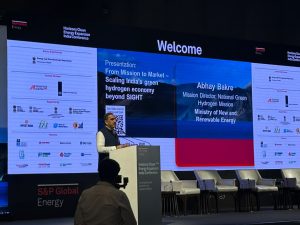
Mumbai, Sept. 24 -- The hydrogen economy is estimated to attract more than Rs.10 trillion in investment by 2030, with this potentially expanding five- to sixfold in the following decade.
Industry must invest in, as well as build ancillary infrastructure for, the vast opportunity emerging around India's green hydrogen ecosystem, the Mission Director of the National Green Hydrogen Mission (NGHM) has said.
Abhay Bakre, Mission Director, NGHM, told the audience at the Horizons Clean Energy Expansion India 2026 conclave organised by S&P Global Energy in New Delhi that the hydrogen ecosystem, spanning both production and consumption, would require substantial investment. "To give a sense, hydrogen production alone-just 1 million tonnes-demands around Rs.1.5 trillion (about $18 billion) of investment," he said.
Bakre added that producing 5 million tonnes of green hydrogen could generate economic value in the region of Rs.8-10 trillion (about $96-120 billion). "But that only covers the production part. There will be huge additional investment required in logistics. The kind of infrastructure we envisage will see different ports supplying hydrogen derivatives to other parts of the world. That is where the contracts are coming from, but we need to invest in it."
Drawing a parallel with the natural gas-based economy, he said investments would also be required in pipelines, storage facilities and other logistics to transport hydrogen and its derivatives from production to consumption centres within the country and for export. The industry has a huge opportunity, he said, not only in investing in hydrogen derivative production but also in other parts of the ecosystem, including logistics, infrastructure, storage and consumption.
Sounding bullish on the opportunity, he said, "The hydrogen economy, even by 2030, will fetch more than Rs.10 trillion (about $120 billion) of investment. But as we move into the next decade, this investment will be at least five to six times more than what we expect by 2030."
He emphasised that, backed by positive policies, supportive investments and favourable frameworks, the industry was eager to invest in the hydrogen ecosystem and help make India a leader in the global hydrogen economy by 2030.
- Manish Pant
Published by HT Digital Content Services with permission from Infrastructure Today.